
In the rush to adopt global reporting frameworks, many companies make a critical mistake: they attempt to run before they can walk. We see seed-stage startups trying to track 50 different KPIs and multi-national corporations still treating ESG like a philanthropic side-project.
Both are failing.
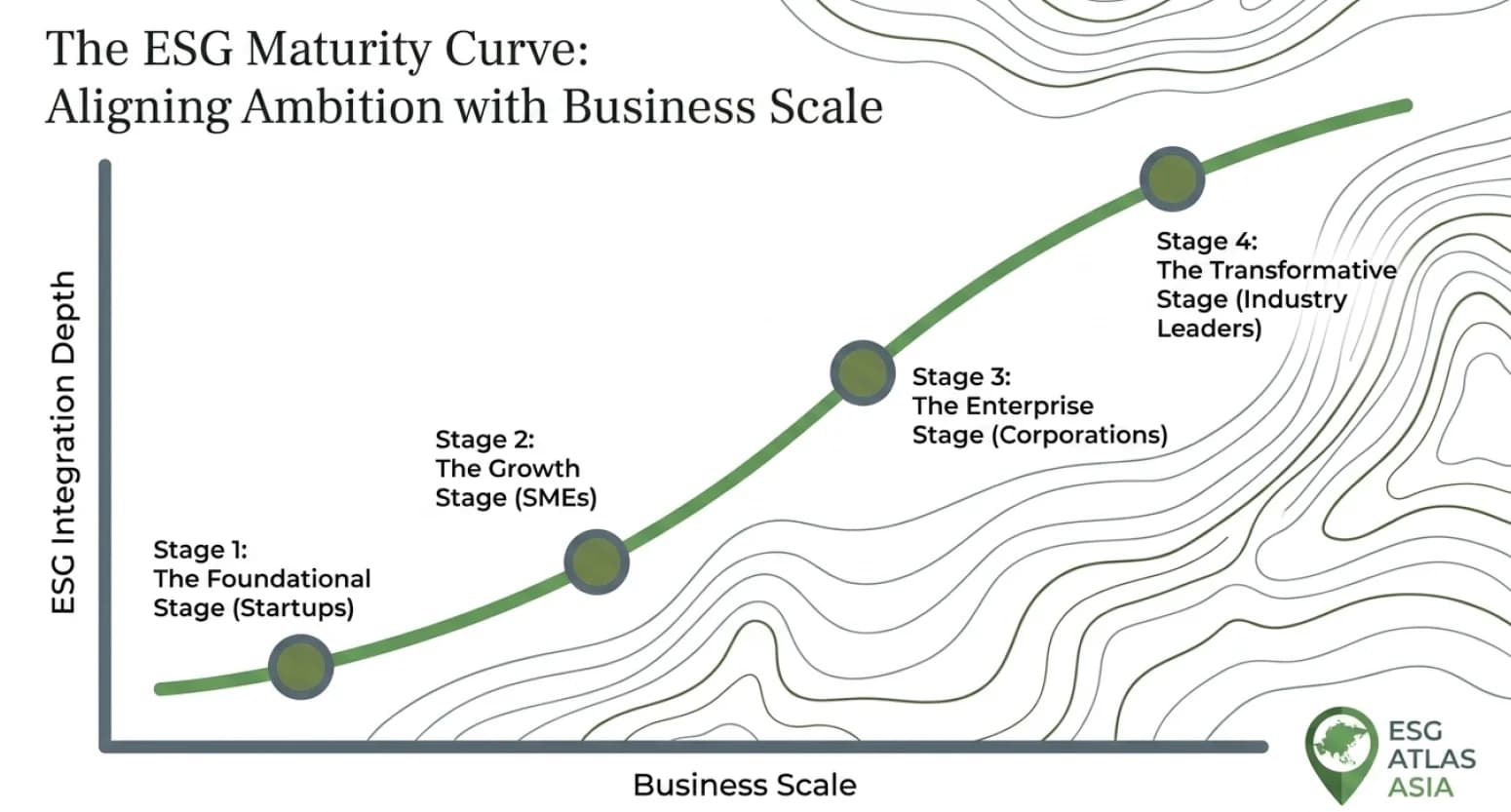
Real ESG maturity isn’t about how long your report is; it’s about how deeply sustainability is integrated into your decision-making. To help leaders navigate this, we’ve broken down the four stages of ESG maturity through a pragmatic, business-first lens.
Stage 1: The Foundational Stage (Startups & Early Ventures)
The Philosophy: “Compliance as a Competitive Edge”
At this stage, ESG is often driven by the founders' values or the immediate requirements of Venture Capital (VC) investors. You don’t need a 100-page report, but you do need a "License to Operate."
- The Focus: Establishing a code of conduct, basic DEI (Diversity, Equity, and Inclusion) in hiring, and resource efficiency to keep overhead low.
- The Trap: Over-complicating data collection. A startup’s biggest risk isn't its carbon footprint—it’s its governance. Focus on building a clean, transparent board structure first.
Stage 2: The Growth Stage (SMEs & Scaling Businesses)
The Philosophy: “Risk Management & Operational Efficiency”
As a company scales—especially in the Asian manufacturing and supply chain sectors—ESG moves from "values" to "validity." You are likely now a supplier to a larger firm that requires you to disclose your data.
- The Focus: Performing your first Materiality Assessment. This is the moment you stop trying to save the world and start identifying which specific environmental and social issues actually impact your bottom line.
- The Pivot: This is where you conduct your first Greenhouse Gas (GHG) inventory (Scope 1 and 2) and begin formalizing labor policies to prevent supply chain disruptions.
Stage 3: The Enterprise Stage (Large & Public Corporations)
The Philosophy: “ESG as a Financial Control System”
At this level, ESG is no longer an "extra" task for the HR or Marketing department. It belongs in the CFO’s office. With the arrival of standards like IFRS S1&S2, sustainability data must be as accurate as your cash flow statements.
- The Focus: Audit-ready disclosures and Scope 3 (Value Chain) management. You aren't just responsible for your own chimney; you are responsible for the emissions of your smallest suppliers.
- The Pivot: Linking executive compensation to sustainability targets. If your leadership isn't financially incentivized to meet ESG goals, the strategy will remain a "glossy report" exercise.
Stage 4: The Transformative Stage (Industry Leaders)
The Philosophy: “Resilience & Market Shaping”
This is the peak of maturity. These companies don’t just follow regulations; they help write them. They recognize that their long-term survival depends on the health of the entire ecosystem.
- The Focus: Quantitative scenario analysis (predicting how the business survives a 2∘C world) and radical innovation. They invest in circular economy R&D not just for PR, but because raw material scarcity is a legitimate threat to their 2050 business model.
- The Outcome: ESG is no longer a department. It is the invisible thread that runs through every investment, acquisition, and product launch.

The Reality Check: Where Do You Sit?
Maturity isn't a race to Stage 4. In fact, a Stage 2 company trying to act like a Stage 4 company often results in "Green-stretching"—committing to complex targets they have no internal governance to actually achieve. This is the fastest route to accusations of greenwashing.
Insights: Match your ESG efforts to your risk profile. If you are a mid-sized exporter in Asia, focus on Stage 2 excellence: master your data, secure your supply chain, and build a governance system that can survive an audit.
Efficiency first. Reporting second.
- IFRS S1 & S2 General Requirements
- GRI: Starting your ESG Journey
- ESG Atlas Asia: Materiality Assessment
- ESG Atlas Asia: Why governance is the real core of ISSB reporting
- ESG Atlas Asia: ISSB