
Unlike the usual opening, today, this article will be started by a thesis statement.
Our current way of operating the economy, which is called the material economy, threatens our environment and humanity's survival because of its linear "take – make – dispose" model, but we can fix it by moving forward to a circular economy.
So one might wonder: What is the material economy?
The Materials Economy is a production system that dominates our manufacturing world nowadays. It is a system that starts with the extraction of raw materials by digging into the ground and their processing into usable materials. This is followed by the refined materials being used to manufacture products in factories. The next two stages are the distribution of products to retail outlets or directly to consumers for consumption. The last stage, at the end of the product's useful life, is its disposal.

The material economy has been around for over a century, started it journey in the early 20th century in some industrialized countries like the United Kingdom or the United States, before a short end of the 1st wave due to the Great Depression in 1929. However, the strong ritual of material economy and consumerism has never disappeared; it came back and rose stronger right after World War II and continues to this day.
As the famous American economist Victor Lebow (1902-1980) stated, "Our enormously productive economy demands that we make consumption our way of life, that we convert the buying and use of goods into rituals, that we seek our spiritual satisfaction, our ego satisfaction, in consumption.… We need things consumed, burned up, replaced, and discarded at an ever-accelerating rate". This is how we, human beings, build our consumerism society.

As mentioned above, the driving force of the material economy is corporations trying to maximize profit, accelerated by planned obsolescence, under no (or minimal) legal constraints and fueled in a consumerist society. The material economy heightens the scarcity crisis and the environmental problems, which in the end threaten humanity's survival. According to the Stockholm Resilience Centre, by 2026, seven out of nine planetary boundaries have been crossed.

"Anyone who thinks you can have infinite growth on a finite planet is either a madman or an economist" - Kenneth Boulding.
Is the recycling economy a solution?
Simple answer. No. Recycling is not the solution!
Recycling only validates waste. Recycling makes waste become socially normalized, becoming the trend of disposable production and consumption since we believe that recycling will save us in the end. But the truth is most of the disposable waste is not captured or recycled but rather end of on the wild. Even the ones that are lucky enough to be recycled it means more energy and more greenhouse gas emissions.
Remember
- The more we use
- The more we produce
- The more we extract
- The more we waste

We should move toward a circular economy
"The circular economy is a model of production and consumption, which involves sharing, leasing, reusing, repairing, refurbishing, and recycling existing materials and products as long as possible".
(European Parliament, 2009)
The basic idea of the circular economy lies in the aim of achieving more by using less, which refers to the way of keeping resources and products at high value and for as long as possible by extending their lifetime to function longer. Instead of troubling at the last stage - disposal- Circular economy emphasizes the Design phase - the very first stage of products.
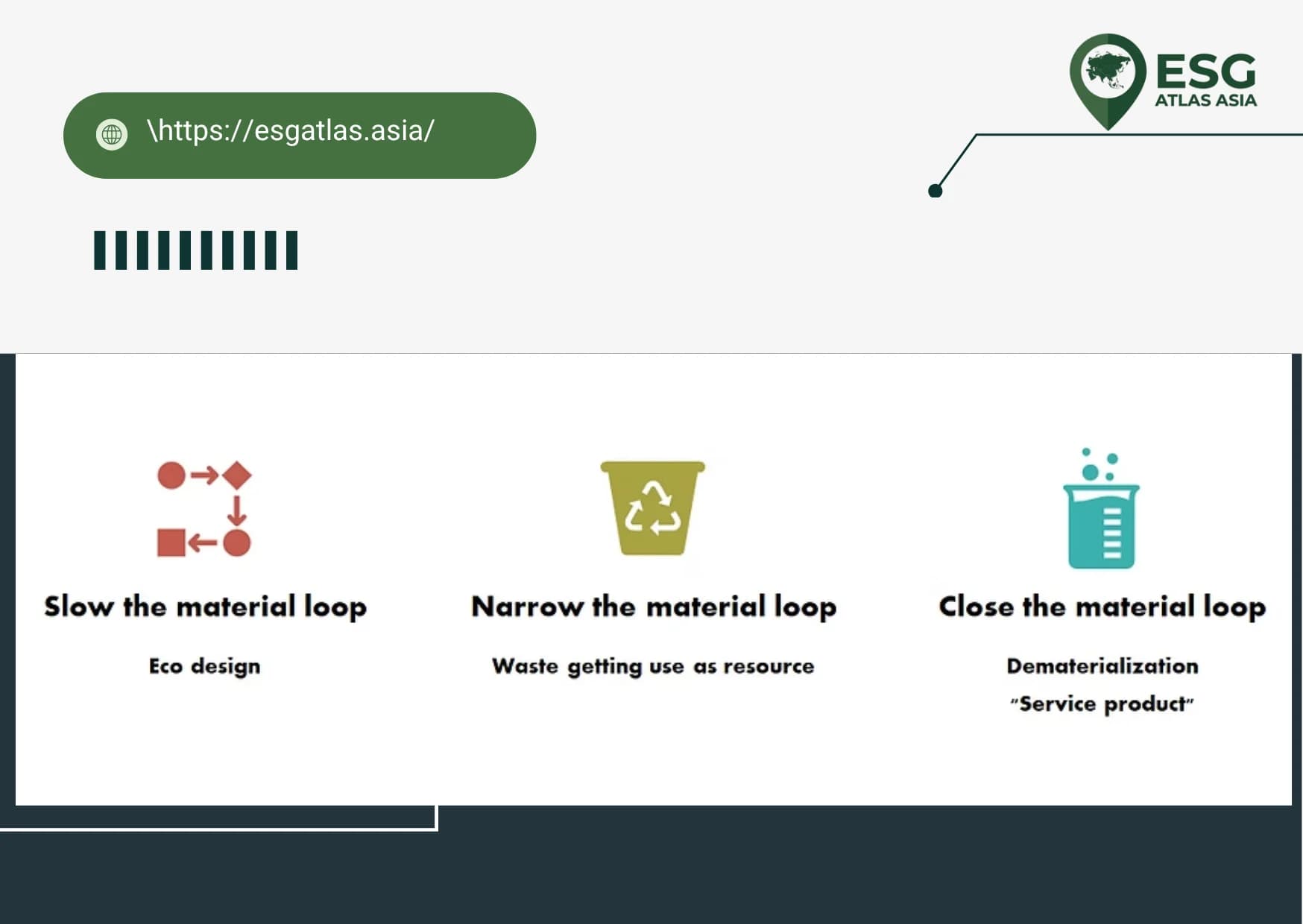
The principles of circular economy are (1) Slow the material loop; (2) Narrow the material loop; (3) Close the material loop.

Now, Let's take a look at our current practice and the one that we must aim to!

Reference:
- The story of stuff,
- Stockholm resilience center
- Disrupt design - Dr. Leyla Acaroglu
- Twist & Turn: Why your circular business model needs more than just a push
- How to promote Circular Economy in your organization?
- Circular Economy - Sustainable material management, Coursera.