
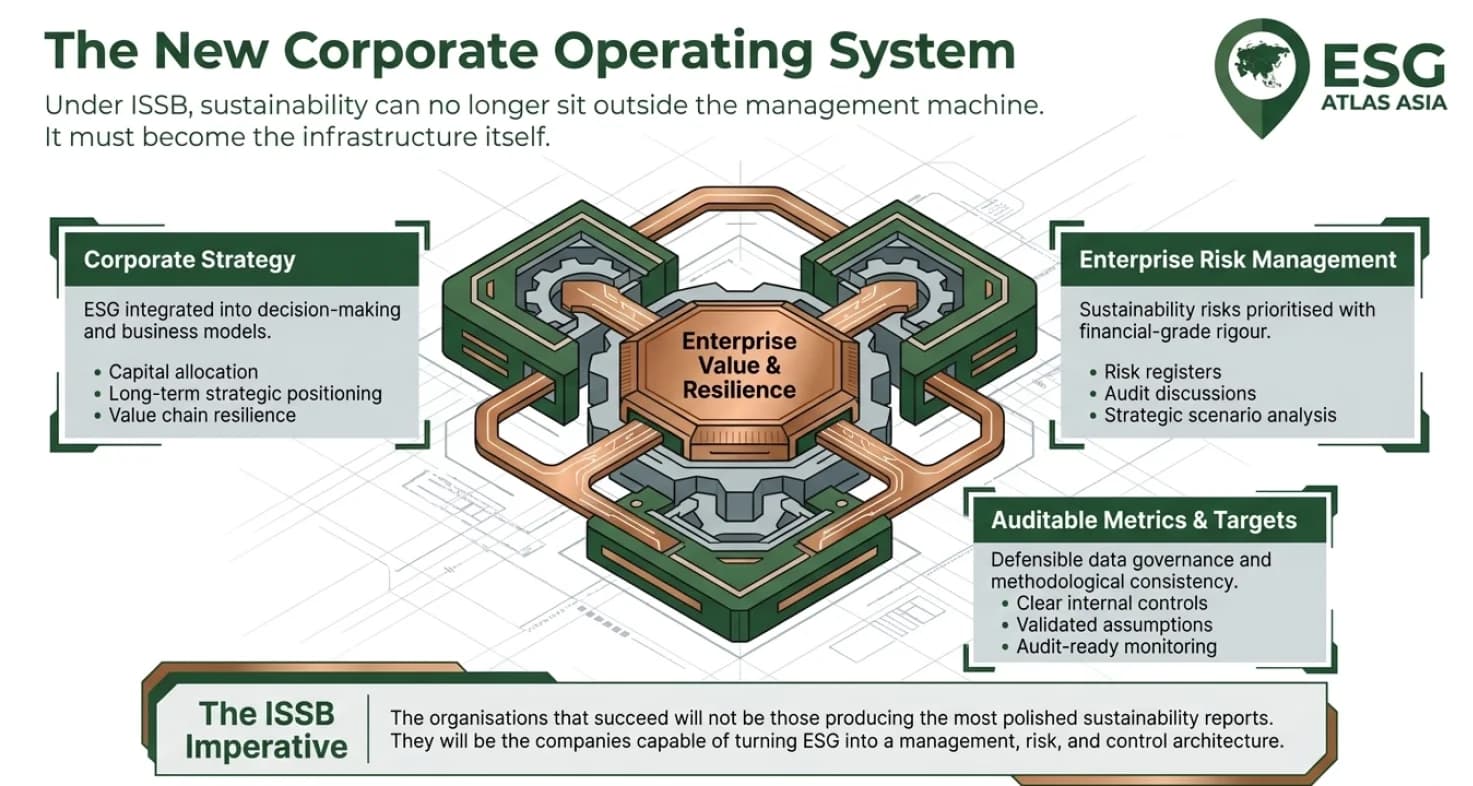
Many companies still believe ISSB implementation is mainly about producing sustainability disclosures.
But the real challenge is far deeper.
The International Sustainability Standards Board (ISSB) is not simply asking companies to report ESG information. It is forcing companies to operationalize ESG inside management systems, risk frameworks, strategic planning, and internal controls.
Under ISSB, sustainability can no longer sit outside the management machine. It must become part of how the company:
- makes decisions
- allocates capital
- manages risk
- measures performance
- sets targets
- monitors execution
This is one of the biggest organizational shifts happening inside ESG today.
Strategy: ESG Must Be Connected to Enterprise Value
Under the ISSB framework, companies are expected to explain how sustainability-related risks and opportunities affect:
- business models
- value chains
- financial performance
- resilience
- long-term strategic positioning
This is a major shift from traditional ESG reporting. Historically, sustainability initiatives often existed separately from:
- strategic planning
- financial forecasting
- investment decisions
- enterprise risk discussions
ISSB changes that entirely. The framework effectively forces companies to integrate sustainability into:
- corporate strategy
- capital allocation
- operational planning
- long-term resilience analysis
This means ESG can no longer operate as:
- a branding initiative
- a silo department
- a standalone reporting exercise
Under ISSB, sustainability risks must be treated as strategic business risks.

Risk Management: ESG Must Enter the Enterprise Risk System
One of the most underestimated parts of ISSB is its risk management requirement. Companies must explain:
- how sustainability risks are identified
- how they are assessed
- how they are prioritized
- how they are monitored
- how they integrate into enterprise risk management (ERM)
This is critical. ISSB is not asking companies whether they “care” about sustainability. It is asking whether sustainability risks are managed with the same rigor as:
- financial risks
- operational risks
- legal risks
- market risks
This creates significant organizational pressure. In many companies today:
- ESG data sits in sustainability teams
- financial data sits in finance
- risk sits in enterprise risk management
- procurement manages suppliers
- operations manage emissions
But these systems often do not communicate effectively. ISSB forces integration across functions. Over time, ESG risks will increasingly need to appear inside:
- risk registers
- audit discussions
- investment approvals
- scenario analysis
- procurement decisions
- strategic planning cycles
This is where ESG stops being a side initiative and becomes part of the management infrastructure itself.
Metrics and Targets: ESG Must Become Measurable and Defensible
Perhaps the biggest long-term implication of ISSB is the transformation of ESG information into something increasingly auditable. Historically, sustainability reporting often operated with:
- inconsistent methodologies
- fragmented ownership
- limited assurance
- weak documentation
- low internal control maturity
ISSB changes market expectations significantly. Because sustainability disclosures increasingly sit alongside financial disclosures, companies are expected to establish:
- clearer internal controls
- stronger documentation processes
- data governance systems
- methodological consistency
- management review procedures
- audit readiness
This creates pressure for “financial-grade ESG data.” Under ISSB, companies cannot simply publish sustainability initiatives or ambitious targets. They must demonstrate:
- how metrics are calculated
- who owns the data
- how assumptions are validated
- how targets link to strategy
- how performance is monitored
- how issues are escalated internally
This is where governance becomes inseparable from disclosure quality.
The challenge is no longer only:
“Can we report ESG data?”
The challenge becomes:
“Can we govern ESG information with the same rigor as financial information?”

Final thoughts
Many companies still see ISSB as a sustainability disclosure framework. But its deeper purpose is much larger. ISSB is transforming ESG into a management, risk, and control architecture integrated directly into the corporate operating system.
The organizations that succeed under ISSB will not necessarily be those producing the most polished sustainability reports. They will be the companies capable of:
- integrating ESG into strategy
- governing sustainability risk effectively
- establishing credible controls
- producing auditable sustainability information
- connecting ESG performance to enterprise value
That is the real transformation ISSB is driving.
Reference: