
Most companies still misunderstand what the ISSB is.
Many executives, sustainability teams, and even consultants continue to frame the International Sustainability Standards Board (ISSB) as “another climate/sustainability reporting framework” focused mainly on emissions data, sustainability metrics, or ESG disclosure requirements.
But that interpretation misses the real significance of the ISSB entirely.
The ISSB is not primarily a climate framework. It is a governance and financial-risk framework.
Its most transformative impact is unlikely to be the production of longer sustainability reports or more climate charts. Instead, the real impact lies in how boards, executives, CFOs, risk teams, and investors govern sustainability-related risks and opportunities inside the company itself.
Under ISSB, sustainability must become part of the corporate management system. That is the hidden governance revolution inside ISSB.
The DNA of ISSB: Financial Risk Before Sustainability
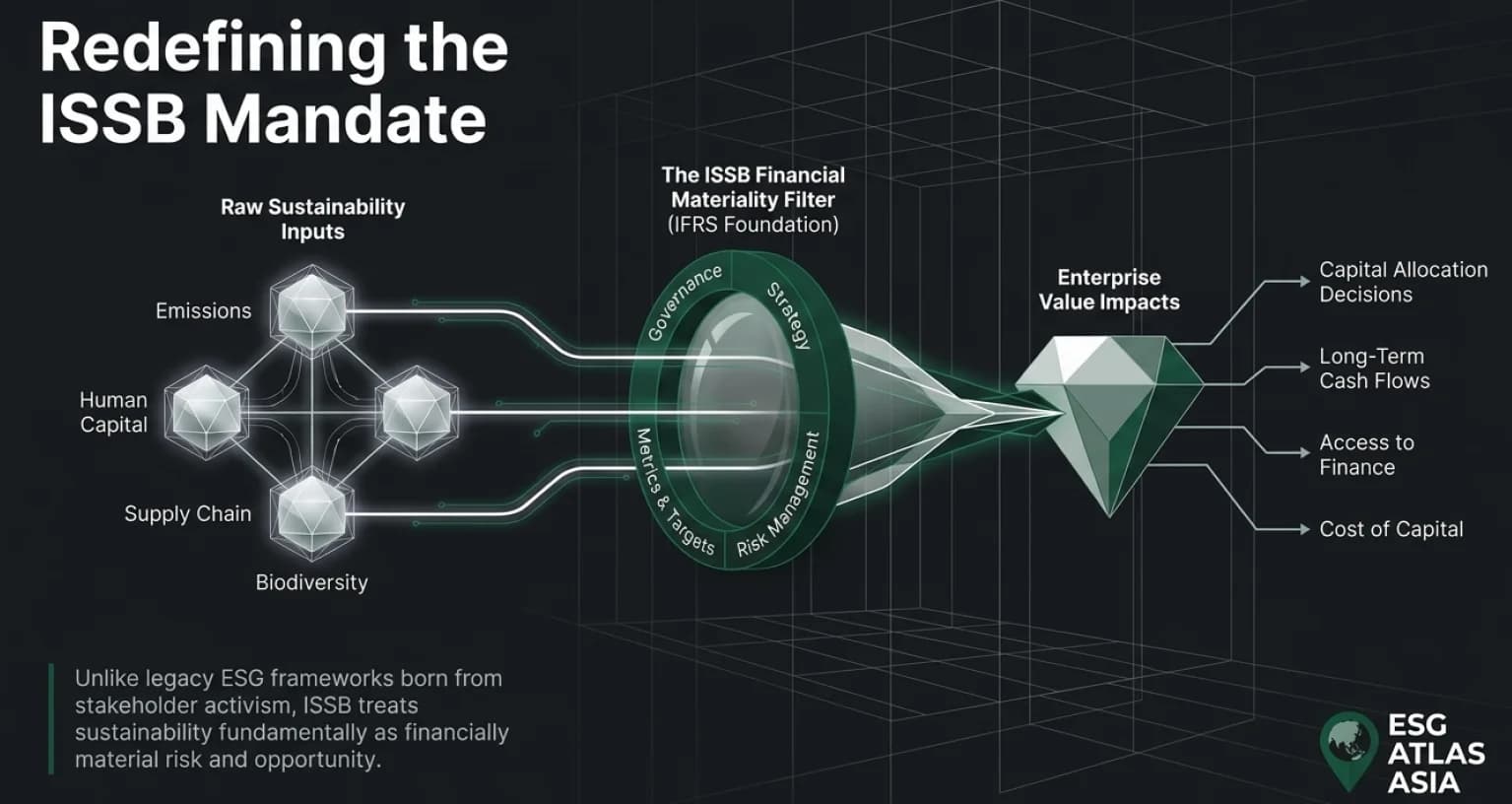
The ISSB was established under the IFRS Foundation — the same institutional ecosystem responsible for global financial reporting standards. Unlike many earlier sustainability frameworks that emerged from corporate responsibility or stakeholder engagement movements, the ISSB was designed from the outset as an investor-focused disclosure system. Its core standards — IFRS S1 and IFRS S2 — focus specifically on sustainability-related information that could reasonably affect:
- enterprise value
- capital allocation decisions
- access to finance
- long-term cash flows
- cost of capital
In other words, ISSB treats sustainability as financially material risk and opportunity.
Under traditional ESG approaches, sustainability often existed separately from finance, governance, and enterprise risk management. Under ISSB, sustainability becomes integrated into the financial architecture of the company itself. The framework adopts the structure of the Task Force on Climate-related Financial Disclosures (TCFD):
- Governance
- Strategy
- Risk Management
- Metrics & Targets
But importantly, ISSB applies this architecture beyond climate alone and embeds it within a financial-materiality lens.
Sustainability may be the content being discussed. But governance and financial risk are the real design logic underneath the framework.
Governance First: From “We Care” to “Who Is Accountable?”
One of the clearest signals of ISSB’s priorities is its structure itself. Governance is not an afterthought. It is the first pillar. And ISSB governance disclosures are not abstract statements about ethics, responsibility, or sustainability commitments. They are operational governance disclosures.
Companies are expected to explain:
- who oversees sustainability-related risks and opportunities
- which board committees are involved
- how often discussions occur
- how information flows to decision-makers
- whether leadership possesses relevant expertise
- how responsibilities are assigned
- how management performance is monitored
This is a fundamentally different level of scrutiny from traditional ESG reporting. Under older ESG models, companies could often publish aspirational sustainability statements without demonstrating how decisions were actually made internally.
ISSB changes that. The framework pushes organizations away from:
“We care about sustainability.”
toward:
“Show us the governance architecture behind sustainability decision-making.”
This creates several immediate implications for companies.

1. ESG Accountability Must Become Explicit
Many companies still operate with fragmented ESG ownership:
- sustainability teams produce reports
- finance owns financial disclosures
- risk teams manage enterprise risk
- procurement handles suppliers
- operations manage emissions
But no single governance structure truly integrates these functions. ISSB makes this increasingly difficult to sustain. Organizations now need:
- named accountability
- formal reporting lines
- defined escalation processes
- board oversight mechanisms
- governance mandates embedded into committees and charters
The question is no longer whether sustainability exists inside the company. The question is: Who is accountable when sustainability risks materially affect enterprise value?
2. Boards Must Become ESG Risk Governors
ISSB significantly expands the role of corporate boards. Boards are no longer expected to oversee only:
- financial reporting
- audit
- compliance
- executive compensation
Increasingly, they are expected to govern:
- climate transition risk
- physical climate exposure
- supply chain resilience
- biodiversity dependencies
- human capital risks
- cybersecurity
- AI governance
- regulatory transition risk
This requires new governance capabilities: sustainability expertise, climate literacy, scenario analysis capability, understanding of ESG-financial linkages
Over time, ISSB may reshape expectations around: board composition, director competencies, governance training, committee structures, time allocation within board agendas
In practice, governance maturity may become one of the most important indicators of ESG credibility.
The Hidden Governance Revolution Inside ISSB
The most important impact of ISSB may not be more sustainability disclosures. It may be the redesign of corporate governance itself. ISSB is quietly driving several major organizational shifts:
ESG can no longer remain isolated within sustainability or communications teams. ISSB requires collaboration across: finance, risk, legal, procurement, operations, strategy, investor relations, internal audit.
From CSR Narrative to Financial-Risk Narrative
Traditional ESG reporting often emphasized storytelling on commitments, initiatives, campaigns, stakeholder engagement
ISSB shifts the focus toward:
- financial materiality
- governance structures
- risk exposure
- resilience
- enterprise value implications

Final Thoughts
The ISSB is often presented as a sustainability reporting framework. But its deeper significance lies elsewhere. It is transforming sustainability from a disclosure exercise into a governance discipline. Under ISSB, companies are no longer judged only by whether they publish ESG reports. They are increasingly judged by whether sustainability risks are:
- governed
- controlled
- integrated
- monitored
- financially understood
- embedded into decision-making systems
In the coming years, “good ISSB reporting” may become shorthand for something much bigger: Mature ESG governance.
And the companies that treat ISSB as a governance upgrade — rather than simply another compliance burden — will likely be far better positioned for both capital market expectations and the realities of long-term economic transition.
Reference: