
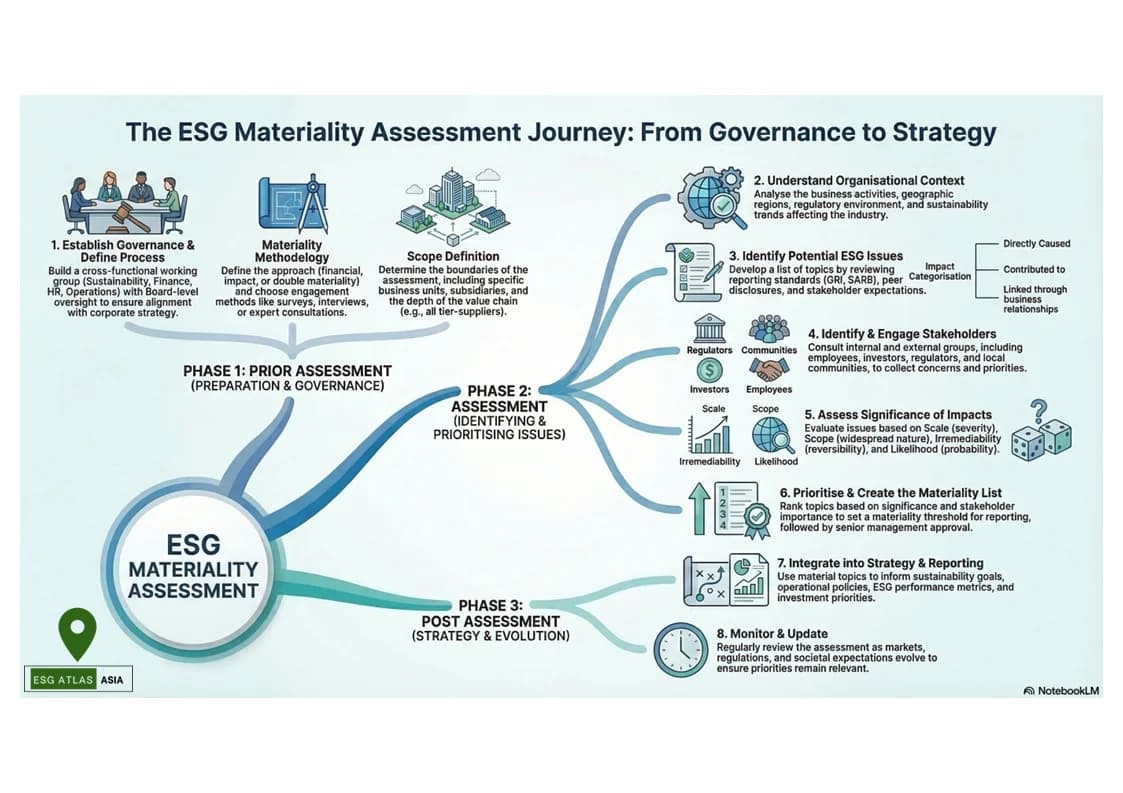
This guide provides a practical example of ESG materiality assessment. It helps organizations understand how to evaluate, prioritize, and quantify ESG risks and impacts using a structured, data-driven approach aligned with global sustainability frameworks.
Key takeaway
- An ESG materiality assessment follows a structured process to identify and prioritize the most significant environmental, social, and governance issues affecting a company and its stakeholders.
- A credible materiality assessment requires clear methodology, data-supported analysis, leadership involvement, and regular updates as ESG risks and stakeholder expectations evolve.
- The key steps typically include: establishing governance and scope, understanding the organization’s context, identifying potential ESG topics, engaging stakeholders, assessing the significance of impacts, prioritizing material issues, and integrating results into strategy and reporting.
- Stakeholder engagement and impact analysis are critical to ensure the assessment reflects both business priorities and stakeholder concerns.
- Companies should avoid common mistakes, such as treating the assessment as a reporting exercise only, relying on generic ESG topic lists, limiting stakeholder participation, or ignoring impacts in the value chain.
Start your ESG journey with a practical checklist (built for Asia) No theory. No frameworks overload. Just what you can apply. 👉 Download Free
As sustainability becomes a central part of business strategy, companies are under increasing pressure from investors, regulators, and stakeholders to clearly identify and manage their most significant environmental, social, and governance (ESG) issues.
An ESG materiality assessment helps organizations determine which sustainability topics matter most to their business and stakeholders. By identifying and prioritizing these issues, companies can focus their resources on the areas with the greatest impact on both business performance and society.
This guide explains what ESG materiality means, why it matters, and how companies conduct a materiality assessment step by step. It also highlights common mistakes organizations should avoid when performing the process.
What is materiality?
In general terms, material means something that is important or significant.
In the context of ESG, materiality refers to the environmental, social, and governance issues that are most important to an organization and its stakeholders.
However, materiality is not based on a universal list of issues. What is considered material depends on whom it affects, such as investors, communities, or regulators. That's why definitions vary: organizations apply different lenses, like impact materiality (company effects on society/environment), financial materiality (ESG risks to business performance), double materiality (both perspectives), dynamic materiality (evolving over time), or triple materiality.
Approach | Focus | Key Standards/Examples |
Financial Materiality | Focuses on ESG issues that affect a company’s financial performance, risks, or opportunities. (e.g., regulatory costs). | ISSB/IFRS, investor-driven. |
Impact Materiality | Focuses on how a company’s activities impact the environment and society, regardless of financial implications. (e.g., emissions, labor rights). | |
Double Materiality | Combines both financial and impact perspectives, assessing how sustainability issues affect the company and how the company affects society and the environment. | |
Dynamic Materiality | Recognizes that material issues can evolve over time due to technological change, regulation, or societal expectations. | Future-proofing assessments. |
Triple Materiality | An emerging concept that seeks to balance financial, environmental, and social impacts equally with emphasis on local context. | Emerging holistic strategies. |
In practice, a materiality assessment is the process companies use to identify and prioritize these ESG topics.
Why ESG Materiality Matters for Companies
An ESG materiality assessment helps organizations focus on the sustainability issues that truly matter. Instead of addressing every possible ESG topic, companies can prioritize areas with the greatest impact.
Below are some of the key benefits.
1. Supporting Better Strategic Decision-Making
Materiality assessments help business leaders understand which ESG issues require immediate attention and investment. By identifying the most significant topics, companies can allocate resources more efficiently and ensure that sustainability initiatives align with business strategy.
Example:
- A manufacturing company may identify energy consumption and greenhouse gas emissions as highly material issues. As a result, it invests in energy-efficient equipment and renewable electricity. These actions not only reduce environmental impact but also lower long-term operating costs and exposure to carbon regulations.
2. Stronger Stakeholder Relationships
Stakeholders including investors, employees, customers, and local communities, expect companies to address issues that matter to them. A materiality assessment incorporates stakeholder perspectives, ensuring that corporate sustainability initiatives respond to real concerns.
Example:
- A global apparel company may find through stakeholder surveys that labor conditions in supplier factories are a top concern for both consumers and NGOs. By prioritizing fair labor practices and supply chain transparency, the company can improve trust and strengthen its brand reputation.
3. Improved Risk Identification
Many ESG issues represent financial, operational, or reputational risks.
Materiality assessments help companies identify these risks early and develop strategies to manage them.
Example:
- A food production company operating in water-scarce regions may determine that water availability is a highly material issue. By investing in water-efficient production processes and sustainable sourcing practices, the company can reduce the risk of supply disruptions and regulatory restrictions.
4. Meeting Regulatory and Investor Expectations
Investors and regulators increasingly expect companies to disclose their most significant ESG impacts.
A structured materiality assessment provides the foundation for credible ESG reporting and disclosures.
5. Better ESG Performance Measurement
Once material topics are identified, companies can establish clear metrics and performance indicators to track progress across environmental, social, and governance areas.
Example:
- If employee wellbeing and diversity are material issues, a company may track:
- employee turnover
- gender diversity in leadership
- workplace injury rates
6. Identifying Business Opportunities
Materiality assessments do not only highlight risks, they can also reveal new opportunities for innovation and growth. By understanding emerging sustainability priorities, companies can develop products, services, or business models that respond to evolving market expectations.
Example:
- A consumer goods company that identifies plastic waste and circular economy practices as material issues may develop recyclable packaging or refillable product systems. This can open new market opportunities while reducing environmental impact.
7. Improving ESG Reporting and Transparency
Materiality assessments help companies determine which ESG topics should be prioritized in sustainability reports. This ensures that disclosures focus on the issues most relevant to stakeholders rather than presenting a broad but unfocused set of data.
Clear reporting also strengthens credibility with investors and the public.
Steps in a Materiality Assessment
Although approaches vary between organizations, most companies follow a structured process to ensure their assessment is credible and aligned with sustainability frameworks.
A typical ESG materiality assessment includes three main stages:
- Prior Assessment
- Assessment
- Post Assessment
Prior Assessment
Step 1: Establish Governance and Define the Assessment Process
Before identifying material ESG topics, organizations must first establish a clear governance structure, assessment methodology, timeline and scope of the assessment. This ensures that the process is credible, coordinated across departments, and aligned with corporate strategy.
Many companies create a cross-functional working group including representatives from:
- sustainability teams
- finance
- risk management
- operations
- human resources
Senior leadership and the board should also be involved to ensure alignment with strategic priorities.
Example: Governance Structure
- Board / ESG Committee: Oversight of the materiality process and final approval of material topics.
- Sustainability Team: Leads the assessment, coordinates data collection and stakeholder engagement.
- Department Representatives: Provide input on operational ESG impacts (e.g., HR, Procurement, Operations).
Assessment Methodology
- Decision on materiality approach (financial, impact, or double materiality)
- Stakeholder engagement methods: Conduct stakeholder surveys/interviews/ focus groups (employees, customers, investors, suppliers).
- Expert consultations
Timeline: 6 - 8 months
Scope of Assessment
- Business units: Global operations or only some specific subsidiaries.
- Value chain: All tier-suppliers or only key suppliers
- ESG dimensions: Environmental, social, and governance topics aligned with which reporting standards/ regulations.
Assessment - Identify ESG issues
Step 2: Understand the organisation’s context.
Before identifying material topics, organizations need to develop a clear understanding of their operational and sustainability context.
This involves analyzing:
- the organization’s business activities and value chain
- geographic regions of operation
- regulatory environment
- sustainability trends affecting the industry
- relationships with suppliers, partners, and communities
Understanding the organization’s context helps identify where ESG risks, impacts, and opportunities may occur.
Step 3: Identify Potential ESG Issues
Once the organizational context is understood, the next step is to develop a comprehensive list of ESG topics that could potentially be material.
Companies often identify these topics by reviewing:
- Organization’s context insights - step 2
- sustainability reporting standards
- industry guidelines
- peer company disclosures
- regulatory requirements
- stakeholder expectations
Organizations should also identify actual and potential impacts associated with these issues. Impacts can be positive or negative and may occur directly through operations or indirectly through the value chain.
These impacts are often categorized as:
- Caused by the organization (direct impacts from its operations
- Contributed to by the organization (shared responsibility with other actors)
- Directly linked through business relationships (impacts occurring in the value chain)
Example: A technology company assessing its ESG impacts may identify topics such as energy consumption in data centers, electronic waste management, employee diversity, and data privacy. While the company directly causes emissions from its data centers, it may be indirectly linked to labor practices in electronics supply chains.
Step 4: Identify and Engage Stakeholders
Stakeholder engagement is essential to understanding which ESG issues are most important to those affected by the organization’s activities.

Image: ESG Atlas Asia
Engagement methods may include surveys, interviews, focus groups, or workshops. These interactions help organizations collect information about stakeholder concerns, expectations, and priorities.
Step 5: Assess the Significance of ESG Impacts
After collecting internal analysis and stakeholder feedback, organizations evaluate the significance of each ESG issue.
Several factors are typically considered during this evaluation:
- Scale: how severe the impact is
- Scope: how widespread the impact may be
- Irremediability: whether the harm can be reversed
- Likelihood: the probability of the impact occurring
Step 6: Prioritize Material Topics and Create the Materiality List
Once the significance of impacts has been evaluated, organizations prioritize the issues to determine which topics are material.
Companies typically rank ESG topics based on their significance and stakeholder importance. Organizations then set a materiality threshold, which determines which issues will be considered material and included in ESG reporting.
The final list of material topics is usually reviewed and approved by senior management or the highest governance body.
If you’re new to ESG, don’t start with frameworks. Start with a clear, practical materiality. 👉 Get It Free
Post Assessment
Step 7: Integrate Material Topics into Strategy and Reporting
Once material topics have been identified, organizations integrate them into business strategy, risk management, and sustainability reporting.
Material topics often inform:
- sustainability goals and targets
- operational policies and initiatives
- ESG performance metrics
- investment priorities
Example: If employee wellbeing is identified as a material topic, a company may introduce new workplace safety programs, establish diversity targets, and disclose employee health and safety performance indicators in its sustainability report.
Step 8: Monitor and Update Materiality Over Time
Material ESG issues can evolve as markets, regulations, and societal expectations change. For this reason, companies should regularly review and update their materiality assessments. Continuous monitoring ensures that sustainability priorities remain relevant and aligned with stakeholder expectations.

Image: ESG Atlas Asia
How Often Should an Organization Conduct a Materiality Assessment?
There is no single rule for how often an organization should conduct a materiality assessment. However, because material ESG topics are closely linked to an organization’s business activities, value chain, stakeholder expectations, and broader sustainability context, they can change over time.
As companies grow, enter new markets, introduce new products, or face evolving regulations and societal expectations, the significance of certain environmental, social, or governance issues may also shift. For this reason, organizations should treat materiality assessments as an ongoing and evolving process rather than a one-time exercise.
In practice, many organizations conduct a full materiality assessment every two to three years, while reviewing their list of material topics annually to ensure it remains relevant. During these reviews, companies reassess their operating context, evaluate emerging ESG risks and opportunities, and consider feedback from stakeholders.
Regular updates help ensure that the organization’s sustainability strategy and reporting continue to reflect the issues that matter most to both the business and its stakeholders.
Common Mistakes Companies Make in ESG Materiality Assessments
Even though materiality assessments are widely used in sustainability reporting, many organizations still make mistakes that reduce the credibility and usefulness of the process. Below are some of the most common pitfalls companies encounter when identifying their material ESG topics.
1. Treating the Assessment as a Reporting Exercise Only
Some companies conduct materiality assessments primarily to produce a sustainability report, rather than to inform strategic business planning, investment decisions, or internal policies. When the process is driven solely by reporting requirements, the results may not meaningfully influence business strategy, risk management, or operational priorities.
2. Limited Stakeholder Engagement
Another common mistake is failing to engage a broad and representative group of stakeholders. Companies may only collect feedback from internal teams or a small number of investors, overlooking perspectives from employees might lead to missing critical issues such as labor conditions in its supply chain.
3. Using a Generic List of ESG Topics
Some organizations rely on standardized lists of ESG issues without tailoring them to their specific business activities and industry context. This can lead to materiality assessments that overlook the most significant impacts associated with the company’s operations.
Example: A logistics company may include biodiversity conservation as a key topic but fail to prioritize transportation emissions, which represent a far more significant impact in its sector.
4. Lack of Evidence and Data
Materiality assessments should be supported by data, stakeholder feedback, and documented methodology. When companies rely on assumptions or limited internal opinion without conducting stakeholder surveys, industry benchmarking, or impact analysis to gather evidence, the assessment may lack credibility.
5. Overlooking Value Chain Impacts
Many ESG impacts occur outside a company’s direct operations, particularly in supply chains. Some companies focus only on internal activities and fail to evaluate impacts linked to suppliers, contractors, or product use.
6. Failing to Define Clear Materiality Thresholds
A materiality assessment should include clear criteria for determining which topics are considered material. Without defined thresholds, companies may include too many issues in their reports, reducing focus and clarity.
7. Not Involving Senior Leadership
Materiality assessments are sometimes conducted solely by sustainability teams without sufficient involvement from senior management or the board. This can limit the influence of the results on corporate strategy.
8. Treating Materiality as a One-Time Exercise
ESG priorities can evolve as markets, regulations, technologies, and societal expectations change. Treating materiality as a one-time exercise can cause organizations to overlook emerging risks or opportunities.
9. Poor Communication of Results
Even when the assessment is well conducted, some companies fail to clearly communicate their methodology and results. Stakeholders may struggle to understand how topics were identified or why certain issues were prioritized.

Image: ESG Atlas Asia
ESG doesn’t fail because companies lack effort — it fails because they don’t know where to start.
👉Get the ESG Starter Checklist (free) A practical starting point for companies in Asia.
Conclusion
An ESG materiality assessment is a fundamental tool for companies seeking to manage sustainability risks and opportunities effectively.
By identifying and prioritizing the ESG issues that matter most, organizations can align sustainability initiatives with business strategy, stakeholder expectations, and regulatory requirements.
When conducted systematically and transparently, a materiality assessment provides a clear roadmap for integrating ESG considerations into decision-making, operations, and reporting.
As sustainability expectations continue to evolve globally, companies that regularly review and update their material ESG topics will be better positioned to build resilience, create long-term value, and maintain stakeholder trust.
References
- Global Reporting Initiative – GRI Standards on determining material topics
- International Sustainability Standards Board – IFRS sustainability disclosure standards
- Corporate Sustainability Reporting Directive – EU regulation requiring double materiality assessments
- Example Corporate Materiality Assessment Process (GRI-aligned)
- Example of Impact Scoring in ESG Materiality Assessment