
Understand healthy employee turnover rates by industry in 2026. Explore global benchmarks and Asia insights, including Vietnam trends and ESG implications.
Employee turnover rate—the percentage of a company’s workforce that leaves over a given period—is one of the clearest signals of organizational health. It reflects how well a company retains talent, how stable its operations are, and how competitive it is in the labor market.
But here’s the nuance: there is no universal “good” turnover rate. What’s considered healthy depends heavily on industry structure, geography, and workforce dynamics. A 50% turnover rate might be normal in retail, but alarming in finance.
Drawing on 2025–2026 data from Corporate Navigators, Xceleration, Aon, Mercer, HR Datahub UK, Navigos Group, Reeracoen Vietnam, and Southeast Asia outlook reports, this article breaks down global benchmarks and explains what “healthy turnover” really looks like, especially in Asia.
What Is a Healthy Employee Turnover Rate?
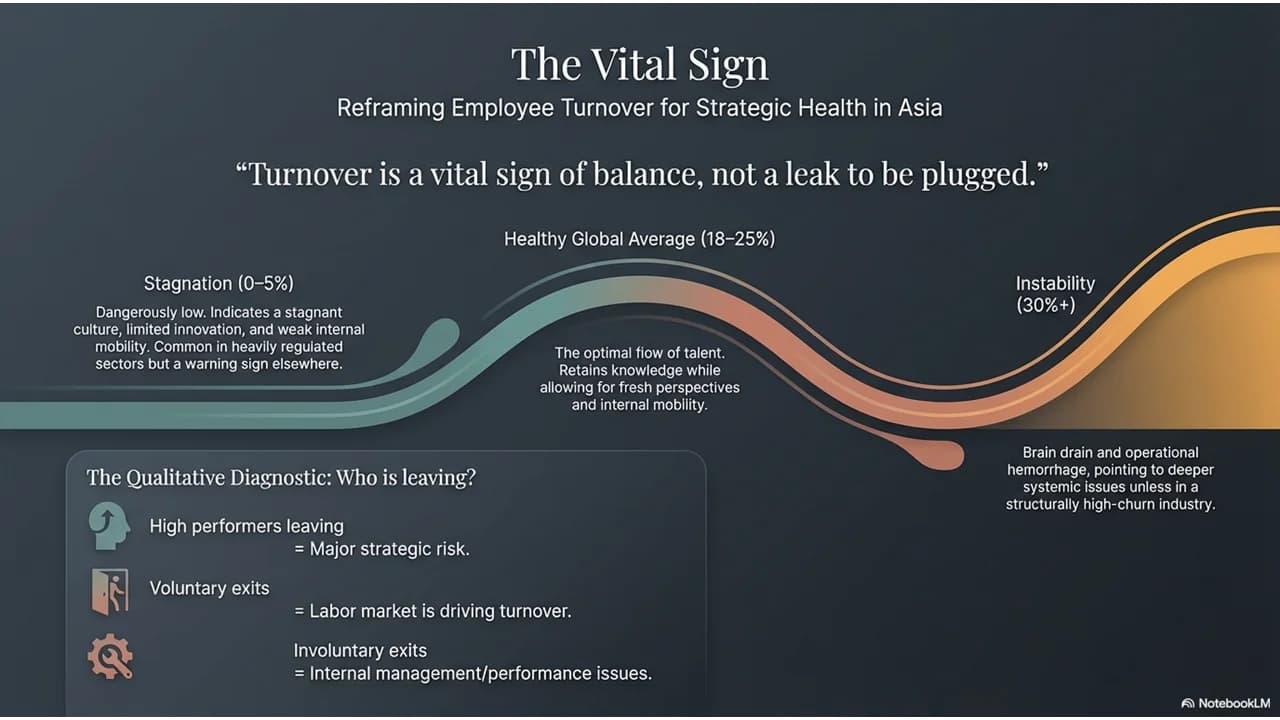
A healthy turnover rate sits somewhere between too much instability and too little movement. Companies need to retain knowledge and high performers, but also allow for fresh talent and internal mobility.
Globally, average turnover rates across industries fall around 18%–25% annually, but this number alone doesn’t mean much without context.
A simpler way to think about it:
- Low turnover (0–10%): Common in finance, government, and regulated sectors
- Moderate turnover (10–30%): Typical for manufacturing, tech, and corporate roles
- High turnover (30–80%): Normal in retail, hospitality, and labor-intensive industries
Extremely low turnover (below 5%) can actually be a warning sign. It may suggest limited innovation, weak internal mobility, or a stagnant culture. On the other hand, very high turnover—especially outside high-churn industries—often points to deeper issues.
What matters just as much is who is leaving.
- If high performers are leaving, that’s a major risk
- If most exits are voluntary, the labor market is driving turnover
- If involuntary exits are high, internal issues may be at play
Global Turnover Benchmarks by Industry (2025–2026)
Turnover varies dramatically by industry, and this is where most misinterpretation happens.
In hospitality and retail, turnover is structurally high. Annual rates often exceed 60%, driven by seasonal work, entry-level roles, and wage dynamics. In this context, a company with 40–50% turnover may actually be performing well.
Professional services and healthcare also show elevated turnover, but for different reasons. In consulting, long hours and high pressure push employees to leave frequently. In healthcare, burnout and staffing shortages are major drivers.
Manufacturing tends to fall in the middle. Turnover is influenced by wage competition and labor supply, typically ranging between 20% and 35%. Technology roles are more stable globally, often between 10% and 20%, although this can increase in talent-short markets.
Financial services and insurance consistently show lower turnover, usually below 15%. These industries rely heavily on experience, regulatory knowledge, and long-term relationships, making stability more important.
Key takeaway: turnover is not a universal metric—it is an industry-specific signal.

Why Turnover Is Higher in Asia
Across all datasets, Asia reports higher turnover rates than global averages—often 20% to 30+%, compared to 10–25% in Western markets.
This isn’t necessarily negative. It reflects how labor markets in Asia function.
Several structural factors drive this:
- Rapid economic growth creates more job opportunities
- Salary competition encourages job switching
- Younger workforce leads to shorter job tenures
- Skills shortages increase employee bargaining power
Another important factor is contract labor. In sectors like manufacturing and logistics, contract workers can make up 30–70% of the workforce. If they’re excluded from reporting, turnover can appear artificially low—creating a misleading picture of stability.
Cultural patterns also matter. Employees may delay resignations or cite indirect reasons, making turnover harder to interpret. Seasonal spikes—such as after Lunar New Year—are also common across Asia.
Southeast Asia and Vietnam: A Closer Look
In Southeast Asia, overall turnover rates typically fall between 15% and 20%, but industry-level variation is significant.
Vietnam is especially interesting because it is in transition. On paper, turnover appears moderate, but real figures can be much higher depending on sector and methodology.
This reflects Vietnam’s shift from a low-cost labor market to a competitive talent market. Salary growth, foreign investment, and urbanization are all accelerating employee movement.
Younger workers, in particular, are more willing to switch jobs for 20–30% salary increases, making retention more challenging.
At the same time, leading companies—especially multinational firms—are managing to keep turnover lower through better benefits, structured career paths, and stronger workplace policies.
Asia vs Global: What’s Actually Different?
When comparing Asia to global benchmarks, the differences are consistent but nuanced.
- Turnover is higher across most industries, especially in tech and manufacturing
- Labor-intensive sectors behave similarly globally, but peaks are higher in Asia
- Financial services remain relatively stable everywhere, though still slightly higher in Asia
The key insight is that “healthy” turnover in Asia is naturally higher. A rate that looks concerning by global standards may be completely normal regionally.
Why Turnover Matters for ESG
Turnover is more than an HR metric—it’s a core ESG indicator. It sits at the intersection of:
- Social (S): employee wellbeing, engagement, retention
- Governance (G): leadership quality, talent strategy
High turnover can signal:
- Weak management or poor culture
- Lack of career development
- Uncompetitive compensation
It also comes with real costs. Replacing an employee can cost several months of salary when factoring in hiring, training, and lost productivity.
But low turnover isn’t automatically good either. It can indicate:
- Limited diversity or fresh perspectives
- Reduced innovation
- Organizational stagnation
Healthy turnover, therefore, reflects balance and adaptability—key traits for long-term sustainability.
What Actually Drives Employee Turnover
Across regions, the drivers of turnover are surprisingly consistent.
The most common factors include:
- Compensation: still the top driver in fast-growing markets
- Career growth: lack of progression leads to exits
- Manager quality: one of the strongest predictors of retention
- Recognition and engagement: employees leave when they feel undervalued
- Work-life balance: increasingly important in high-pressure industries
In Asia, compensation plays a slightly larger role, but non-financial factors are becoming more important as markets mature.
How Companies Can Maintain Healthy Turnover
Managing turnover effectively requires more than just increasing salaries. It requires understanding why employees leave and addressing root causes.
Some practical approaches include:
- Benchmark regularly against industry and regional peers
- Segment data by role, location, and performance level
- Use exit interviews and surveys to identify patterns
- Invest in onboarding to reduce early-stage turnover
- Offer clear career pathways to retain high-potential employees
More advanced organizations are also using data analytics and AI to predict turnover risk and intervene early.

The Future of Turnover in Asia
Looking ahead, turnover in Asia is likely to remain higher than global averages—but more structured.
Several trends will shape the next phase:
- Skills competition will intensify, especially in tech and sustainability
- Emerging markets like Vietnam will continue to see high mobility
- ESG reporting requirements will push companies to disclose and manage turnover more transparently
- Retention strategies will evolve, focusing more on purpose, flexibility, and development—not just salary
Final Thoughts
Employee turnover is not something to eliminate—it’s something to manage intelligently.
For companies and ESG practitioners, the goal is not to chase the lowest number. It is to understand what turnover means in context—and to ensure it reflects a workforce that is both stable and evolving.
Reference
- Corporate Navigators "Average Turnover Rate By Industry (2026 Update)"
- Xceleration "Average Employee Turnover Rate by Industry"
- Aon’s 2025 Salary Increase & Turnover Study
- Vietnam coverage
- HR Datahub UK
- 108 Employee Turnover Statistics & Trends for 2026
- Mercer ASEAN Turnover Drivers
- Navigos Group 2026 Report
- Reeracoen VN Retention
- Industry Turnover: Data Reports 2026
- SEA Outlook 2026
- VSS VN Salary Growth
- Mercer US Turnover 2025