
This article maps the core labor safety indicators used across Asia’s textile and garment sector, from TRIR and LTIFR to training completion and heat-stress metrics and explains, in practical terms, how each is calculated according to prevailing international and regional practice. It equips factory managers, brand compliance teams, and auditors with a clear, standardized toolkit for measuring safety performance in a way that aligns with ILO guidance and buyer expectations.
When a sustainability manager in a global apparel brand asks a supplier in Bangladesh, Vietnam, or Cambodia for its “safety performance,” the answer almost always comes in the form of a few standardized numbers: TRIR, LTIFR, fatality counts, and perhaps a handful of compliance percentages. These indicators have become the common language of occupational safety in Asia’s textile and garment sector, used by factories, auditors, brands, and multi-stakeholder initiatives alike.
But what exactly do these indicators measure? How are they calculated in practice? And which metrics matter most in the Asian context, where hazards like heat stress, fire risk, and excessive overtime loom larger than in Western manufacturing?
This article breaks down the most common labor safety indicators used across Asia’s textile industry and provides clear, practical guidance on how to calculate them according to prevailing standards.
The Two Families of Safety Indicators
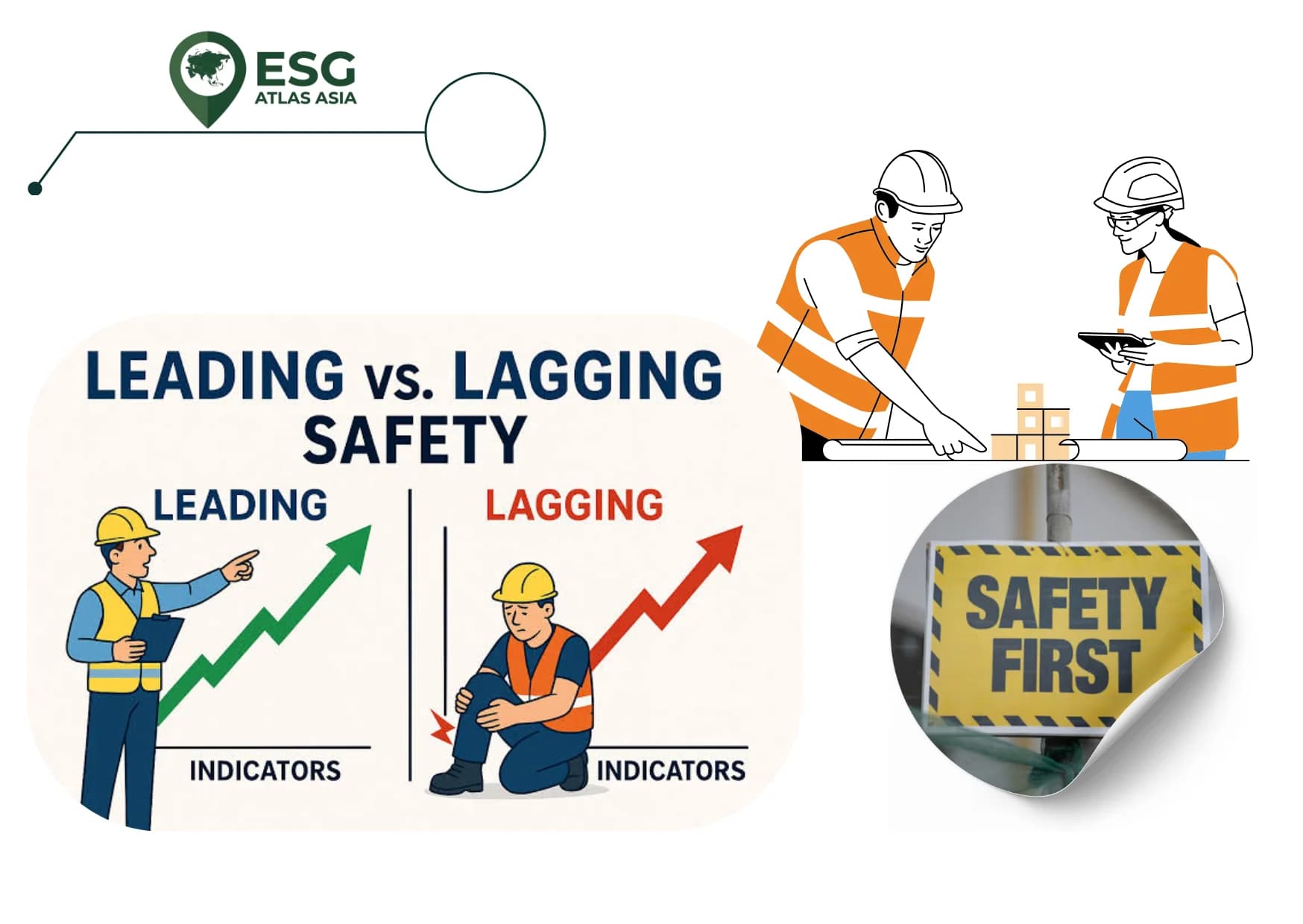
Occupational safety metrics fall into two broad categories: lagging indicators and leading indicators.
- Lagging indicators capture outcomes like injuries, illnesses, and fatalities that have already occurred.
- Leading indicators measure the strength of prevention systems like training, safety committees, near-miss reporting, and audit closure rates and offer early warning signals about whether a factory is building the organizational capabilities that prevent accidents.
In Asia’s textile hubs, both types are increasingly expected by global buyers. The International Labour Organization’s 2021 code of practice on safety and health in textiles, clothing, leather and footwear explicitly calls for systematic recording and notification of work-related injuries alongside robust OSH management systems, worker participation mechanisms, and hazard identification processes. Factories that report only incident rates without evidence of functioning safety systems are no longer seen as fully compliant with international best practice.
Lagging Indicators: The Core Metrics
1. Total Recordable Incident Rate (TRIR)
TRIR is the most widely reported safety metric in global supply chains. It measures the frequency of all recordable work-related injuries and illnesses, normalized to a standard base of hours worked.
Formula

The 200,000 multiplier represents 100 full-time workers (40 hours per week × 50 weeks).
What counts as a “recordable incident”? Typically, this includes:
- Fatalities
- Injuries resulting in at least one day away from work (lost-time injuries)
- Restricted work cases or job transfers due to injury
- Cases requiring medical treatment beyond first aid
- Diagnosed occupational illnesses
Some Asian jurisdictions or academic studies use a simpler rate per 100,000 workers rather than per hours worked, especially when hours data are unreliable:

2. Lost Time Injury Frequency Rate (LTIFR)
LTIFR narrows the focus to injuries serious enough to cause at least one full day away from work. It is widely used in international contexts, particularly where the one-million-hour normalization is standard.
Formula:

Some US-aligned programs use 200,000 instead of 1,000,000 as the denominator base, so factories should clarify which standard their buyers expect.
3. Fatal and Non-Fatal Injury Rates
These are often reported in national statistics and sectoral studies across Asia, particularly when hours-worked data are not consistently tracked.
Fatal injury rate:

Non-fatal injury rate:

These metrics are simpler to compute but less precise than TRIR/LTIFR because they do not account for differences in actual exposure time.
4. Severity Rate / Days-Lost Rate
While TRIR and LTIFR measure frequency, severity metrics capture how serious incidents are.
Severity rate (average days lost per incident):

Lost-day rate (normalized to hours):

A factory with a low TRIR but high severity rate may be experiencing fewer but more serious incidents which is a warning sign that warrants deeper investigation.
Leading Indicators: Measuring Prevention Systems
Leading indicators are increasingly demanded by brands and multi-stakeholder initiatives as evidence that a factory is building sustainable safety capacity, not just managing incident statistics.
1. Safety Training Completion Rate

The ILO code emphasizes competence and training as foundational elements of any OSH management system. Factories should track both initial onboarding training and periodic refresher courses.
2. Safety Committee Functionality
Rather than simply counting whether a safety committee exists, leading factories measure how well it operates:
- Safety committee meeting rate = (Total months in the period/ Number of months with documented safety committee meetings) ×100%
- Worker representation rate= (Total safety committee meetings/ Number of safety committee meetings with genuine worker representatives present) ×100%
3. Near-Miss Reporting Rate
Near misses, which are incidents that could have caused harm but did not, are powerful leading indicators. A high near-miss reporting rate often signals a strong safety culture where workers feel empowered to speak up.

Where K is 200,000 (US-style) or 1,000,000 (international-style), consistent with TRIR/LTIFR normalization.
4. Audit Finding Closure Rate
Many Asian garment factories undergo regular OSH audits by brands, third-party auditors, or multi-stakeholder initiatives. The speed and completeness with which findings are closed offer a clear signal of management commitment.

5. Heat-Stress Mitigation Indicators
Heat stress has emerged as a distinctive safety priority in Asia’s garment sector, particularly in Bangladesh, Cambodia, Vietnam, and Pakistan, where indoor heat limits are often absent or weakly enforced. Factories serving climate-conscious brands are beginning to track:
Heat-exceedance days:
Heat-exceedance days=Number of days when indoor WBGT exceeds threshold (e.g., 30°C)
Paid break coverage on high-heat days:

These metrics have no direct equivalent in Western apparel manufacturing but are increasingly expected in Asian supply chains.
Fire and Building Safety Indicators
Following disasters like Rana Plaza, fire and building safety indicators occupy a prominent place in Asian textile factory scorecards. These include:
- Functional fire alarm and sprinkler systems (yes/no, or % of buildings compliant)
- Clear and unobstructed emergency exits (audit pass/fail)
- Structural integrity certifications (valid/invalid)
- Fire drill frequency (number per year)
- Electrical safety audit compliance (% of findings closed)
While not always expressed as rates, these binary or percentage-based indicators are critical components of any comprehensive safety dashboard in Asia.
Data Quality and Normalization: Practical Considerations
The formulas above are straightforward, but their accuracy depends on the quality of underlying data. In Asia’s textile sector, several challenges are common:
- Hours tracking: Incomplete or manipulated time-and-attendance records can distort TRIR and LTIFR. Factories should invest in reliable digital systems and regular audits of hours data.
- Injury classification: Inconsistent application of “recordable” definitions can lead to underreporting. Training for HR and safety staff on ILO and buyer-specific criteria is essential.
- Normalization consistency: Factories serving multiple buyers may be asked to report TRIR using 200,000 hours and LTIFR using 1,000,000 hours. Clear documentation of which standard is used prevents confusion in benchmarking.
A Practical Dashboard for Asian Textile Factories
A robust safety dashboard for a textile or garment factory in Asia might include the following indicators, reported monthly or quarterly:
Lagging indicators: | Leading indicators: | Fire and building safety: |
Conclusion: From Compliance to Capability
It is important to calculate safety indicators, but it is not an end in itself, instead it is a means to build organizational capability and drive continuous improvement. Factories that treat TRIR and LTIFR as box-ticking exercises will miss the deeper value of these metrics: the ability to identify trends, allocate resources, and hold management accountable.
Those that complement lagging indicators with robust leading metrics like training, safety committees, near-miss reporting, and heat-stress mitigation will be better positioned to prevent accidents before they happen and to demonstrate genuine safety leadership to global buyers.
In the next article in this series, we will explore what these indicators reveal about the state of occupational safety in Asia’s textile industry and how brands, factories, and policymakers can use them to drive meaningful change.
Reference
1. ILO
2. SmartQHSE