
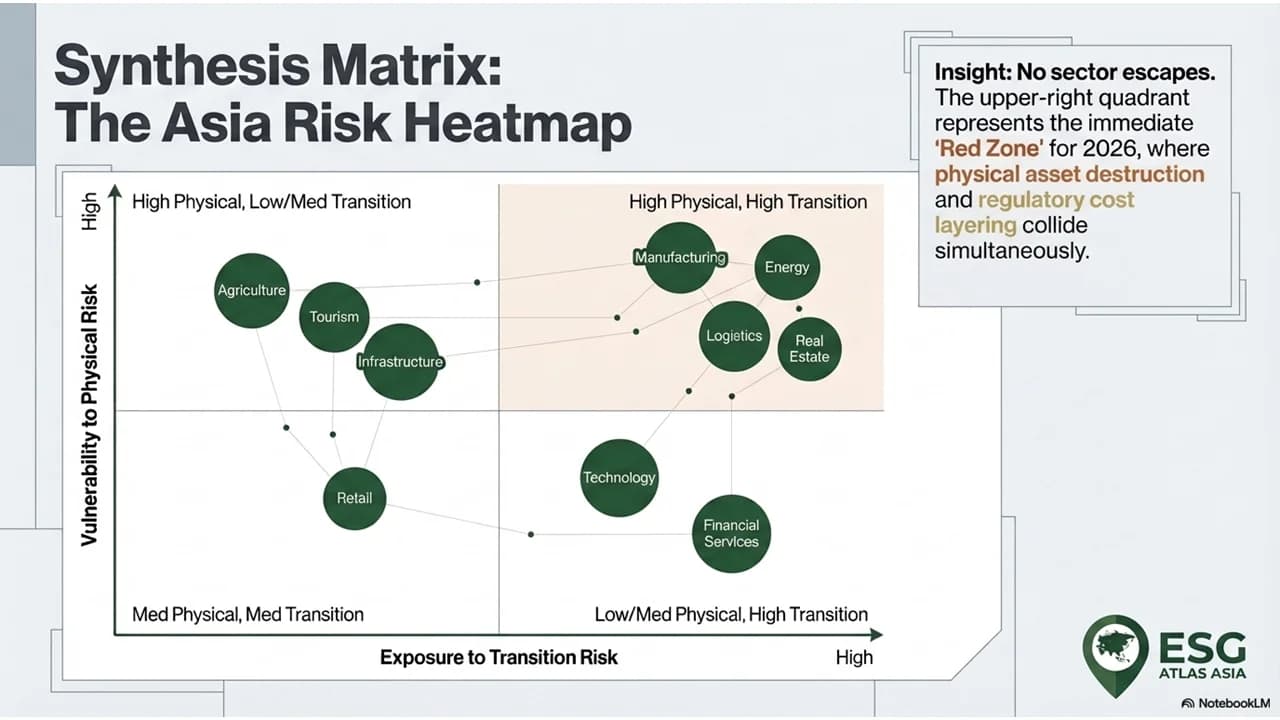
Discover how climate risks impact energy, finance, retail, tourism, technology, and infrastructure sectors in Asia, with actionable ESG strategies for businesses.
As climate risk intensifies across Asia, its impact extends far beyond physical assets. It is increasingly shaping financial systems, consumer behavior, and long-term investment decisions.
In this second article, we examine how climate risk affects six additional industries, focusing on both operational impacts and strategic implications
👉 Top Climate Risks by Industry in Asia (Part 1): Manufacturing, Agriculture, Real Estate, and Logistics
⚡ Energy (Power & Utilities)
The energy sector sits at the center of the climate transition.
1. Stranded Fossil Fuel Assets (Transition)
As renewable energy becomes more cost-competitive and climate policies tighten, fossil fuel-based power plants face declining utilization.
This leads to “stranded assets”—infrastructure that cannot generate expected returns over its lifetime. For utilities, this represents:
- Write-downs on existing assets
- Reduced revenue streams
- Investor pressure to accelerate transition
2. Policy and Regulatory Shifts (Transition)
Energy policy in Asia is evolving rapidly, often with short notice. Changes in subsidies, tariffs, or renewable targets can significantly alter market dynamics.
This creates uncertainty in:
- Investment planning
- Project viability
- Long-term contracts
Companies must operate in an environment where policy risk is as important as market risk.
3. Extreme Weather Impacts (Physical)
Energy infrastructure—power plants, transmission lines, substations—is highly exposed to weather events.
Storms can damage grids, while heatwaves increase demand and strain capacity. This creates a dual challenge:
- Maintaining reliability under stress
- Investing in resilience upgrades
Failures in the energy system have cascading effects across all industries.
4. Water Dependency (Physical)
Thermal power plants require large amounts of water for cooling. In water-scarce regions, this becomes a critical constraint.
During droughts:
- Plants may reduce output
- Operating costs increase
- Regulatory restrictions may apply
This risk is particularly relevant in parts of Southeast Asia and India.
5. Capital Reallocation Pressure (Transition)
Utilities are under pressure to shift investment toward renewable energy sources.
This involves:
- Large capital expenditures
- Long payback periods
- Technological and operational uncertainty
Balancing legacy assets with new investments is a complex financial and strategic challenge.

🏦 Financial Services
Climate risk is increasingly a financial risk.
1. Portfolio Exposure (Transition + Physical)
Banks and investors are indirectly exposed to climate risk through the companies they finance.
If clients in high-risk sectors (e.g., coal, agriculture, real estate) face losses, this translates into:
- Loan defaults
- Reduced asset values
- Portfolio instability
Climate risk becomes systemic financial risk, not just sector-specific.
2. Climate Credit Risk (Transition)
As regulations tighten and markets shift, some borrowers may struggle to adapt.
For example:
- A manufacturer facing carbon tariffs
- A real estate developer with non-compliant assets
These pressures increase the likelihood of credit deterioration, requiring banks to reassess risk models.
3. Insurance Loss Escalation (Physical)
Insurance companies face rising claims due to more frequent and severe weather events.
This affects:
- Profitability
- Pricing strategies
- Market availability of insurance products
In high-risk areas, insurance may become unaffordable or unavailable, creating broader economic implications.
4. Disclosure Requirements (Transition)
Regulators are requiring financial institutions to disclose climate-related risks, often aligned with global frameworks.
This involves:
- Data collection across portfolios
- Scenario analysis
- Reporting infrastructure
Compliance is resource-intensive and requires new capabilities.
5. Asset Repricing (Transition)
Markets are increasingly incorporating climate risk into asset valuations.
This leads to:
- Declining value of high-emission assets
- Increased cost of capital for risky sectors
- Shifts in investment flows
Financial institutions must anticipate these changes to avoid losses.
🛍️ Retail & Consumer Goods
Retail sits at the intersection of supply chains and consumer demand.
1. Supply Chain Disruption (Physical)
Retailers rely on global supply chains that are vulnerable to climate events.
Disruptions can lead to:
- Stock shortages
- Increased sourcing costs
- Lost sales opportunities
Companies may need to diversify suppliers or hold more inventory, increasing operational complexity.
2. Changing Consumer Preferences (Transition)
Consumers, particularly in urban Asia, are becoming more environmentally conscious.
This drives demand for:
- Sustainable products
- Transparent sourcing
- Ethical practices
Companies that fail to adapt risk losing market share.
3. Packaging Regulations (Transition)
Governments are introducing restrictions on plastic and waste.
This requires:
- Redesigning packaging
- Finding alternative materials
- Adjusting supply chains
These changes often increase costs and require innovation.
4. Supplier Cost Pass-Through (Transition)
As suppliers face higher costs from energy, carbon, and compliance, these costs are passed downstream.
Retailers must decide whether to:
- Absorb the costs
- Increase prices
- Adjust product offerings
5. Weather-Driven Demand Volatility (Physical)
Extreme weather affects consumer behavior.
For example:
- Heatwaves increase demand for cooling products
- Storms reduce foot traffic in physical stores
This creates unpredictability in sales and inventory planning.

🏨 Tourism & Hospitality
Tourism is highly sensitive to environmental conditions.
1. Extreme Weather Damage (Physical)
Hotels and resorts are often located in coastal or scenic areas, making them highly exposed.
Damage from storms or flooding leads to:
- Repair costs
- Business interruption
- Loss of revenue
2. Changing Climate Patterns (Physical)
Climate change can alter the attractiveness of destinations.
Rising temperatures, coral bleaching, or reduced snowfall can reduce tourist demand over time.
3. Resource Constraints (Physical)
Tourism operations are resource-intensive, particularly in water and energy use.
Scarcity can:
- Limit operations
- Increase costs
- Create conflicts with local communities
4. Sustainability Expectations (Transition)
Travelers increasingly prefer environmentally responsible accommodations.
Hotels must invest in:
- Energy efficiency
- Waste reduction
- Sustainable sourcing
5. Carbon Footprint Scrutiny (Transition)
Tourism is closely linked to aviation, a high-emission sector.
Growing awareness of travel emissions may influence consumer choices and regulatory action.
💻 Technology & Data Centers
A fast-growing sector with rising climate exposure.
1. Energy Demand (Transition)
Data centers require continuous, high-volume electricity.
As energy systems decarbonize, companies face:
- Higher costs
- Pressure to source renewable energy
- Need for energy efficiency improvements
2. Cooling Requirements (Physical)
Rising temperatures increase the need for cooling systems.
This leads to:
- Higher operational costs
- Greater energy consumption
- Technical challenges in maintaining performance
3. Water Usage (Physical)
Many cooling systems depend on water.
In water-scarce regions, this creates:
- Operational constraints
- Regulatory pressure
- Community concerns
4. Supply Chain Pressure (Transition)
Tech companies depend on hardware manufacturing, which is carbon-intensive.
This creates indirect exposure to:
- Emissions regulations
- ESG expectations
- Supply chain disruptions
5. Emissions Scrutiny (Transition)
Tech firms face increasing pressure to meet net-zero targets.
This requires:
- Measuring emissions accurately
- Investing in renewable energy
- Offsetting residual emissions
🏗️ Infrastructure & Urban Development
Infrastructure underpins economic resilience but faces long-term climate exposure.
1. Flooding and Climate Exposure (Physical)
Infrastructure assets are long-lived and highly exposed.
Damage from climate events leads to:
- High repair costs
- Service disruption
- Economic losses
2. Design Obsolescence (Transition)
Infrastructure designed for past climate conditions may not withstand future realities.
This creates a need for:
- Retrofitting
- Redesign
- Updated engineering standards
3. Regulatory Changes (Transition)
Governments are introducing stricter requirements for resilience and sustainability.
Projects must meet:
- New design standards
- Environmental assessments
- Long-term climate considerations
4. Urban Heat Stress (Physical)
Heat increases wear and tear on infrastructure.
It also affects:
- Energy demand
- Public health
- Urban livability
5. Financing Constraints (Transition)
Investors are prioritizing climate-resilient and sustainable projects.
Projects that do not meet these criteria may face:
- Higher financing costs
- Reduced access to capital
- Delays or cancellations
🔗 Missed Part 1?
To understand the full picture of climate risk across Asia, start with Part 1, which covers manufacturing, agriculture, real estate, and logistics—sectors where climate risk is already deeply embedded in daily operations.
👉 Top Climate Risks by Industry in Asia (Part 1): Manufacturing, Agriculture, Real Estate, and Logistics

Final Insight: From Risk Identification to Strategic Response
Across all industries in Asia, climate risk is no longer a future concern—it is actively shaping business performance today.
What distinguishes leading companies is not just awareness of these risks, but their ability to:
- Integrate climate risk into core strategy
- Build resilience across operations and supply chains
- Align with the direction of global transition
In this context, climate risk is not just a threat—it is a defining factor of competitiveness in the Asian market.

References
- Southeast Asia’s energy security and net‑zero emissions go hand in hand. CASE for SEA.
- “Stranded assets linked to MDB finance trigger Asia’s economic tailspins.” Energy Tracker Asia Fazeli, R. et al. (2025). Southeast Asia faces high stranded asset risk from coal power expansion. Energy Policy
- Overview of stranded assets risk in the Vietnamese energy sector. Vietnam Fair Finance Asia.
- Climate impacts on South and Southeast Asian hydropower. OECD
- Climate financing renewable energy projects in Asia.Marsh Asia
- Climate Change Highlights in ASEAN (factsheet on energy‑related emissions). ASEAN Centre for Energy
- Financing climate‑resilient infrastructure in Asia and the Pacific. World Bank.
- Understanding barriers to financing solar and wind energy projects in selected Asian countries. EY
- Climate Change Highlights in ASEAN. ASEAN Centre for Energy
- Climate‑resilient infrastructure in Asia and the Pacific. World Bank