
Learn what climate risk is and how physical and transition risks impact businesses. Explore why climate risk is rising across Asia and what companies need to know.
For years, climate change was treated as a long-term environmental concern—important, but distant from day-to-day business decisions. It was something addressed in sustainability reports, not boardrooms.
That assumption no longer holds.
Today, climate risk is a financial, operational, and strategic issue. It influences where companies invest, how supply chains are structured, how assets are valued, and whether businesses can continue to operate under changing environmental and regulatory conditions.
Across Asia, the evidence is increasingly visible. Flooding in industrial zones disrupts production cycles. Heatwaves reduce labor productivity. At the same time, tightening carbon regulations in export markets are reshaping cost structures and market access. These are no longer hypothetical risks—they are active forces shaping business outcomes.
At the core of this shift are two distinct but interconnected categories: physical risk and transition risk. Understanding the difference between them is the first step for any company looking to assess exposure, build resilience, and meet growing ESG expectations.

What Is Climate Risk?
Climate risk refers to the potential negative impacts of climate change on a company’s operations, financial performance, or long-term viability.
These risks are typically grouped into two categories:
- Physical risk: Direct impacts from climate-related events or environmental changes
- Transition risk: Indirect impacts arising from the global shift toward a low-carbon economy
This classification is widely used across ESG frameworks, including TCFD and ISSB, both of which emphasize that climate risk is financially material and decision-relevant.
Physical Risk: When Climate Directly Disrupts Business
Physical risks arise from the observable and measurable effects of climate change on physical assets, infrastructure, and business operations. These are often the most immediate and visible risks companies face.
They can be broadly divided into two categories:
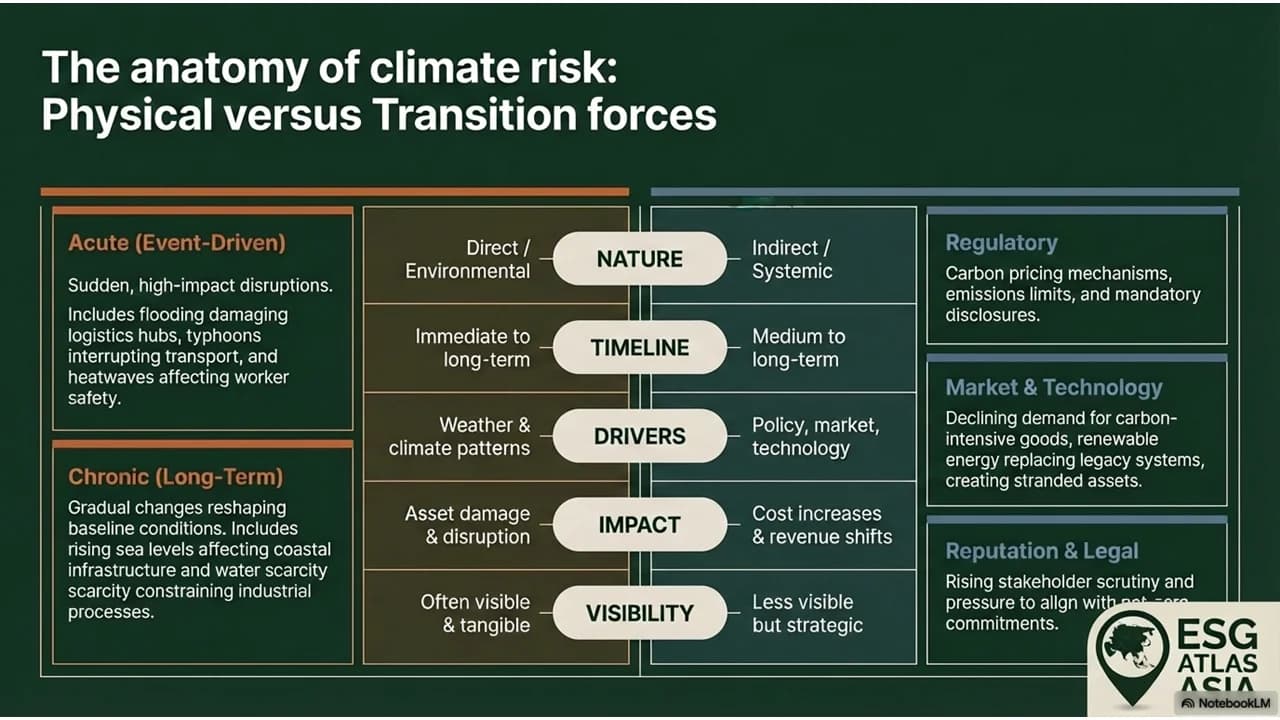
1. Acute Physical Risks (Event-Driven)
Acute risks are sudden, high-impact events that can cause immediate operational disruption:
- Flooding that damages factories, warehouses, or logistics hubs
- Typhoons and storms that interrupt transportation networks
- Heatwaves that affect worker safety, productivity, and equipment performance
For example, a manufacturing facility located in a flood-prone industrial zone may experience repeated shutdowns, inventory losses, and increased maintenance costs. Over time, these disruptions can erode profitability and reduce operational reliability.
2. Chronic Physical Risks (Long-Term Changes)
Chronic risks develop gradually and are often less visible in the short term, but more structurally significant:
- Rising sea levels affecting coastal infrastructure
- Increasing average temperatures reducing labor efficiency
- Water scarcity constraining industrial processes or agricultural output
Unlike acute events, chronic risks reshape the baseline conditions under which businesses operate. They can gradually undermine productivity, increase operating costs, and in some cases, make certain locations or business models no longer viable.
Transition Risk: The Cost of Moving to a Low-Carbon Economy
While physical risks stem from environmental changes, transition risks arise from the economic and systemic adjustments required to address climate change.
As governments, investors, and consumers push toward a low-carbon economy, companies face a range of pressures that can significantly alter cost structures, competitiveness, and long-term strategy.
Key drivers of transition risk include:
1. Regulatory Changes
Governments are introducing policies designed to reduce emissions and accelerate decarbonization. These include:
- Carbon pricing mechanisms
- Emissions limits and reporting requirements
- Mandatory climate disclosures
For export-oriented companies in Asia, this risk is often indirect but significant. Regulations such as the Carbon Border Adjustment Mechanism effectively extend carbon costs beyond domestic borders, impacting suppliers that may not be directly regulated in their home countries.
2. Market and Consumer Shifts
Consumer preferences and corporate procurement strategies are evolving rapidly:
- Increased demand for low-carbon and sustainable products
- Declining demand for carbon-intensive goods
- Greater scrutiny from ESG-focused investors and buyers
Companies that fail to adapt may experience declining revenue, even if their physical operations remain unaffected.
3. Technology Disruption
The transition to a low-carbon economy is driven by rapid technological change:
- Renewable energy replacing fossil fuel-based systems
- Electrification transforming transportation and logistics
- Efficiency technologies reducing cost advantages of legacy systems
These shifts can render existing assets obsolete, creating stranded assets—investments that lose economic value before the end of their intended lifespan.
4. Reputation and Legal Risks
Stakeholder expectations are rising, creating additional layers of exposure:
- Public scrutiny over environmental performance
- Legal challenges related to climate accountability
- Pressure to align with net-zero commitments
These risks can affect brand equity, customer relationships, and access to financing.
Physical vs Transition Risk: Key Differences
While both fall under climate risk, they operate in fundamentally different ways.
Aspect | Physical Risk | Transition Risk |
Nature | Direct, environmental | Indirect, systemic |
Timeline | Immediate to long-term | Medium to long-term |
Drivers | Weather and climate patterns | Policy, market, technology |
Impact | Asset damage, operational disruption | Cost increases, revenue shifts |
Visibility | Often visible and tangible | Often less visible but strategic |
In practice, companies are rarely exposed to just one type. Most face a combination of both, often interacting in complex ways.
Why Asia Faces Higher Climate Risk Exposure
While climate risk is global, its impacts are unevenly distributed. Asia, and particularly Southeast Asia, sits at the intersection of multiple climate risk drivers, making it one of the most exposed regions globally.

High Physical Risk Exposure
- Extensive coastlines vulnerable to flooding and sea-level rise
- High frequency of extreme weather events, including typhoons and heatwaves
- Rapid urbanization placing strain on infrastructure systems
Rising Transition Pressure
- Strong dependence on export markets with tightening climate regulations
- Energy systems still heavily reliant on fossil fuels
- Increasing scrutiny from global investors and multinational buyers
Concentration of Global Supply Chains
Asia’s role as a manufacturing hub means that disruptions in the region have global implications, amplifying both physical and transition risks.
In countries such as Vietnam, this creates a dual exposure:
- Immediate operational disruptions from physical risks
- Structural economic pressure from transition risks
Common Misconceptions About Climate Risk
Despite growing awareness, several misconceptions persist:
- “Climate risk is only long-term” → Many risks are already material today
- “Only large companies are affected” → SMEs are often more vulnerable due to limited resources
- “Physical risk matters more than transition risk” → Transition risk can be equally, if not more, disruptive
- “Climate risk is just an environmental issue” → It is fundamentally a business and financial issue
The Strategic Importance of Understanding Both Risks
Understanding climate risk is not an end in itself—it is the foundation for better decision-making.
Companies that integrate climate risk into strategy can:
- Improve operational resilience
- Anticipate regulatory and market changes
- Identify emerging opportunities in low-carbon sectors
- Strengthen long-term competitiveness
Conversely, companies that fail to act may face increasing costs, operational disruptions, and reduced access to markets and capital.
Conclusion: From Awareness to Action
Climate risk is no longer a peripheral ESG topic. It is a core determinant of business performance and long-term value.
Physical risks are already disrupting operations across Asia, while transition risks are reshaping the global economic landscape. The interaction between these forces makes climate risk both immediate and systemic.
For businesses operating in Asia, the urgency is particularly pronounced. High exposure to environmental changes combined with growing external pressure from global markets means that climate risk cannot be deferred or ignored.
The priority now is clear: move beyond awareness, and begin integrating climate risk into strategy, operations, and decision-making frameworks.
Because in today’s business environment, climate risk is not just about sustainability—it is about resilience, competitiveness, and survival.
References
- Physical Climate Risk & Transition Climate Risk | UKGBC
- Climate resilience
- Vietnam climate risk report
- Center for global sustainability
- ICAEW - Climate crisis is a core business issue
- Gaps in businesses climate action
- Country climate and development report for Vietnam
- Weforum - Climate hazards are reshaping business realities and responses
- Climate risk index
- Climate risk explain