
Vietnam is deploying a structured, step-by-step carbon market architecture designed to balance industrial competitiveness with decarbonization goals.
Understanding the compliance schedule, commodity rules, and pricing dynamics is critical for financial and operational planning.
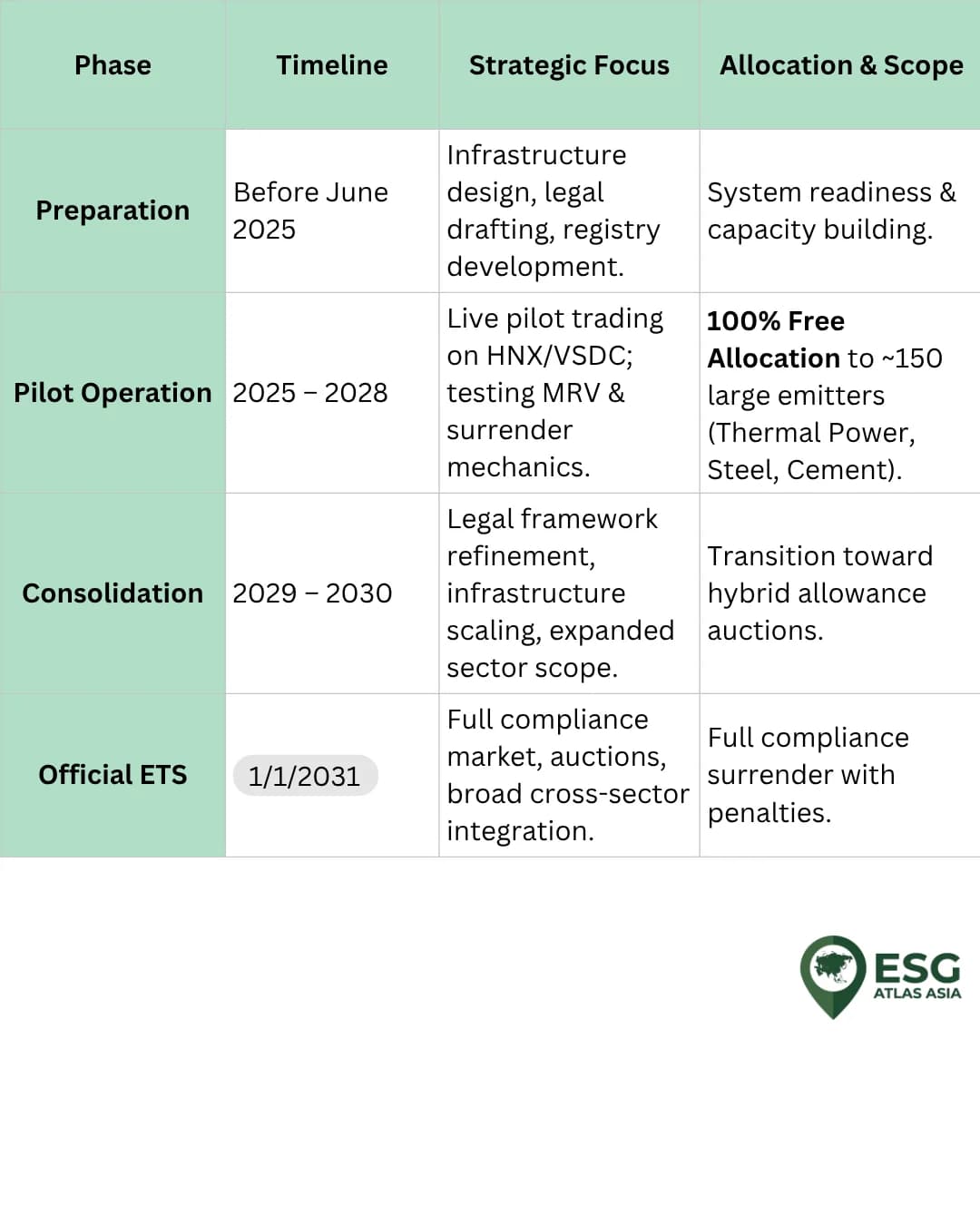
The Development Roadmap to Full Compliance
Vietnam’s carbon market rollout is divided into clear regulatory phases:
Phase | Timeline | Strategic Focus | Allocation & Scope |
Preparation | Before June 2025 | Infrastructure design, legal drafting, registry development. | System readiness & capacity building. |
Pilot Operation | 2025 – 2028 | Live pilot trading on HNX/VSDC; testing MRV & surrender mechanics. | 100% Free Allocation to ~150 large emitters (Thermal Power, Steel, Cement). |
Consolidation | 2029 – 2030 | Legal framework refinement, infrastructure scaling, expanded sector scope. | Transition toward hybrid allowance auctions. |
Official ETS | 1/1/2031 | Full compliance market, auctions, broad cross-sector integration. | Full compliance surrender with penalties. |
Compliance Cycles & Flexibility Mechanisms
The compliance framework incorporates key market flexibility mechanisms:
- Two-Year Compliance Cycles: The pilot operates in two-year cycles (2025–2026, 2027–2028, and 2029–2030). Facilities submit verified emissions inventories and surrender equivalent allowances/credits.
- Borrowing Provisions: Facilities facing allowance deficits may borrow up to 15% of their allocated allowances from the subsequent period.
- Carry-Over Rules: Unused allowances from a completed period can be carried forward into the next compliance period.
- Credit Offsetting Cap: Covered entities can use verified carbon credits to offset up to 30% of their total compliance allowance surrender obligation.
Tradable Commodities & Recognized Standards
The domestic trading floor supports two distinct asset classes:
- GHG Emission Allowances (Vietnam ETS Allowances): 1 allowance equals 1 tCo2 allocated by the Government.
- Verified Carbon Credits: Credits generated from approved domestic and international reduction or removal programs:
- Compliance/UNFCCC Mechanisms: Clean Development Mechanism (CDM), Joint Crediting Mechanism (JCM), Article 6.4 units, and Article 6.2 ITMOs.
- Mandatory Market (Domestic Exchange): Currently does not allow trading of credits from independent international voluntary standards, such as Verra (VCS) or Gold Standard (GS).
- International Voluntary Market: Vietnamese enterprises can still develop projects and generate credits under Verra or Gold Standard to sell to international buyers; however, these credits cannot currently be traded or used to offset mandatory emission compliance obligations within the domestic regulatory system.
Market Pricing Outlook
According to the World Bank's State and Trends of Carbon Pricing 2025, global carbon pricing mechanisms generate over $100 billion annually, covering roughly 28% of global emissions across 80 active carbon tax and ETS initiatives.
Vietnam Pricing Dynamic
- Pilot Phase (2025–2028): Initial trading driven by 100% free allocation and 30% offset cap, while forest carbon credits are about $5/tons now.
- Long-Term Outlook (Post-2029): Transition to paid allowance auctions and tightening caps will drive convergence toward regional compliance prices.
Key takeaways
With the pilot phase testing quota distribution and registry systems, the primary risk for Vietnamese enterprises is waiting too long to prepare. Organizations should establish internal shadow carbon pricing now to test capital expenditure plans against future allowance costs.
Reference: