
Key Insight
👉 More data does not mean better decisions—better interpretation does
Many Asian companies struggle not because tools are unavailable, but because:
- Tools are too complex for current capability
- Data is not translated into business insights
- Scenario analysis is disconnected from decision-making

As climate risk assessment evolves, companies are increasingly expected to move beyond static risk identification toward forward-looking scenario analysis.
However, one of the biggest challenges—especially in Asia—is not the lack of tools.
👉 It is knowing which tools to use, and when.
Before diving into advanced tools, it is critical to understand one thing:
Scenario analysis is not the starting point.
It builds on a solid foundation of physical climate risk assessment.
If you have not yet done this, start here: → Physical Climate Risk Assessment for Beginners: Step-by-Step Guide for Asian Businesses (Part 1)
This earlier guides cover:
- Scope
- Hazard
- Exposure
- Sensitivity
- Risk scoring (Exposure × Sensitivity)
- Translating risks into business impact
- Identifying mitigation actions
👉 Without these steps, scenario analysis often becomes disconnected from real business decisions.
Who This Guide Is For
This guide is designed for:
- SMEs in Asia starting climate risk assessment
- ESG consultants building their first scenario analysis
- Companies preparing for disclosures aligned with the Task Force on Climate-related Financial Disclosures
👉 Get more pratical ESG guides and Asia-focused insights This series is designed to move beyond theory into real business applications.
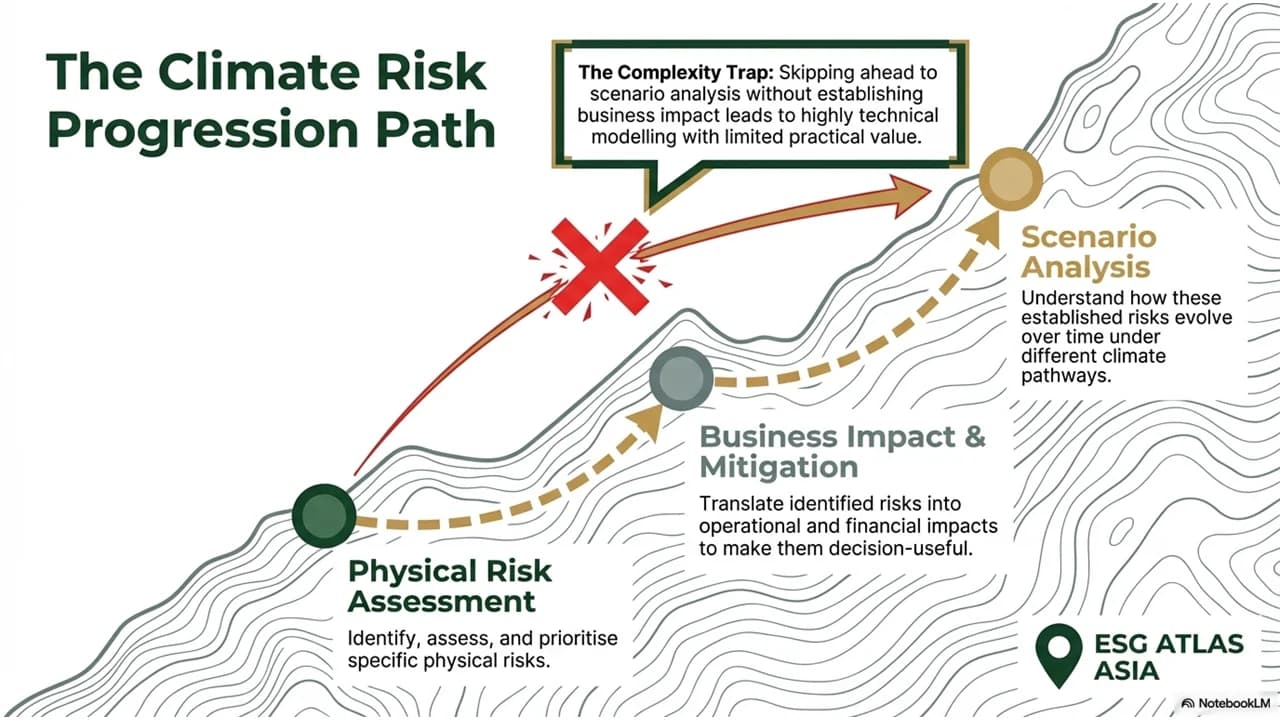
Your Climate Risk Journey
Think of climate analysis as a progression:
- Physical risk assessment → Identify, assess, and prioritize risks
- Business impact and mitigation → Make risk decisions-useful
- Scenario analysis (this stage) → Understand how risks evolve over time
Skipping ahead often leads to complex analysis with limited practical value.

Understanding the Tool Landscape
Climate scenario tools generally fall into three categories:
1. Raw Climate Data Platforms
- Highly technical
- Provide climate variables (temperature, rainfall, extreme events)
- Require modeling expertise
2. Processed Datasets and Reports
- Pre-analyzed insights
- Easier to interpret
- Useful for ESG reporting
3. Commercial Tools
- Business-oriented
- Translate climate data into operational or financial impacts
- Often user-friendly but paid
The goal is not to use everything, but to use the right level of complexity for your stage
Level 1: Practical / Business-Ready Tools (Beginner-Friendly)
These tools are designed for decision-makers, not climate scientists.
They translate scenario data into business impact and risk exposure.
Zurich Climate Spotlight (Asia Pacific)
An interactive platform designed for businesses and cities.
- Visualizes exposure to risks like heat, floods, and storms
- Allows multi-location comparison
- Offers both self-service and expert-supported versions
Best for:
- Corporates
- SMEs starting scenario analysis
- Multi-site risk comparison
Difficulty level: ⭐⭐☆☆☆ (Easy–Moderate)
ClimateAi
A data-driven platform linking climate scenarios to business performance.
- Combines climate and economic data
- Projects impacts on supply chains and operations
- Strong in agriculture and manufacturing use cases
Best for:
- Supply chain analysis
- Scenario-based business planning
Difficulty level: ⭐⭐⭐☆☆ (Moderate)
👉 If you want more practical ESG frameworks and Asia-focused insights,subscribe to ESG Atlas Asia.
Level 2: Intermediate / Interpreted Data (Consultant-Friendly)
These sources translate complex climate data into structured insights, making them more accessible for ESG practitioners.
State of the Climate in Asia – World Meteorological Organization
An annual report summarizing observed and projected climate trends.
- Covers temperature, extreme events, and sectoral impacts
- Provides regional insights without requiring modeling
- Useful for contextualizing risks in ESG reports
Best for:
- ESG reporting
- Market and risk context analysis
Difficulty level: ⭐⭐☆☆☆ (Moderate)
NGFS-aligned Data Platforms (via World Bank and others)
Widely used by financial institutions.
- Provides standardized climate scenarios (e.g. orderly vs disorderly transition)
- Often linked to physical and transition risk datasets
- Increasingly referenced in regulatory and investor expectations
Best for:
- Banks and financial institutions
- Scenario-based ESG analysis
Difficulty level: ⭐⭐⭐☆☆ (Moderate–High)
Asia-Pacific Network for Global Change Research
Provides accessible summaries of climate projections in Southeast Asia.
- Focus on temperature and precipitation trends
- Translates technical scenarios into readable insights
Best for:
- Early-stage analysis
- ESG education and training
Difficulty level: ⭐⭐☆☆☆ (Moderate)
Level 3: Advanced / Technical Tools (Expert Use)
These tools provide raw or semi-processed climate scenario data. They are powerful—but require technical expertise in climate science or data analysis.
AP-PLAT (Asia-Pacific Climate Change Adaptation Platform)
Developed by the National Institute for Environmental Studies
One of the most comprehensive regional platforms for Asia.
- Provides downscaled datasets (CMIP3, CMIP5, ISIMIP, d4PDF)
- Covers multiple climate variables (temperature, rainfall, etc.)
- Allows map visualization and raw data downloads
Best for:
- Researchers
- Advanced ESG consultants
- Impact modeling
Difficulty level: ⭐⭐⭐⭐☆ (High)
CORDEX South Asia (CCCR-IITM)
A regional dataset focused on South Asia, with high-resolution projections.
- ~50 km resolution climate projections
- Includes daily outputs under RCP scenarios
- Strong for analyzing monsoon variability and extreme events
Best for:
- Climate scientists
- Sector-specific modeling (e.g. agriculture, water)
Difficulty level: ⭐⭐⭐⭐☆ (High)
Southeast Asia Regional Modeling (PRECIS / SEACAM)
A regional modeling initiative focused on Southeast Asia.
- High-resolution projections (~25 km)
- Long-term outlooks up to 2100
- Useful for understanding regional climate trends
Best for:
- Government agencies
- Academic or policy research
Difficulty level: ⭐⭐⭐⭐☆ (High)
Quick Comparison: Which Tool Should You Use?
Tool Type | Best For | Region | Difficulty |
AP-PLAT / CORDEX | Climate modeling | Asia | High |
WMO Reports | ESG reporting context | Asia | Low |
NGFS datasets | Financial risk analysis | Global / Asia | Medium |
Zurich Climate Spotlight | Business users | APAC | Low–Medium |
ClimateAi | Operational impact | Global | Medium |
👉 Download FREE comprehensive Guide, Checklist, and Question bank for your risk assessment.
How to Choose the Right Tool
The biggest mistake companies make is jumping straight into complex tools.
Instead, align your choice with your ESG maturity level:
If you are just starting:
- Use WMO reports or APN summaries
- Combine with internal risk assessment
At this level, you should focus on understanding trends, not modeling
If you are building structured ESG analysis:
- Add NGFS scenarios
- Use tools like Climate Spotlight
Now, you can start linking scenarios to business impact
If you are doing advanced assessments:
- Use AP-PLAT, CORDEX, or regional models
- Integrate into financial or operational models
At this stage, you can focus on quantification and stress testing

References
- AP‑PLAT (Asia‑Pacific Climate Change Adaptation Platform)
- Climate Change in Southeast Asia
- Asia-Pacific Network for Global Change Research
- CORDEX South Asia (CCCR‑IITM Climate Data Portal)
- World Meteorological Organization (WMO)
- Network for Greening the Financial System (NGFS)
- Asia‑Pacific Network for Global Change Research (APN)
- Zurich Climate Spotlight (Asia Pacific)
- ClimateAi
- Guidance on Physical Climate Risk Assessment
- Tackling Climate Risk in Asia through AMRO and the NGFS – East Asia Forum
- A Regional Climate Modelling Experiment for Southeast Asia