
Climate risk is no longer an abstract debate—it’s a boardroom priority. From the "future problem" fallacy to the "data perfection" trap, we break down the 8 common misconceptions holding companies back. Learn why climate risk is a current business variable that belongs in finance and operations, not just ESG reports.
Key Takeaways
- Climate risk is already impacting business operations—not just a future concern
- Physical and transition risks extend across value chains, not just direct operations
- Transition risk affects all companies, regardless of emissions level
- Climate risk must be integrated into core business strategy, not treated as compliance
- Imperfect data should not delay action—basic assessments already create value
- Climate risk is inherently linked to social and governance factors
- Market pressure often precedes regulation, especially in Asia
SMEs are not exempt—they are often the most exposed

Climate risk has moved from abstract debate to boardroom priority. Yet despite the growing volume of disclosures, frameworks, and regulatory pressure, many companies still operate based on outdated or misleading assumptions.
These myths are not harmless—they shape how businesses assess exposure, allocate capital, and design strategy. In Asia, where climate exposure is often more acute and economic structures more complex, these misconceptions can lead to significant blind spots.
This article breaks down the most common myths around both physical and transition climate risks—and demystifies them.
1. “Climate Risk Is a Future Problem”
The myth:
Climate risk is something to prepare for in 10–20 years, not something affecting operations today.
The reality:
Climate risk is already material.
Physical risks such as flooding, heatwaves, and typhoons are increasing in both frequency and severity. In cities like Ho Chi Minh City, Bangkok, and Jakarta, urban flooding is no longer an extreme event—it is operational reality.
At the same time, transition risks are already unfolding:
- Carbon pricing mechanisms are expanding
- Export markets are introducing carbon border taxes
- Investors are integrating ESG into capital allocation
In Asia:
The misconception is particularly dangerous because:
- Infrastructure is often highly exposed
- Supply chains are geographically concentrated
- Climate resilience planning is still uneven
👉 Climate risk is not a future scenario—it is a current business variable.
2. “Physical Risk Only Affects Asset-Heavy Industries”
The myth:
Only sectors like agriculture, real estate, or energy need to worry about physical climate risks.
The reality:
Physical risk propagates through value chains, not just assets.
Even companies without physical assets in high-risk zones are exposed through:
- Suppliers
- Logistics networks
- Workforce disruption
- Utility dependencies (water, electricity)
For example, a technology firm may have:
- Data centers in flood-prone areas
- Suppliers in climate-sensitive regions
- Employees affected by heat stress or commuting disruption
👉 Physical risk is systemic, not sector-specific.
3. “Transition Risk Only Matters for High-Carbon Companies”
The myth:
If a company is not in oil, gas, or heavy industry, transition risk is minimal.
The reality:
Transition risk affects entire ecosystems, not just emitters.
It includes:
- Regulatory changes (carbon pricing, disclosure mandates)
- Market shifts (customer preferences, green procurement)
- Financial pressures (cost of capital, investor screening)
- Technology disruption
In Asia:
Export-oriented economies face disproportionate exposure:
- EU Carbon Border Adjustment Mechanism (CBAM)
- Sustainability requirements from global brands
- Supply chain decarbonization demands
👉 Transition risk is not about how much you emit—it’s about where you sit in the system.
4. “Climate Risk Can Be Managed Separately from Business Strategy”
The myth:
Climate risk is a compliance or reporting issue, handled by sustainability teams.
The reality:
Climate risk is a strategic risk, not a siloed function.
It directly affects:
- Revenue stability
- Cost structures
- Capital expenditure decisions
- Market access
Treating climate risk as a reporting exercise leads to:
- Superficial disclosures
- Missed financial implications
- Reactive rather than proactive decisions
In Asia:
This disconnect is common in SMEs, where:
- ESG is seen as a “client requirement”
- Risk assessment is not integrated into financial planning
👉 Climate risk belongs in strategy, finance, and operations—not just ESG reports.
5. “Data Limitations Make Climate Risk Assessment Impossible”
The myth:
Without perfect data, climate risk analysis is not meaningful.
The reality:
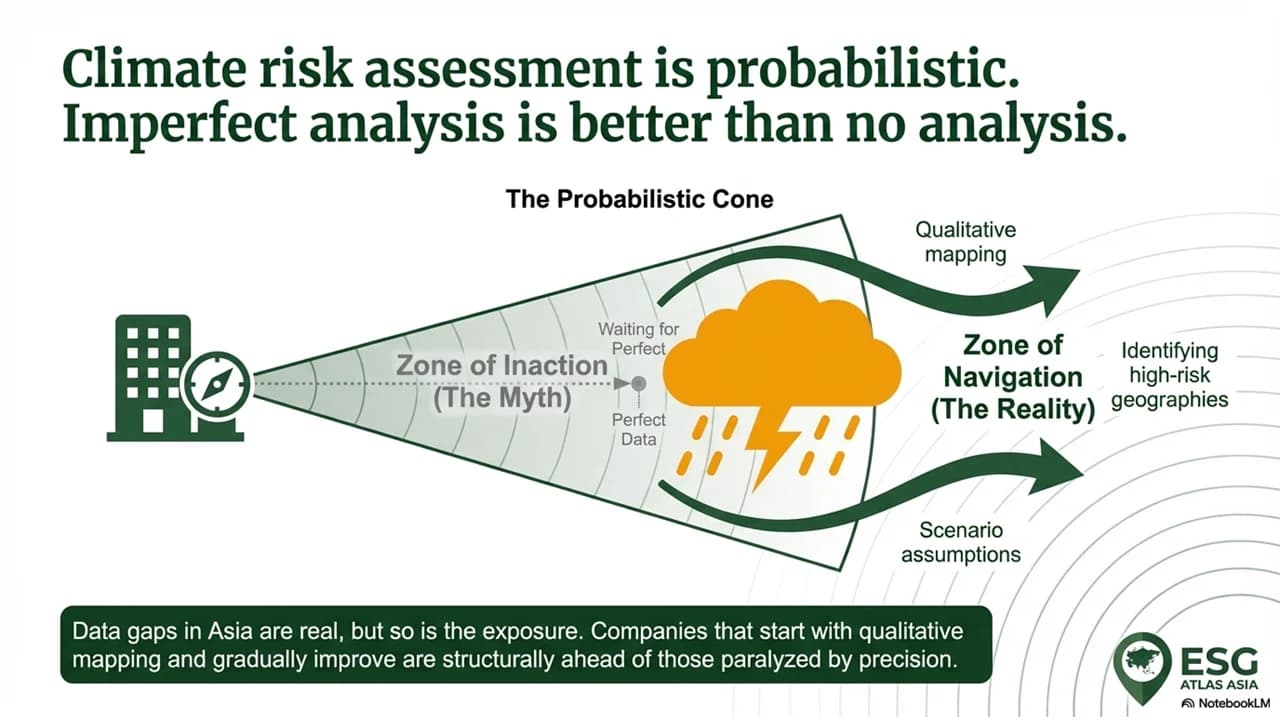
Climate risk assessment is inherently probabilistic, not precise.
Even basic approaches provide value:
- Identifying high-risk geographies
- Mapping exposure across operations
- Using scenario-based assumptions
Waiting for perfect data leads to inaction.
In Asia:
Data gaps are real—but so is risk exposure. Companies that:
- Start with qualitative mapping
- Gradually improve data quality
…are significantly ahead of those that delay.
👉 Imperfect analysis is better than no analysis.
6. “Climate Risk = Environmental Risk Only”
The myth:
Climate risk is purely environmental and does not affect social or governance factors.
The reality:
Climate risk is deeply interconnected with social and governance issues.
Examples:
- Heat stress affects worker productivity and safety
- Flooding disrupts communities and labor availability
- Governance failures lead to poor risk oversight
In Asia:
High population density and labor-intensive industries amplify these impacts:
- Worker welfare becomes a climate issue
- Migration and urban pressure increase
👉 Climate risk is an ESG issue—not just an environmental one.

7. “If It’s Not Regulated Yet, It’s Not Urgent”
The myth:
Companies only need to act when local regulations require it.
The reality:
Markets often move faster than regulation.
Pressure comes from:
- International buyers
- Investors
- Financial institutions
- Global reporting standards
In Asia:
This is especially critical because:
- Many companies are integrated into global supply chains
- External stakeholders often dictate ESG expectations
👉 Waiting for regulation means reacting too late.
8. “Climate Risk Is Too Complex for SMEs”
The myth:
Only large corporations have the resources to assess and manage climate risk.
The reality:
SMEs are often more vulnerable, not less.
They typically have:
- Less diversified supply chains
- Limited financial buffers
- Higher dependency on specific markets or suppliers
Yet, climate risk assessment at SME level can be simple:
- Identify key assets and suppliers
- Map exposure to major hazards
- Understand customer and regulatory expectations
👉 Simplicity does not mean irrelevance—it means prioritization.

References
- UNFCCC – Building the Needs of MSMEs to Engage in Climate Action (Asia)
- C‑TIF – Guidelines for SMEs (Climate Action and Risk Management)
- ESG Sustainability Directory – “How Does Supply Chain Pressure Affect an SME’s Need for Climate Disclosure?”
- Climate Capital Strategies – “From Supply Chains to Sustainable Gains: Engaging SMEs on Sustainability”
- EY – “Generate Strategic Value by Building Climate Resilience”
- PlanA / Climate Risk Academy – “What Is Climate Risk, and How Can Companies Manage It?”
- Integrating Climate Risk into Business Strategy
- UNDP & Generali – Driving MSME Resilience Across Asia
- ScienceDirect – “SMEs respond to climate change: Evidence from developing countries”
- Task Force on Climate‑related Financial Disclosures (TCFD)