
April 30, 2026, marked a historic milestone for China’s capital markets.
For the first time, listed companies subject to China’s new mandatory sustainability disclosure regime submitted ESG reports under the “Self-Disciplinary Guidelines for Listed Companies — Sustainability Reporting,” issued by the Shanghai, Shenzhen, and Beijing Stock Exchanges in 2024.
What regulators called the market’s “first ESG exam” is now complete.
And the results reveal something important:
China’s ESG reporting system is growing fast — but maturity remains deeply uneven.
A Record Number of ESG Reports
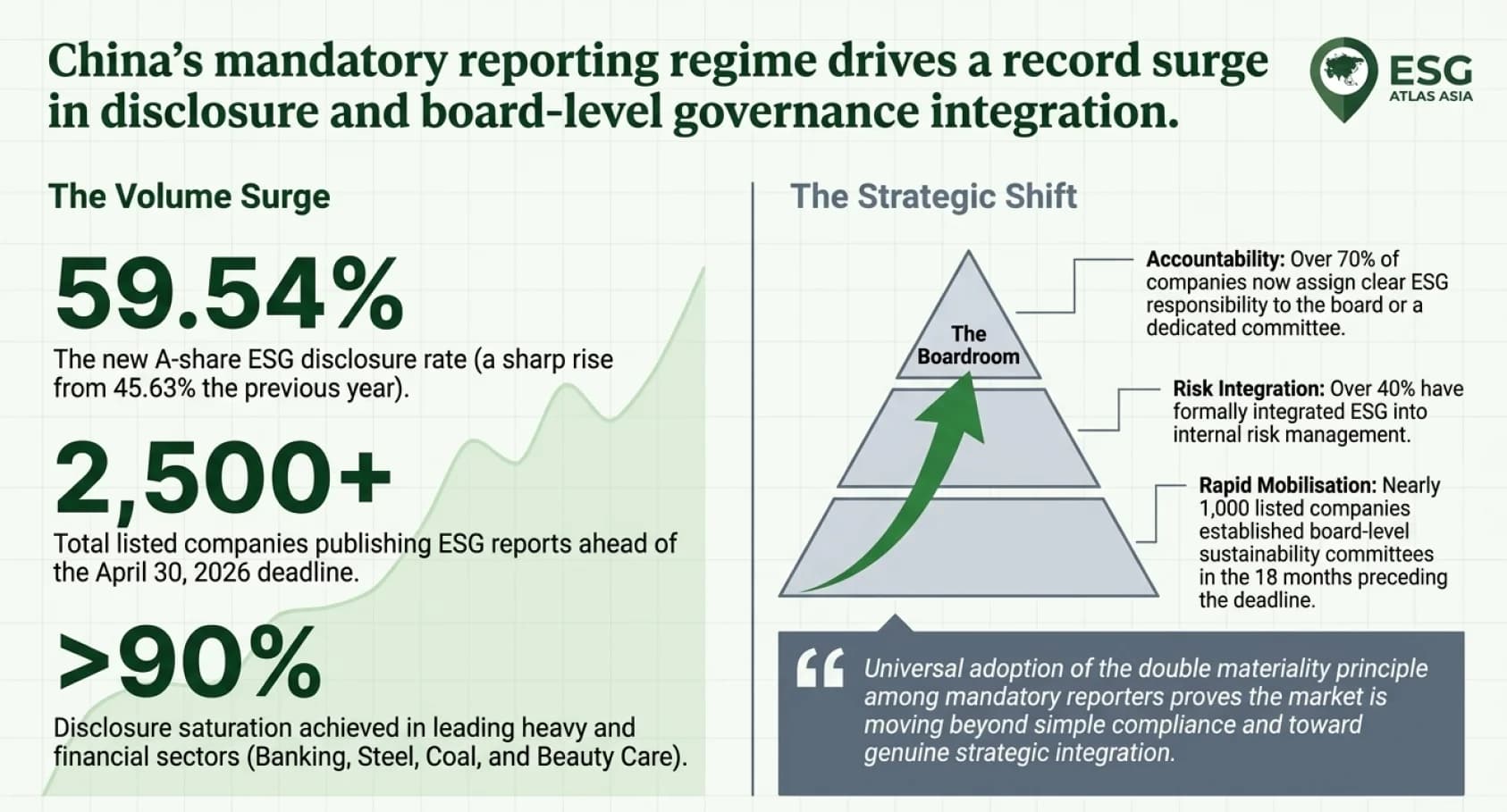
More than 2,500 A-share companies published ESG-related reports before the April 30 deadline, with nearly 200 companies disclosing for the first time.
The overall ESG disclosure rate across the A-share market climbed to 59.54%, up sharply from 45.63% the previous year.
Some sectors moved especially quickly:
- Banking, steel, coal, and beauty care industries recorded disclosure rates above 90%
- Pharmaceuticals, electronics, and machinery sectors produced some of the highest reporting volumes
- Voluntary disclosures also surged as companies increasingly recognise ESG’s growing influence on capital access, customer expectations, and valuation
On the surface, the first reporting cycle looks like a success story.
But underneath the rising disclosure numbers lies a far more complicated reality.
From Compliance to Strategy: Governance Leads the Way
The most notable—and arguably the most transformative—development came under the governance pillar.
- Board-level accountability. Companies with clear responsibility assigned to their board or a dedicated sustainability committee now exceed 70%.
- Governance integration. Over 40% of A-share companies have formally integrated ESG elements into their risk management and internal control systems.
- However, analysts noted that mid- and small-cap companies, particularly private manufacturers, traditional energy firms, and agricultural businesses, still lag considerably, often producing abbreviated reports with weak data comparability.
Behind these figures lies a concrete shift: compulsory disclosure forced companies to move beyond “box‑ticking” compliance and toward genuine strategic integration. Over the 18 months leading up to the deadline, nearly 1,000 listed companies established board‑level sustainability committees. Among mandatory reporters, adoption of the “double materiality” principle—assessing issues from both impact and financial perspectives—was universal. Topics such as supply chain security, energy management, and employee development saw substantially improved information quality, reflecting a more realistic, data‑driven corporate understanding of ESG.
ESG considerations are moving into the boardroom in a much more substantive manner than before. Governance has thus emerged as the indisputable bright spot of the first mandatory reporting cycle.
Environment data problem
Environmental metrics have seen the most regulatory focus, yet quantitative data remains thin. Climate‑related risk and opportunity disclosure reached 62.07 per cent, while greenhouse gas emissions disclosure stood at 65.90 per cent. Scope 1 and Scope 2 emissions were the most frequently reported environmental metrics, largely because they involve direct corporate data.
But the deeper picture is far less encouraging. According to Huazheng Index data:
- Direct emissions (Scope 1) disclosure rate — only approximately 26%
- Indirect energy emissions (Scope 2) — approximately 27%
- Value chain emissions (Scope 3) — a remarkably low 5%
By stark contrast, international CDP statistics indicate disclosure rates of approximately 70 per cent for Scope 1, 50 per cent for Scope 2 and 20 per cent for Scope 3, underscoring the substantial gap A-share companies must close.
The primary obstacle is cost and complexity. Scope 3 involves 15 categories across a company’s full value chain, requiring coordination with suppliers, customers and partners. Research estimates that it took one large Chinese enterprise four years just to complete the necessary data collection. Numerous companies are unable or unwilling to bear those costs. As a result, environmental disclosures frequently rely on broad qualitative language rather than robust quantitative reporting — creating what regulators increasingly describe as “branding-style ESG.”
A further complication is that some environmentally significant disclosures—notably pollutant release categories, total volumes, and compliance status —fall under new 2026 application guidelines covering pollutants, water, and energy, leading to incomplete first-year capture.
Bottom line on E: Regulatory ambition is high, but perhaps moving faster than companies’ actual data infrastructure.

Social: The Weakest Link
If environmental disclosure struggles with data quality, social disclosure struggles with substance itself.Among the three ESG pillars, social reporting remains the least mature.
Many companies continue to frame ESG primarily through philanthropy, volunteerism, and charitable initiatives rather than workforce governance or supply chain accountability.
Nearly 10% of companies that reported in the first cycle continued to title their documents “Social Responsibility Reports” rather than “Sustainability Reports,” emphasising traditional charitable activities and volunteerism. While important, such topics are neither the primary focus of international social disclosure frameworks nor the most decision‑relevant metrics for investors.
Workforce safety data appears, but quality is highly inconsistent. Gender diversity metrics, wage equity statistics, employee retention rates and supply‑chain labour standards are reported with far less regularity. Core employee turnover rates, the proportion of female managers, and grievance resolution for labour rights disputes are listed as exemplary indicators, but these remain the exception rather than the rule.The overall picture is one of broad narrative coverage but weak quantitative rigor and even weaker cross‑company comparability.
A Glaring Weakness: Third‑Party Assurance
Compounding all of the above is an issue that cuts across all three pillars: an absence of independent verification. According to industry data, only approximately 4% of A‑share ESG reports had undergone third‑party assurance as of mid‑2026. Absent independent assurance, much of the quantitative data that is provided remains difficult for investors to trust or compare. This creates a circular problem: investors seek reliable data from ESG reports, but without verification, markets cannot fully incorporate ESG information into valuation and risk management.
Conclusion
The first mandatory ESG reporting cycle in China’s A‑share market produced some genuine achievements. Disclosure volume surpassed expectations, governance structures improved markedly, and the mandatory cohort proved capable of meeting baseline requirements.

Yet the “first exam” also made clear that the gap between regulatory aspiration and corporate reality remains substantial. Governance now leads. Environment follows, but with critical data gaps, especially on Scope 3. Social disclosure trails noticeably, relying too heavily on qualitative philanthropy narratives rather than substantive workforce and supply‑chain metrics. And across all three pillars, the lack of third‑party assurance continues to undermine data credibility.
The next phase of China’s ESG transition will not be defined by whether companies disclose. It will be defined by whether markets trust what they disclose.
China has successfully launched mandatory ESG reporting.
Now comes the harder part: turning disclosure into decision-useful, investment-grade information capable of shaping capital allocation and corporate value creation.
The first train has left the station.
But the system behind it is still under construction.
Reference
- China ESG Regulations Timeline (2003–2030): From Voluntary Disclosure to Mandatory Rules
- A-share mandatory ESG disclosure increases in quantity and quality.
- Shanghai Bourse Unveils New Annexes to Enhance Sustainability Reporting.
- A Look Inside Listed Companies' ESG Reports: Five Major Deviations Behind "Brand Promotion" Disclosures.
- The first mandatory ESG disclosure test for A-shares is underway; how can investors identify promising opportunities?.
- IICF