
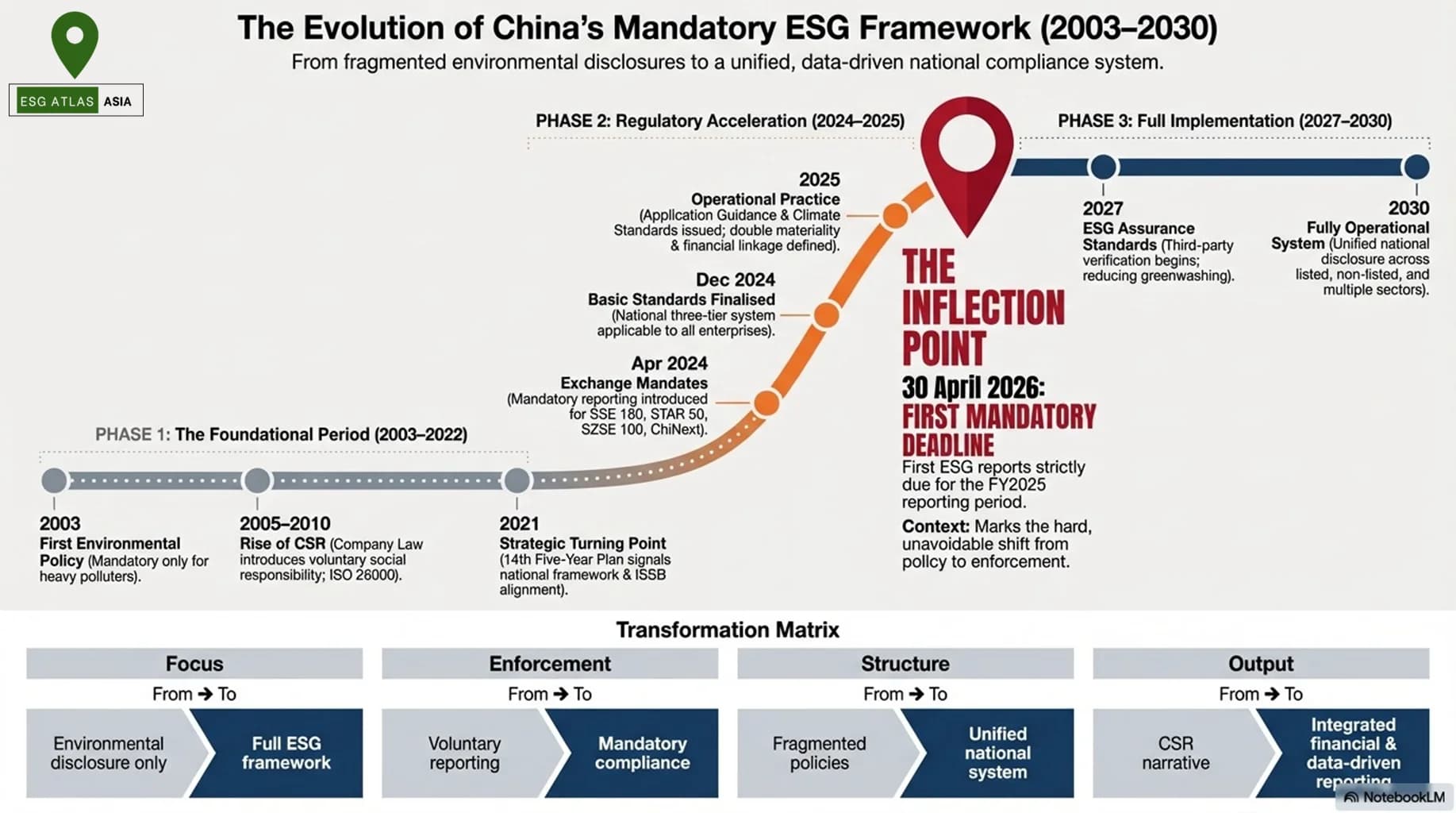
Trace the evolution of ESG regulation in China from voluntary guidelines to mandatory disclosure. A 2030 timeline of key policies shaping China’s ESG landscape.
With the first mandatory sustainability reporting deadline set for April 30, 2026, China’s ESG regulatory transition has reached a critical inflection point. What was once a fragmented, largely voluntary disclosure landscape is now evolving into a structured, top-down system that integrates sustainability into financial reporting, corporate governance, and capital markets.
This transformation has not been linear. Instead, it reflects a deliberate, phased strategy led by regulators, moving from environmental disclosure to a comprehensive ESG framework aligned with global standards—while retaining distinct local characteristics such as double materiality and policy-driven priorities.
This article traces that transition journey across three phases:
- The foundational period (2003–2022)
- The regulatory acceleration (2023–2025)
- The implementation roadmap toward 2030

Phase 1: The Foundational Period (2003–2022)
China’s ESG journey began with a narrow environmental focus before gradually expanding into broader corporate responsibility and, eventually, early sustainability standardization.
2003: The First Step in Environmental Disclosure
China’s first ESG-related policy emerged in 2003 through an Announcement on Corporate Environmental Information Disclosure, issued by the State Environmental Protection Administration. Rather than a comprehensive ESG framework, the policy targeted high-impact polluters and introduced mandatory transparency requirements.
Key features included:
- Mandatory disclosure for heavily polluting enterprises, identified by regulators
- Public reporting on:
- Environmental policies
- Pollutant discharge levels
- Pollution control measures
- Compliance records
- Environmental management practices
- Voluntary disclosure encouraged for other companies
- Enforcement mechanisms, including fines for non-compliance
This marked an important shift: sustainability disclosure became a regulatory expectation, even if limited to environmental performance.
2005–2010: The CSR Era
The late 2000s saw the rise of Corporate Social Responsibility (CSR) as a broader concept within China’s corporate landscape.
A key milestone was the 2005 Company Law, which introduced the requirement for companies to “bear social responsibilities.” However, this remained a principle-based provision, lacking specific metrics, reporting standards, or enforcement mechanisms
During this period, CSR was often interpreted narrowly, typically focusing on:
- Philanthropic contributions
- Basic labor compliance
The release of ISO 26000 in 2010 helped expand awareness to include governance, human rights, and community impact. Still, ESG practices remained fragmented and largely qualitative, without integration into financial or strategic decision-making.
2021: A Strategic Blueprint Emerges
A more structured approach began to take shape in 2021, when the Ministry of Finance included the development of a sustainability reporting system in its 14th Five-Year Plan for accounting reform.
This marked a clear transition toward:
- National standardization of ESG disclosure
- Alignment with international frameworks such as ISSB, aid the ISSB office opening in Beijing in June 2023
The roadmap was implicitly phased:
- 2021-2025: Research, consultation, and international alignment
- 2025-2030: Drafting, piloting, and gradual implementation
This period also strengthened China’s engagement with global standard-setting bodies, laying the groundwork for future convergence.
Phase 2: The Great Acceleration (2023–2025)
After two decades of gradual development, China’s ESG regulatory landscape entered a phase of rapid acceleration. Within a short period, multiple regulatory layers were introduced, transforming ESG from voluntary practice into structured compliance.
Key Milestones (2024–2025)
Timeline | Development |
April 2024 | Stock exchanges issue mandatory ESG reporting rules |
May 2024 | Draft national Basic Standards released |
December 2024 | Final Basic Standards issued (trial) |
September 2025 | Application Guidance released |
December 2025 | Climate disclosure standards issued |
Together, these developments established the foundation of a multi-tier ESG regulatory system.
April, 2024: Exchange-Level Mandates
The first major shift toward mandatory ESG reporting came through stock exchange regulations.
Under the supervision of the China Securities Regulatory Commission, the Shanghai, Shenzhen, and Beijing Stock Exchanges introduced sustainability disclosure guidelines targeting large-cap and dual-listed companies.
Scope of Application
Exchange | Total Listed Companies | Mandatory Coverage |
Shanghai (SSE) | 2,306 | SSE 180, STAR 50 |
Shenzhen (SZSE) | 2,886 | SZSE 100, ChiNext |
Beijing (BSE) | 292 | Various BSE Indices, Phased approach |
Timeline
Companies within these indices must publish their first mandatory sustainability reports for FY2025 by April 30, 2026, while other firms are encouraged to report voluntarily.
Disclosure Framework
The exchange guidelines introduced a structured reporting framework aligned with global practices.
Core pillars:
- Governance
- Strategy
- Impact, Risk, and Opportunity Management
- Metrics and Targets
Key disclosure areas include:
- Environmental: climate, emissions, energy, water, biodiversity
- Social: supply chain, product safety, employee rights, innovation-driven development, rural development (a uniquely Chinese priority)
- Governance: anti-corruption, corporate governance structures
A defining feature is the adoption of double materiality, requiring companies to assess both financial risks and societal/environmental impacts.
May 2024: National-Level Standards
While exchange rules focused on listed companies, the Ministry of Finance moved to establish a broader national framework through the Corporate Sustainability Disclosure Standards – Basic Standards(draft released in May and finalized in December). Its scope was notably broad, intended to eventually apply not just to listed companies but to non-listed and small-to-medium enterprises as well .
This system is designed with a three-tier structure:
- Basic Standards – general principles
- Specific Standards – topic-based requirements
- Application Guidance – implementation details
Key Requirements of the Basic Standards
The Basic Standards introduce a level of rigor comparable to financial reporting.
Core elements include:
- Scope: all enterprises established in China
- Information quality requirements:
- Reliability
- Relevance
- Comparability
- Verifiability
- Timeliness
- Disclosure structure:
- Governance
- Strategy
- Risk and opportunity management
- Metrics and targets
- Value chain reporting: Coverage of upstream and downstream activities
- Double materiality approach
Comparison: China vs Global ESG Frameworks
Feature | MOF Basic Standards | Stock Exchange Guidelines | IFRS S1 |
Scope | All enterprises | Listed companies | Global |
Materiality | Double | Double | Financial only |
Users | Investors + stakeholders | Investors + stakeholders | Investors |
Reporting format | Standalone report | Standalone report | Flexible |
Value chain | Required | Required | Required |
This comparison highlights China’s hybrid approach: globally aligned but locally adapted.
2025: From Principles to Practice
The release of Application Guidance in 2025 by the Ministry of Finance (MOF) and partners, marked a shift toward operationalization. It provides detailed instructions on how companies should implement ESG reporting requirements.
Key areas include:
- Materiality assessment
- Topic identification
- Financial risk assessment (likelihood and financial impact).
- Impact assessment (scale, scope, irremediability, and likelihood of impacts on society/environment)
- Integration of results
- Basic users
- Although, it recognizes other stakeholders, the guide prioritizes investors and creditors a basic users.
- Financial linkage: Connecting ESG metrics to financial decision thru
- Quantitative linkages: How sustainability data connects to assets, liabilities, revenue, and expenses in financial statements .
- Qualitative linkages: How strategy, metrics, and targets affect financial planning .
- Scenario analysis:
- Provide guidance to evaluating resilience under different sustainability scenarios with five-step methodology :
- Identify sustainability risks
- Define scenarios
- Assess financial impact
- Adjust operational and financial assumptions
- Assess impact on enterprise value
- Proportionality principle:
- Allowing flexibility based on company size and capacity
December 2025: Climate Standards
China’s first climate-specific disclosure standard, issued in December 2025 by MOF and partners, represents a major step toward topic-specific ESG regulation. As of now, it is a voluntary, trial implementation standard.
While broadly aligned with the international framework's structure of four pillars: Governance, Strategy, Risk and Opportunity, Metrics and Targets, this standard has one more requirement about Impact dimension, which reflects China’s double materiality approach.
Comparison with IFRS S2
The standard is generally aligned with IFRS S2 to ensure international comparability, which helps lower cross-border financing costs . However, it has distinct local adaptations:
Feature | China Climate Standard (No. 1) | IFRS S2 |
Materiality | Double Materiality | Financial Materiality |
Scenario Analysis | Mandatory, with a phased approach from qualitative to quantitative. Must consider scenarios consistent with China's Nationally Determined Contributions (NDCs) | Encouraged, aligned with Paris Agreement goals |
Development Path | Part of a planned national system; sector-specific application guides are already in development | Global baseline standard |
Phase 3: The Road to 2030
With the regulatory framework largely in place, the focus is now shifting to implementation and enforcement.
2026: The First Mandatory Deadline
The April 30, 2026 deadline represents the first real test of China’s ESG system.
Companies must:
- Publish sustainability reports for FY2025
- Demonstrate readiness in data, governance, and processes
This will set the baseline for future regulatory tightening.
2027–2030: Expansion and Assurance
China’s roadmap outlines a clear path toward a fully mature ESG system.
Milestone | Target |
By 2027 | Introduction of ESG assurance standards |
By 2030 | Fully operational national ESG system |
The introduction of assurance standards will be particularly significant, as it will:
- Enable third-party verification
- Improve data credibility
- Reduce greenwashing risks
Implications for Enterprises
This marks a pivotal moment for ESG in China, and companies must prepare now as regulatory requirements and enforcement are set to become increasingly stringent.
Timeline | Action Required |
2026 | First mandatory reports due April 30 (for 2025 fiscal year) |
2027 | Prepare for Assurance Standards (third-party verification) |
2027-2030 | Strengthen data systems, internal controls, and governance structures |
2030 | Full compliance with unified national system expected |
Conclusion: ESG as a Regulatory and Financial Imperative
China’s ESG evolution reflects a highly coordinated, top-down approach that combines regulatory mandates, financial integration, and global alignment.
As the 2026 deadline approaches, ESG is no longer a voluntary or reputational tool.
For companies, this shift demands stronger internal systems, clearer governance structures, and deeper integration of sustainability into strategy. For investors and stakeholders, it signals a new era of transparency and comparability in one of the world’s most important markets.
The coming years will determine how effectively this ambitious framework translates into real-world impact—but one thing is clear: China’s ESG transition is no longer about whether to act, but how quickly companies can adapt.