
For decades, international trade relied on a simple mechanism: products moved physically across borders while documentation followed on flat sheets of paper or siloed PDFs. However, a major regulatory shift is changing how global supply chains operate. In July 2026, the European Commission is scheduled to launch its centralized Digital Product Passport (DPP) Registry, under the Ecodesign for Sustainable Products Regulation (ESPR). This registry serves as the core verification gateway for international trade; any covered product entering the EU must be logged here via its Unique Product Identifier.
This infrastructure launch directly precedes the First Wave of enforcement hitting in February 2027. This initial wave mandates that all industrial, electric vehicle (EV), and light-transport batteries over 2 kWh carry a functional, QR-code-accessible passport. Simultaneously, finalized rules for high-impact consumer goods like textiles, apparel, and iron/steel are locking in, with market surveillance penalties beginning shortly after.
For manufacturers and exporters across Asia - the world's factory floor - this sequence means that data readiness is now an immediate prerequisite for market access.
What is the EU Digital Product Passport?
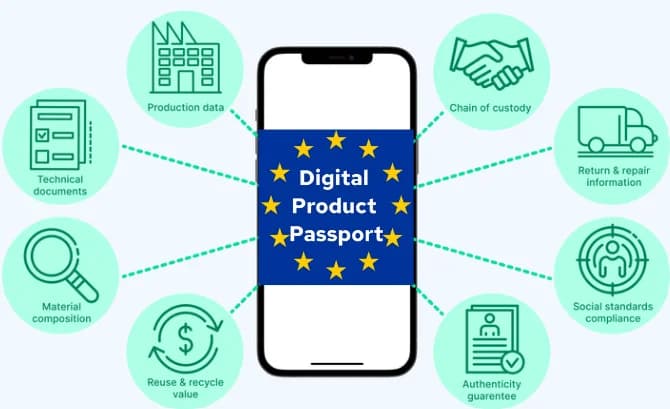
The DPP is a machine-readable digital profile linked to a physical item via a data carrier like a QR code, RFID chip, or NFC tag. It does not exist as a single, static file stored on an EU server, instead, it operates on a decentralized data architecture: the EU registry hosts the identity keys and lookup compliance logs, while the actual, granular lifecycle data is securely hosted by the manufacturers.
Rather than focusing merely on corporate-level sustainability pledges, the EU is making product-level transparency a mandatory condition for entering its single market.
Core Data Categories Included in a DPP:

- Traceability & Identification: Unique Product Identifiers (UIDs), Global Trade Identification Numbers (GTINs), and verified economic operator data.
- Material Composition: A granular breakdown of raw materials, recycled content percentages, and the presence of any "substances of concern" (hazardous chemicals).
- Environmental Performance: Verifiable data on the product’s carbon footprint, energy efficiency, and resource consumption.
- Circularity & Longevity: Clear, accessible repairability scores, maintenance manuals, availability of spare parts, and step-by-step disassembly guidelines for recycling plants.
The Phased Rollout Timeline: 2026 to 2030
The regulatory timeline has shifted from an abstract target to a rigid deployment schedule:
Timeline | Milestone / Affected Categories | Requirements & Impact |
July 2026 | Central DPP Registry Goes Live | System open for identifier registration; automated customs integration begins setup. |
February 2027 | The First Wave: Industrial & EV Batteries | Mandatory QR passports containing battery chemistry, capacity, and recycled lithium/cobalt metrics. |
Late 2027 / 2028 | Textiles, Apparel, and Apparel Destruction Ban | Every garment must disclose fiber down to 1% weight; large-scale destruction of unsold apparel is banned. |
2028 – 2029 | Electronics, Tyres, and Furniture | Hardware requires repairability indices, component mapping, and disassembly manuals. |
The Strategic Link to the Asian Market
Because the EU is a leading consumer market globally, its internal environmental policies historically drive global standards. Since the DPP applies to all products sold within the EU regardless of where they are manufactured, Asian suppliers must adapt or face exclusion at the border.
The introduction of the passport creates three structural shifts across Asian economies:
1. Upstream Supply Chain Radical Transparency
Asia's manufacturing strengths, spanning electronics in Taiwan and South Korea, textiles in Bangladesh and Vietnam, and heavy machinery in China, rely on deeply complex, multi-tiered supply chains.
The DPP effectively forces Asian Tier-1 manufacturers to audit their own upstream component suppliers.If a Vietnamese garment exporter cannot verify the exact chemical dye used by a fabric mill, or if a tech manufacturer cannot map the origin of its recycled aluminum, the final product cannot generate a valid DPP. This shift requires moving away from siloed data spreadsheets toward integrated, secure digital infrastructure like blockchain or federated cloud systems.
2. A Shift in Competitive Advantage
Historically, Asian manufacturing maintained a competitive edge primarily through cost efficiency, speed, and volume. The DPP adds a fourth pillar: data readiness.
Companies that proactively digitize their supply chains will gain market share. Conversely, manufacturers that delay compliance face significant financial risks, including border friction, customs delays, and potential bans from the EU market.
3. Accelerated Green Transformation in Asia
To meet EU requirements, major Asian companies and governments are accelerating their own domestic sustainability initiatives. We are already seeing:
- Policy Convergence: Asian economies are exploring domestic data tracing programs to maintain export parity.
- Investments in Traceability Tech: Increased venture capital and corporate spending on IoT tracking, digital twins, and industrial software platforms across industrial zones in Shenzhen, Tokyo, and Singapore.
- Green Energy Demands: To lower the product carbon footprint stored on the DPP, Asian factories are pressuring local grids for faster access to renewable energy options.
Action Plan: How Asian Exporters Must Prepare
The shift from a linear economy to a data-driven circular framework requires early structural changes. Asian economic operators should focus on three immediate areas:
1. Conduct a Portfolio & Scope Audit: Immediate Focus.
Map out all product lines exported to Europe against the EU’s timeline. Identify which items fall under early waves (e.g., textiles, steel, electronics) and note when compliance becomes legally binding.
2. Engage and Standardize Upstream Suppliers: Next 6-9 Months.
Collaborate with raw material and component vendors across the region. Standardize data collection metrics, such as carbon accounting methodologies and chemical disclosures, to match EU requirements.
3. Upgrade to Interoperable Digital Infrastructure: Next 9–12 Months.
Transition away from static PDF certifications. Implement digital data systems capable of outputting structured, machine-readable formats (like JSON or XML) that integrate smoothly with Europe's centralized DPP registry.
Conclusion
The EU Digital Product Passport is more than a new compliance requirement; it is a fundamental shift in how global commerce values material transparency. For the Asian market, the DPP presents an inflection point. While the initial capital and operational investments to build these data pipelines are substantial, the transition offers a clear path forward. By treating product data as an essential component of the physical asset, forward-looking Asian enterprises can secure long-term access to premium global markets.
Reference
2. EU’s Digital Product Passport: What It Is, Which Products It Affects, and How to Prepare
3. Asuene
4. EU Digital Product Passport: Complete Guide 2026–2030