
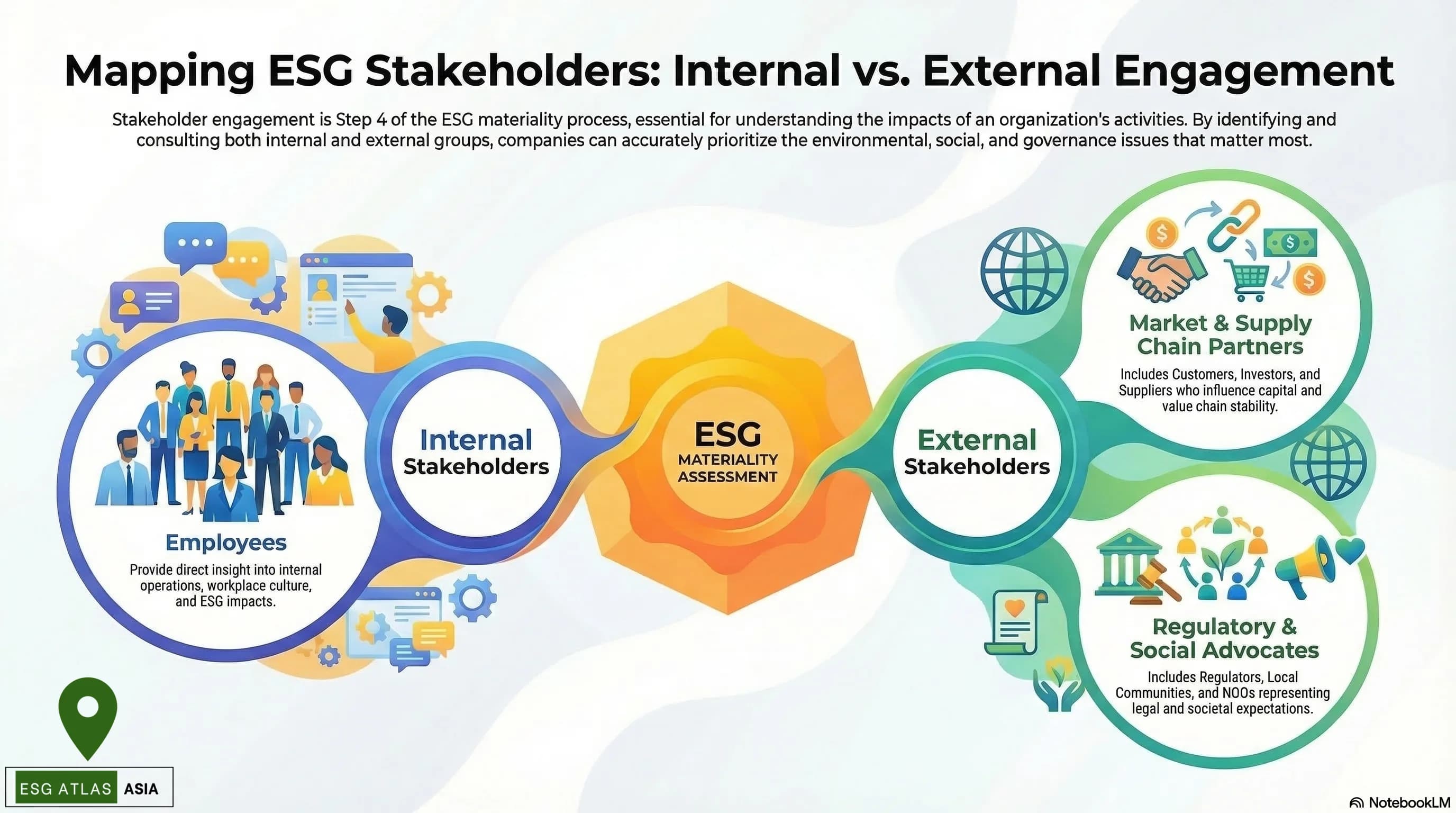
This article introduces the first step in a five-step stakeholder engagement process within an ESG materiality assessment, focusing on understanding stakeholders and their role in shaping material ESG issues.
Stakeholders play a central role in ESG materiality assessments. Their perspectives help organizations understand which environmental, social, and governance issues are most important to the people affected by the company’s operations.
This article marks the first step in a five-step stakeholder engagement process within an ESG materiality assessment: understanding, identifying, prioritizing, selecting, and engaging.
- Understanding → What are stakeholders?
- Identifying → Who are your stakeholders?
- Prioritizing → Which stakeholders matter most?
- Selecting → How to engage each group?
- Engaging → How to execute and collect insights?
A stakeholder is any individual or group that can influence, or is influenced by, an organization’s activities, decisions, or performance.
Stakeholders typically fall into two main categories:
- Internal stakeholders – individuals or groups within the organization who influence operations and decision-making.
- External stakeholders – individuals or groups outside the organization who are affected by the company’s activities or have an interest in its performance.
Understanding the expectations and concerns of different stakeholder groups helps companies identify the ESG issues that truly matter.
Key Stakeholder Groups in ESG Materiality Assessments
Organizations typically engage a range of stakeholders when conducting a materiality assessment.
Common stakeholder groups include:
- Employees
- Customers
- Investors
- Suppliers
- Regulators
- Local communities
- Non-governmental organizations (NGOs)

Image: ESG Atlas Asia
Each group interacts with the organization in a different way, which means their expectations and priorities often differ.
How Stakeholder Expectations Differ
Different stakeholders assess ESG performance from different perspectives based on how they interact with the organization and how its activities affect them. Understanding these perspectives helps companies identify sustainability issues that are truly significant and ensures that material topics reflect both business realities and stakeholder expectations.
It is also important to recognize that stakeholder groups may vary depending on the organization’s industry, operations, and geographic context. Different types of companies interact with different groups of people, which means their stakeholder landscape may not be the same.
For example, a manufacturing company may need to engage closely with factory employees, suppliers, regulators, and local communities affected by its operations. In contrast, a technology company may focus more on employees, customers, investors, and digital rights organizations, particularly around issues such as data privacy and cybersecurity.
Because of these differences, organizations should avoid relying on a generic stakeholder list and instead identify stakeholders based on their specific business activities, value chain relationships, and potential environmental or social impacts.
Employees
Employees are one of the most important internal stakeholder groups in an ESG materiality assessment because they experience the company’s policies, culture, and management practices on a daily basis. Their perspectives often provide valuable insight into workplace conditions, organizational values, and how sustainability commitments are implemented in practice.
Employees are typically most concerned with ESG issues that directly affect their working environment, career development, and overall wellbeing. Common priorities include:
- Workplace health and safety Safe working conditions, accident prevention, and occupational health protections are critical concerns, particularly in industries such as mining, manufacturing, construction, and logistics where physical risks may be higher.
- Fair compensation and benefits Employees often evaluate whether wages, benefits, and incentives are fair and competitive. This may also include concerns about pay equity, living wages, and financial security.
- Diversity, equity, and inclusion (DEI) Many employees expect organizations to foster inclusive workplaces that promote equal opportunities regardless of gender, ethnicity, age, or background. Issues such as representation in leadership and anti-discrimination policies often receive strong attention.
- Career development and training Opportunities for professional growth, skills development, and internal mobility are important for long-term employee engagement and retention.
- Employee wellbeing and work-life balance Modern workplaces increasingly focus on mental health support, flexible work arrangements, and policies that help employees balance professional and personal responsibilities.
Beyond these issues, employees may also raise concerns about organizational culture, ethical leadership, transparency, and the company’s broader social and environmental commitments. In many organizations, employees want to feel that their work contributes to a company that acts responsibly toward society and the environment.
Example
Employees in a manufacturing company may prioritize workplace safety, accident prevention, and compliance with occupational health standards, as these issues directly affect their daily working conditions.
In contrast, employees in a professional service company may place greater emphasis on work-life balance, flexible working arrangements, career development opportunities, and inclusive workplace culture.
Customers
Customers are a key external stakeholder group because their purchasing decisions directly influence a company’s revenue and market reputation. In recent years, customer expectations have expanded beyond product price and quality to include how products are produced, sourced, and managed throughout their life cycle. As a result, many customers now evaluate companies based on environmental responsibility, ethical business practices, and transparency.
From an ESG perspective, customers are often concerned with whether the products or services they purchase are safe, responsibly produced, and aligned with their values. Their priorities typically include:
- Product safety and quality Customers expect products to meet high safety standards and perform reliably. This includes compliance with safety regulations, product testing, and clear labeling of ingredients or materials.
- Responsible sourcing and ethical production Increasingly, customers want to know whether products are produced in ways that respect human and labor rights and environmental standards. This may involve concerns about supply chain transparency, fair labor practices, human rights issues and responsible sourcing of raw materials.
- Environmental impact of products Many consumers are paying closer attention to the environmental footprint of the products they use. This includes issues such as carbon emissions during production, sustainable packaging, recyclability, and the overall life-cycle impact of products.
- Data privacy and cybersecurity For companies that provide digital products or services, customers are highly sensitive to how their personal information is collected, stored, and protected. Strong data governance and cybersecurity practices are therefore critical components of customer trust.
Customer priorities can also vary significantly depending on the industry and product type. In some sectors, environmental concerns may dominate, while in others, safety or privacy may be the primary issue.
Example
Customers purchasing consumer electronics may be particularly concerned about issues such as electronic waste, product durability, and the responsible sourcing of minerals used in components. Durable and repairable products can reduce waste and signal responsible design practices.
In contrast, customers purchasing food products may focus more on food safety, ingredient transparency, sustainable sourcing of agricultural materials, and the environmental impact of packaging. Labels related to organic production, fair trade, or sustainable agriculture can strongly influence purchasing decisions.
Investors
Investors are a critical stakeholder group because they evaluate ESG performance in relation to financial risk, long-term value creation, and corporate resilience. As capital providers, investors are increasingly integrating ESG factors into their investment decisions to assess whether a company is well-positioned to manage emerging sustainability risks and opportunities.
In recent years, many institutional investors have adopted ESG-focused investment strategies and stewardship practices. This means they actively engage with companies to encourage better management of environmental and social risks, stronger governance practices, and more transparent sustainability disclosures.
From an ESG perspective, investors often focus on issues that could influence a company’s financial stability, regulatory exposure, and long-term competitiveness. Key priorities typically include:
- Climate-related risks and transition strategies Investors increasingly assess how companies manage both physical climate risks and transition risks associated with new climate regulations, carbon pricing, or shifts toward low-carbon technologies. Companies that fail to adapt may face higher operating costs, stranded assets, or declining market demand.
- Regulatory compliance and policy exposure Investors closely monitor how companies respond to evolving environmental and social regulations. Non-compliance with regulations related to emissions, labor practices, or product safety can result in fines, legal liabilities, or reputational damage.
- Corporate governance and leadership oversight Strong governance structures are essential for ensuring accountability and effective risk management. Investors often evaluate board independence, executive compensation alignment, anti-corruption policies, and how sustainability issues are integrated into strategic decision-making.
- Transparency and ESG disclosure Investors rely on consistent and comparable ESG data to assess performance. Clear reporting on sustainability metrics, risk management practices, and long-term strategy helps investors evaluate whether a company is managing ESG risks effectively.
- Long-term business resilience and strategy Investors want to understand whether a company’s business model can remain competitive in a rapidly changing economic and regulatory landscape. This includes evaluating innovation, resource efficiency, supply chain stability, and adaptation to sustainability trends.
Suppliers and Business Partners
Suppliers and business partners are important stakeholders because they form a critical part of a company’s value chain. Many environmental and social impacts occur outside a company’s direct operations, particularly in upstream supply chains where raw materials are sourced, products are manufactured, or services are provided.
As a result, companies increasingly work with suppliers to ensure that sustainability standards are upheld throughout the value chain. Suppliers are therefore both contributors to ESG risks and key partners in improving sustainability performance.
From an ESG perspective, suppliers and business partners often focus on issues related to fair business relationships, operational standards, and compliance with sustainability requirements. Common concerns include:
- Responsible procurement practices Suppliers expect procurement processes to be transparent and fair. This includes clear supplier selection criteria, ethical sourcing policies, and responsible purchasing practices that avoid exploitative pricing or unrealistic production timelines.
- Fair contract terms and long-term partnerships Stable contracts, timely payments, and reasonable contractual obligations are important for suppliers to operate sustainably. Unfair contract terms or sudden order cancellations can create financial pressure that may lead to poor labor practices or environmental shortcuts.
- Labor practices within supply chains Suppliers are often expected to comply with labor standards related to wages, working hours, worker safety, and freedom of association. Companies may require suppliers to follow codes of conduct or international labor standards to reduce risks such as forced labor, child labor, or unsafe working conditions.
- Environmental standards and compliance Many companies require suppliers to manage environmental impacts such as emissions, waste, water use, and chemical management. Increasingly, companies also encourage suppliers to adopt energy-efficient processes and reduce greenhouse gas emissions.
In many industries, companies implement supplier codes of conduct, sustainability audits, and responsible sourcing policies to ensure that ESG standards are upheld across the supply chain.
Regulators and Government Authorities
Regulators and government authorities are key stakeholders because they establish and enforce the legal and policy frameworks within which companies operate. Their primary role is to ensure that organizations comply with laws, regulations, and industry standards designed to protect the environment, workers, consumers, and the broader public.
From an ESG perspective, regulators focus on whether companies are operating responsibly and in accordance with applicable rules. Failure to comply with regulatory requirements can lead to fines, legal liabilities, operational restrictions, or reputational damage. As sustainability regulations continue to evolve globally, regulatory expectations have become an increasingly important factor in ESG management and reporting.
Regulators typically prioritize issues related to legal compliance, risk management, and transparency. Key areas of focus often include:
- Environmental compliance Authorities monitor whether companies follow regulations related to emissions, pollution control, waste management, resource use, and environmental protection. Companies may also be required to conduct environmental impact assessments before starting major projects.
- Labor standards and worker protections Governments enforce labor laws related to minimum wages, working hours, workplace safety, and employee rights. Compliance with occupational health and safety regulations is particularly important in industries with higher operational risks.
- Corporate governance and accountability Regulators may establish rules related to corporate governance, including board responsibilities, anti-corruption measures, and financial transparency to ensure that companies operate with accountability and integrity.
- Transparency and reporting requirements Many jurisdictions increasingly require companies to disclose ESG-related information, such as sustainability reports, climate-related risks, or supply chain practices. These disclosures help regulators and investors monitor corporate performance and risk exposure.
Regulatory expectations can vary significantly depending on the industry, jurisdiction, and regulatory environment in which a company operates. Companies operating across multiple countries often need to comply with different ESG regulations in each market.
Local Communities
Local communities are an important stakeholder group because they are often directly affected by a company’s operations, infrastructure, and environmental footprint. Communities located near manufacturing plants, mining sites, energy facilities, or large infrastructure projects may experience both positive and negative impacts from business activities.
From an ESG perspective, community stakeholders are typically concerned with how a company’s operations affect local environmental conditions, public health, economic opportunities, and overall quality of life. Their perspectives are particularly important when assessing the social and environmental impacts of large-scale operations.
Common areas of concern for local communities include:
- Air and water quality Communities may be concerned about pollution from industrial emissions, wastewater discharge, or chemical use that could affect air quality, drinking water sources, and public health.
- Land use and biodiversity Large infrastructure projects, mining activities, or agricultural expansion may alter landscapes, affect local ecosystems, or disrupt biodiversity. Communities may expect companies to minimize environmental damage and restore land after operations end.
- Employment opportunities and local economic benefits Many communities expect companies operating in their region to create jobs, support local suppliers, and contribute to economic development. Fair hiring practices and opportunities for local workers are often key priorities.
- Community wellbeing and development Companies may be expected to support local infrastructure, education, healthcare, or community initiatives. Community engagement and transparent communication are important for maintaining trust.
Community concerns can vary depending on the type of industry and the scale of operations. Companies operating in resource-intensive sectors, such as mining, energy, agriculture, or manufacturing, often have particularly strong relationships with nearby communities due to the potential environmental and social impacts of their activities.
Non-Governmental Organizations (NGOs)
NGOs are important external stakeholders because they often advocate for environmental protection, human rights, and social accountability. Unlike other stakeholders who may be directly involved in business transactions with the company, NGOs typically represent broader societal interests and work to ensure that corporate activities do not harm people or the environment.
NGOs often conduct independent research, public campaigns, and policy advocacy related to corporate sustainability practices. As a result, they can influence public perception, regulatory discussions, and investor expectations. Companies may engage with NGOs during materiality assessments to better understand emerging sustainability risks and societal concerns.
From an ESG perspective, NGOs often focus on the long-term environmental and social impacts of corporate activities, including issues that may not be immediately visible in financial performance but have significant implications for society and ecosystems.
Common areas of focus include:
- Climate change mitigation NGOs frequently evaluate companies’ greenhouse gas emissions, climate strategies, and commitments to transition toward low-carbon operations.
- Human rights protection Many NGOs monitor labor conditions, worker rights, and the treatment of vulnerable populations within corporate supply chains.
- Biodiversity conservation and ecosystem protection Organizations focused on environmental protection often assess how corporate activities affect forests, wildlife habitats, and natural ecosystems.
- Ethical and transparent supply chains NGOs may investigate sourcing practices to identify risks related to forced labor, child labor, deforestation, or other environmental and social harms linked to supply chains.
Because NGOs often work with communities, researchers, and policymakers, they can provide valuable insights into systemic sustainability challenges and emerging ESG expectations.
Why Stakeholder Engagement Matters
Engaging a diverse group of stakeholders helps organizations:
- identify ESG risks and opportunities that internal teams may overlook
- understand societal expectations and emerging sustainability trends
- strengthen transparency and trust with stakeholders
- improve the credibility of ESG reporting
For this reason, stakeholder engagement is a core step in ESG materiality assessments.
Organizations typically collect stakeholder input through surveys, interviews, focus groups, or workshops.
The survey template below provides a structured way to collect stakeholder feedback on ESG topics and identify which issues are most important - DOWNLOAD
This is the first step in the stakeholder engagement process. Next, learn how to identify the right stakeholders for your organization - Identify Stakeholders
References
- McKinsey – Consumers care about sustainability and back it up with their wallets
- Forbes – Consumers demand sustainable products and shopping formats
- QUICK Corp – ESG Investment Survey 2025