
This article is the final part of a 4-part series on stakeholders engagement for an ESG materiality assessment. Following stakeholder identification in Part 3, this article focuses on how to select stakeholders and choose effective engagement methods.
After identifying and prioritizing stakeholders, organizations move to select a representative subset of stakeholders to actively participate in the materiality assessment.
This step is critical: it translates analysis into real stakeholder input, directly shaping which ESG issues are ultimately considered material.
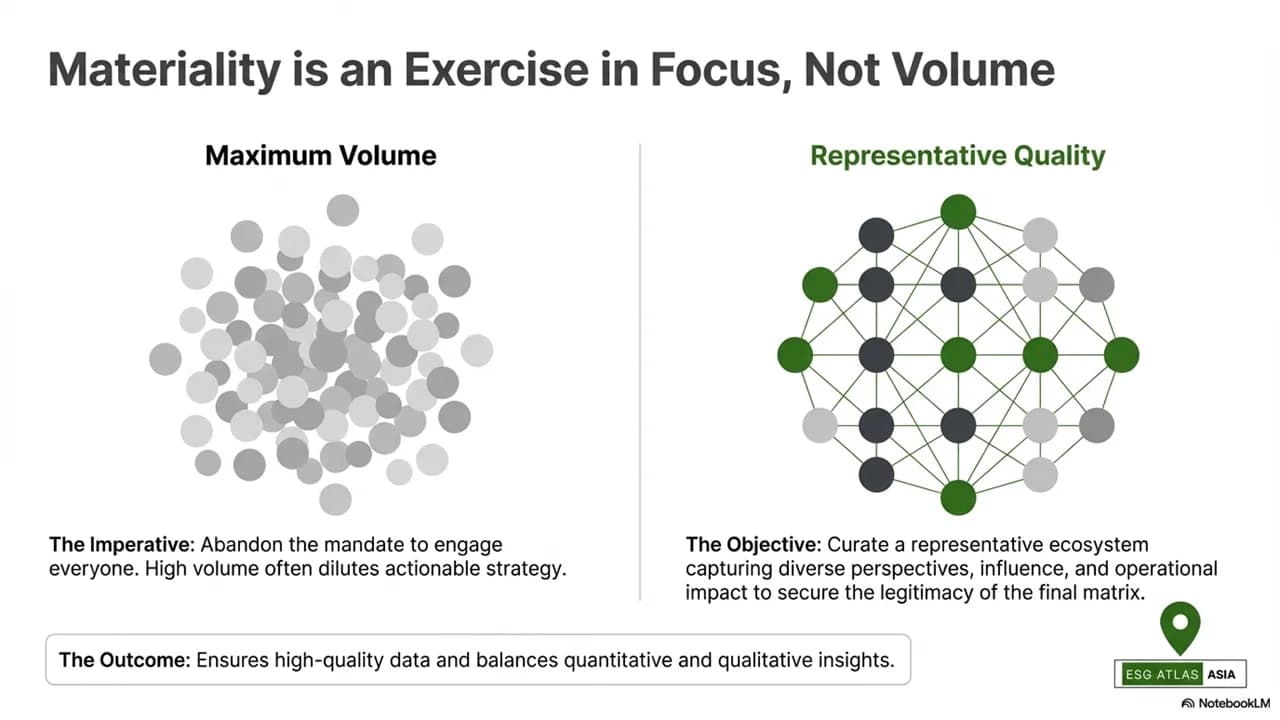
The objective is not to engage as many stakeholders as possible, but to ensure that the selected group:
- Reflects the diversity of perspectives across the stakeholder ecosystem
- Captures both influence and impact
- Balances strategic, operational, and societal viewpoints
Two critical decisions must be made:
- Who to engage→ stakeholder selection
- How to engage them → engagement methods
These decisions directly influence:
- The quality of data collected
- The balance between quantitative and qualitative insights
- The legitimacy of the final materiality outcomes
STEP 3: SELECT STAKEHOLDERS FOR ENGAGEMENT
Stakeholder prioritization identifies who matters most. Stakeholder selection determines who actually participates.
This is a crucial distinction.
The goal is not to engage all stakeholders, but to create a representative and balanced sample that captures:
- Different perspectives
- Different levels of influence
- Different types of ESG exposure
Core Principle: Balance Across Four Dimensions
1. Internal Perspectives
Stakeholders with direct visibility into operations and decision-making.
- Provide insight into feasibility, internal risks, and implementation challenges
- Help validate whether ESG priorities are operationally realistic
Typical participants:
- Senior management (strategy, risk, sustainability)
- Operational managers (plant, supply chain)
- HR and compliance teams
2. Market Perspectives
Stakeholders who shape or respond to the organization’s market positioning.
- Reflect commercial expectations and financial materiality
- Increasingly drive ESG performance through purchasing and capital allocation decisions
Typical participants:
- Key customers (B2B clients or major buyers)
- Retail consumers (for B2C companies)
- Institutional investors and ESG analysts
Markets increasingly reward or penalize ESG performance.
3. Value Chain Perspectives
Stakeholders embedded in the organization’s upstream and downstream activities.
- Provide insight into supply chain risks, dependencies, and ESG performance beyond direct operations
- Critical for identifying Scope 3 emissions, sourcing risks, and operational bottlenecks
Typical participants:
- Strategic suppliers (Tier 1 and, where relevant, Tier 2)
- Manufacturing or logistics partners
- Distributors
4. Societal Perspectives
Stakeholders representing broader environmental and social interests.
- Ensure that the assessment reflects external impacts, not just business priorities
- Often highlight underrepresented or long-term ESG risks
Typical participants:
- Local community representatives (e.g., leaders, affected residents)
- Non-governmental organizations (NGOs)
- Academic or subject-matter experts

Example: Stakeholder Selection Framework
Stakeholder Group | Example Participants | Rationale for Inclusion |
Employees | Plant managers, engineers, HR leads | Operational insight, internal risks |
Customers | Key international buyers, major clients | ESG requirements, market expectations |
Investors | Institutional investors, ESG analysts | Capital allocation, governance expectations |
Suppliers | Strategic Tier 1 suppliers | Supply chain risks, dependency |
Communities | Local leaders near operations | Direct environmental and social impact |
NGOs / Experts | Environmental NGOs, labor experts | Independent perspective, ESG expertise |
Determining the Right Number of Participants
There is no fixed rule for stakeholder sample size.
The focus should be on quality over quantity:
- Selecting informed and representative participants
- Ensuring diversity within each stakeholder group (e.g., not only senior voices)
STEP 4: CHOOSE ENGAGEMENT METHODS
Why Method Selection Matters
The same stakeholder can produce very different insights depending on how they are engaged.
For example:
- A survey may show “climate is important”
- An interview may reveal why and how it affects decisions
This is not a one-size-fits-all decision. Different stakeholders require different engagement methods depending on:
- The type of insight needed (quantitative vs. qualitative)
- Stakeholder availability and accessibility
- Level of expertise or familiarity with ESG topics
- Sensitivity or complexity of the issues being discussed
A well-designed engagement approach typically combines multiple methods to ensure both breadth (coverage across stakeholders) and depth (quality of insights).
COMPARISON OF CORE ENGAGEMENT METHODS

Combining Methods: The Hybrid Approach
Leading practice is to combine multiple engagement methods to balance:
- Breadth → Surveys provide wide coverage and quantitative scoring
- Depth → Interviews and focus groups provide context and explanation
- Validation → Workshops ensure alignment and credibility
Typical approach:
- Survey → Identify initial ESG priorities across stakeholders
- Interviews / Focus groups → Deepen understanding of key issues
- Workshop → Validate and finalize material topics

Advanced Considerations (What Differentiates Strong Engagement Design)
1. Tailoring Methods to ESG Maturity
- Early-stage organizations → heavier reliance on surveys
- Mature organizations → more workshops and multi-stakeholder dialogues
2. Managing Bias and Representation
- Ensure balanced participation across stakeholder groups
- Avoid over-representation of high-influence stakeholders
3. Designing for Data Integration
- Align survey questions and interview guides to ensure:
- Comparability across inputs
- Smooth integration into scoring and materiality matrices
4. Accessibility and Inclusivity
- Adapt methods for stakeholders with limited access:
- Offline surveys
- Local-language interviews
- Community-based discussions
DETAILED APPLIED EXAMPLE
Company: GreenTech Manufacturing Vietnam (GTMV)
(Continuing example from part 3 - see HERE)
Step 3: Stakeholder Selection
Final Selected Participants
Group | Participants | Rationale |
Employees | 50 survey respondents + 2 focus groups | Operational insights |
Management | 6 interviews | Strategy and risk |
Customers | 3 global buyers | ESG requirements |
Investors | 2 institutional investors | Capital perspective |
Suppliers | 20 survey respondents | Supply chain risks |
Communities | 2 focus groups (local leaders, residents) | Direct impact |
NGOs | 3 interviews | Expertise |
Step 4: Engagement Design
Phase 1: Survey
Target Groups:
- Employees
- Suppliers
- Customers
Content:
- Rate 15 ESG topics (1–5 scale)
- Topics include:
- Labor conditions
- Emissions
- Waste management
- Supply chain transparency
Phase 2: Interviews
Stakeholders:
- Investors
- Buyers
- NGOs
- Senior management
Key Questions:
- What ESG risks are most critical in the next 3–5 years?
- What issues influence your decisions regarding GTMV?
- Where do you see gaps in current ESG performance?
Phase 3: Focus Groups
Stakeholders:
- Employees
- Local communities
Discussion Topics:
- Workplace conditions
- Environmental concerns
- Community impact
Phase 4: Workshop
Participants:
- Internal leadership
- ESG team
Objective:
- Validate top ESG issues
- Align on final material topics
This completes the stakeholder engagement process. If you are starting from scratch, read the full framework starting from understanding stakeholders - Understanding Stakeholders in ESG Materiality Assessments | Complete Guide
This article builds on earlier steps in the ESG materiality assessment process.
Reference List
- AccountAbility (2015). AA1000 Stakeholder Engagement Standard (AA1000SES).
- GRI (2021). GRI 3: Material Topics.
- IFRS Foundation (2023). IFRS S1 General Requirements for Disclosure of Sustainability-related Financial Information.
- OECD (2018). Due Diligence Guidance for Responsible Business Conduct.
- UN (2011). Guiding Principles on Business and Human Rights.