
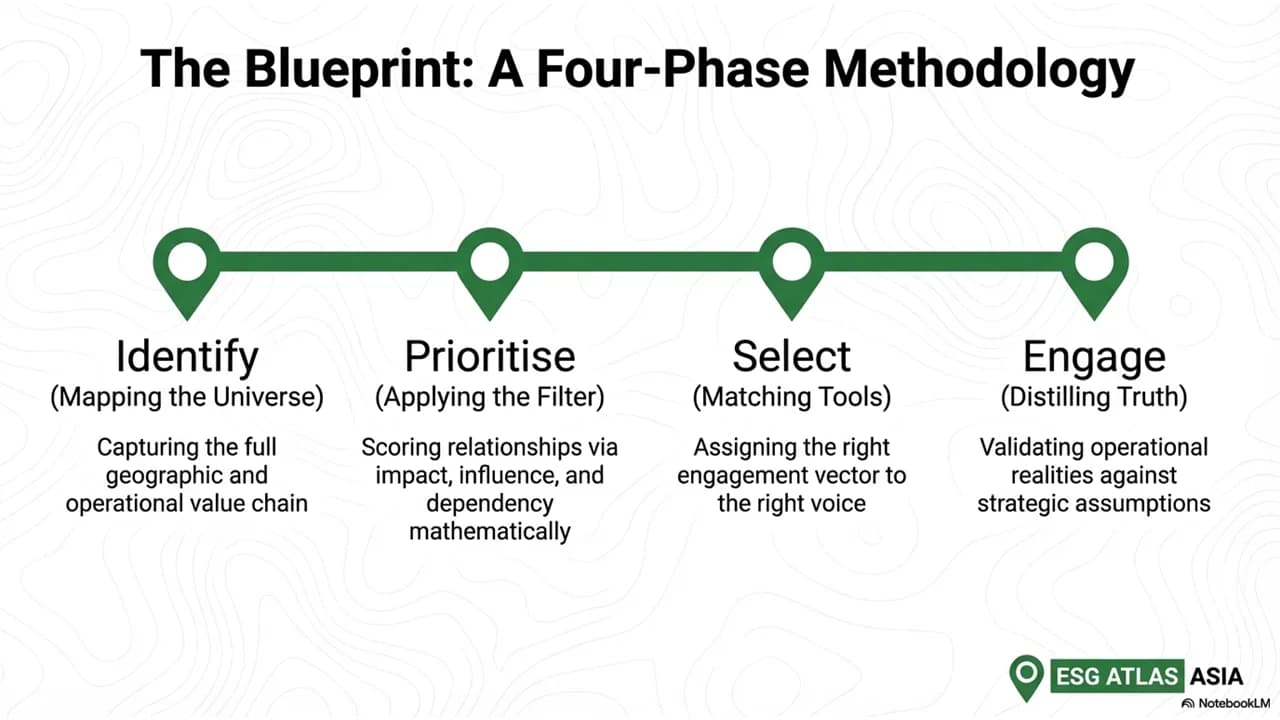
This article is part of a 4-part series on stakeholders engagement for an ESG materiality assessment, designed to provide a practical, step-by-step methodology aligned with leading practices. In this first article, we focus on how to identify stakeholders, building a comprehensive and evidence-based foundation for the entire assessment.
Discover the full framework starting from uderstanding stakeholders - Understanding Stakeholders in ESG Materiality Assessments | Complete Guide
Key Takeaways
A strong stakeholder identification process:
- Moves beyond generic lists
- Is grounded in value chain and operations
- Identifies both visible and hidden stakeholders
- Produces a stakeholder map that informs strategy
Why Stakeholder Identification Defines the Entire Assessment
Identifying the right stakeholders is a critical step in a materiality assessment. Since ESG issues affect different groups in different ways, organizations should engage a diverse and representative set of stakeholders to ensure the assessment reflects a broad range of perspectives.
A well-designed process typically unfolds in four stages: identifying potential stakeholders, assessing their relevance and influence, defining appropriate engagement approaches and finally engaging.
Stakeholder identification is not just the first step—it is the foundation upon which everything else is built. If the wrong stakeholders are identified (or key groups are excluded), the outcome is predictable:
- ESG priorities become internally biased
- Critical risks remain unidentified
- The final report lacks credibility with investors and regulators
At its core, stakeholder identification is about answering one question:
Who has a stake in the organization’s ESG impacts—and whose perspectives are essential to understand them?
Stakeholder identification is not just about inclusion—it is about seeing the full ESG system the organization operates within.
Done well, it ensures that the materiality assessment reflects:
- Real impacts
- Real risks
- Real expectations
Step 1: Identify Potential Stakeholder Groups
Moving Beyond Generic Lists
Many organizations begin with standard stakeholder categories (employees, customers, investors). While useful, this approach is often too generic and risks overlooking:
- Indirectly impacted stakeholders
- Stakeholders in complex supply chains
- Groups with low visibility but high exposure
A more robust approach requires grounding stakeholder identification in how the business actually operates.
A Structured Identification Framework
To ensure completeness and rigor, organizations should systematically assess five key dimensions:

1. Value Chain Mapping
This is the most critical lens. Organizations should map stakeholders across:
- Upstream activities → suppliers, raw material providers
- Core operations → employees, contractors, site-level stakeholders
- Downstream activities → distributors, customers, end-users
👉 Many ESG risks (e.g., labor violations, emissions) occur outside direct operations.
2. Business Activities & Geographic Footprint
Stakeholders vary significantly depending on:
- Where the company operates
- The nature of its operations
3. Regulatory & Policy Environment
Organizations must identify stakeholders that shape compliance and policy expectations, such as:
- Government agencies
- Regulators
- Industry watchdogs
👉 These stakeholders often define minimum ESG standards, but also influence future risks.
4. Historical Stakeholder Engagement
Past interactions provide valuable signals:
- Complaints from communities
- Investor engagement topics
- Employee grievances
- NGO campaigns
👉 These highlight stakeholders who have already demonstrated interest or concern.
5. Industry-Specific ESG Risks
This point helps highlight stakeholders linked to material ESG risks and impacts. Different industries face different ESG issues and each risk area points to relevant stakeholders.
Typical Stakeholder Categories (With Nuance)
Internal Stakeholders
Internal stakeholders, who are directly involved in governance and operations. Not all internal stakeholders are equal. Organizations should distinguish between:
- Operational staff → direct exposure to working conditions
- Management → strategic and financial perspectives
- Board members → governance and oversight
- Contract workers → often overlooked but high-risk
External Stakeholders
External stakeholders, who interact with or are impacted by the organization. These include:
- Customers and end-users
- Investors and lenders
- Suppliers and contractors
- Regulators and government bodies
- Local communities
- NGOs and civil society
- Industry associations
Identifying Less Visible Stakeholders
One of the most common weaknesses in ESG assessments is the exclusion of low-visibility stakeholders, such as:
- Small or informal suppliers
- Migrant or temporary workers
- Communities indirectly affected (e.g., water usage downstream)
As these groups often have high exposure to ESG risks but low ability to raise concerns, including them significantly improves the credibility and completeness of the assessment.
Building a Stakeholder Map
The output of Step 1 should be a stakeholder map, not just a list.
Effective stakeholder mapping:
- Highlights interdependencies across stakeholder groups
- Identifies potential areas of conflict or alignment
- Serves as a foundation for prioritization and engagement strategy
In this sense, the stakeholder map becomes not just a visual tool, but a strategic lens through which organizations understand their ESG exposure, influence, and accountability.

See the whole example in Resource page
DETAILED APPLIED EXAMPLE
Company: GreenTech Manufacturing Vietnam (GTMV)
Company Profile
- Industry: Electronics manufacturing (consumer electronics components)
- Locations: Bình Dương (South), Bắc Ninh (North)
- Business model: B2B supplier to global brands (EU, US, Japan)
- Workforce: ~8,000 employees
- Supply chain: 120+ Tier 1 suppliers, 300+ Tier 2 suppliers
- Key ESG exposure:
- Labor conditions
- Energy use and emissions
- Chemical waste management
- Supply chain transparency
Step 1: Identify stakeholders
1. Value Chain Analysis
Upstream Stakeholders:
- Raw material suppliers (metals, plastics)
- Component manufacturers
- Logistics providers
Key Insight: Tier 2 suppliers (often in China or rural Vietnam) may pose hidden ESG risks.
Core Operations:
- Factory workers
- Plant managers
- Maintenance contractors
- Health & safety teams
Key Insight: Contract workers are often excluded but may face higher safety risks.
Downstream:
- Global buyers (brands like electronics companies)
- Distributors
- End consumers (indirectly)
Key Insight: End consumers influence ESG indirectly via brand pressure.
2. Geographic Context
Factories located in:
- Industrial zones near residential communities
Impacted stakeholders:
- Local residents
- Small businesses nearby
- Local authorities
Key ESG risk:
- Air emissions
- Water discharge
3. Regulatory Mapping
Relevant stakeholders:
- Ministry of Natural Resources and Environment
- Provincial environmental authorities
- Labor regulators
4. Historical Engagement
Findings:
- Previous worker complaints about overtime
- Community concerns about wastewater
- Buyer audits on labor standards
These highlight priority stakeholder groups:
- Employees
- Communities
- Buyers
5. Industry ESG Risks
The industry general risk and as below:
ESG Risk | Stakeholders |
Labor conditions | Employees, NGOs |
Emissions | Communities, regulators |
Supply chain | Suppliers, buyers |
Compliance | Regulators |
Final Stakeholder Identification Output
Internal
- Factory workers
- Line supervisors
- Plant managers
- HR and compliance teams
- Executive leadership
External
- Global buyers
- Tier 1 and Tier 2 suppliers
- Local communities
- Environmental regulators
- Labor NGOs
- Industry associations
Stakeholder Map Insight
From this mapping, GTMV identifies:
1. High Exposure Areas
- Communities → environmental impact
- Workers → labor conditions
2. High Dependency Relationships
- Suppliers depend on GTMV contracts
- GTMV depends on buyers
3. Hidden Risk Zones
- Tier 2 suppliers
- Contract workers
Once stakeholders have been identified, the next step is to determine which groups should be prioritized based on their relevance and influence - Prioritize Stakeholders
Reference List
- AccountAbility (2015). AA1000 Stakeholder Engagement Standard (AA1000SES).
- CDP (2021). Engaging the Chain: Driving Speed and Scale.
- European Commission (2022). Corporate Sustainability Reporting Directive (CSRD).
- GRI (2021). GRI 3: Material Topics.
- ILO (2020). Decent Work in Global Supply Chains.
- OECD (2018). Due Diligence Guidance for Responsible Business Conduct.
- World Bank (2017). Environmental and Social Framework.