
Stock exchanges across Asia are evolving into ESG data hubs, transforming fragmented disclosures into structured, comparable data. Discover key ESG platforms, reporting trends, and how this shift is shaping sustainable finance in Asia.
Across Asia, stock exchanges are undergoing a structural transformation. Traditionally viewed as venues for capital raising and securities trading, exchanges are increasingly positioning themselves as centralized ESG data infrastructure, playing a critical role in how sustainability information is produced, standardized, and consumed.
This transformation is being driven by a simple but powerful force: investors increasingly require consistent, comparable, and decision-useful sustainability information to assess risks, opportunities, and long-term value. As ESG considerations become embedded in financial analysis, the infrastructure supporting ESG data is becoming just as important as the data itself.
Why ESG Data Infrastructure Is Becoming Critical
Investor reliance on ESG data has increased significantly over the past decade, particularly among institutional investors integrating sustainability into risk assessment; portfolio construction and long-term valuation
However, ESG data remains structurally fragmented. Disclosures are often spread across:
- Sustainability or integrated reports
- Regulatory filings
- Corporate websites
- Third-party ESG rating providers
This fragmentation creates three persistent challenges:
- Comparability gaps across companies and markets
- Inconsistent data quality and methodologies
- Limited transparency behind ESG ratings and claims
As a result, investors increasingly seek primary, standardized, and machine-readable ESG data—a demand that traditional disclosure formats struggle to meet.
Stock exchanges are uniquely positioned to address this gap.
Why Stock Exchanges Are Emerging as ESG Data Hubs
The growing role of exchanges in ESG data infrastructure is driven by structural advantages:
1. Existing Disclosure Gatekeepers
Exchanges already operate the core disclosure systems through which listed companies submit financial information. Extending this infrastructure to ESG reporting is a natural evolution.
2. Central Position in Capital Markets
Exchanges sit at the intersection of:
- Issuers
- Regulators
- Investors
This allows them to act as coordinators of ESG transparency, aligning reporting practices with both regulatory requirements and investor expectations.
3. Standardization Pressure from Global Frameworks
With the rise of frameworks such as IFRS Sustainability Disclosure Standards (ISSB), exchanges are increasingly expected to:
- Translate global standards into local implementation
- Ensure consistent adoption across listed companies

Image: ESG Atlas Asia
A Growing Network of ESG Data Platforms in Asia
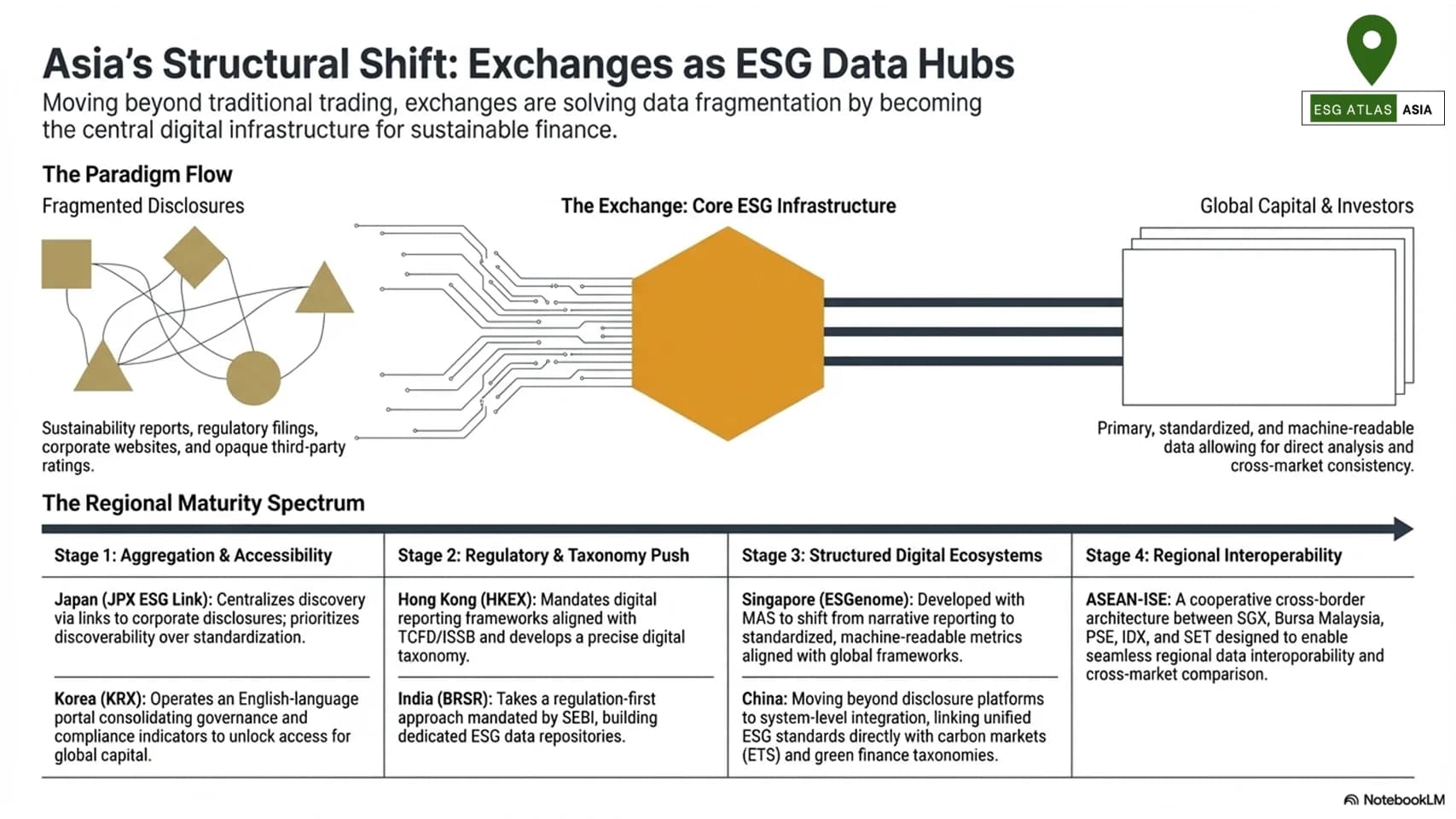
Across Asia, exchanges are developing ESG platforms with varying levels of sophistication—from aggregation portals to fully structured data systems.
🇰🇷 Korea: Opening ESG Data to Global Capital
The Korea Exchange (KRX) recently launched an English-language ESG portal, aimed at improving accessibility for international investors.
The platform consolidates:
- Sustainability reports
- Corporate governance disclosures
- ESG-related announcements
- Compliance indicators
This initiative addresses a key barrier in Asian ESG markets: language and accessibility for global capital.
🇸🇬 Singapore: Structured ESG Data Through ESGenome
Singapore represents one of the most advanced ESG data infrastructures in Asia.
The Singapore Exchange (SGX), together with the Monetary Authority of Singapore (MAS), developed ESGenome—a digital ESG reporting platform.
Unlike traditional disclosures, ESGenome enables:
- Standardized ESG metrics reporting
- Alignment with global frameworks (e.g., TCFD, ISSB)
- Structured, machine-readable data
This marks a shift from narrative reporting to data-driven ESG analysis.
🇯🇵 Japan: Aggregation and Accessibility via JPX
The Japan Exchange Group (JPX) operates JPX ESG Link, which aggregates ESG disclosures across listed companies.
Rather than standardizing data, the platform centralizes links to:
- Integrated reports
- Sustainability reports
- Governance disclosures
This approach prioritizes discoverability over standardization, reflecting a transitional stage in ESG data infrastructure.
🇭🇰 Hong Kong: ESG Disclosure and Digital Reporting Push
The Hong Kong Exchanges and Clearing (HKEX) has taken a regulatory-led approach, strengthening ESG disclosure requirements and moving toward digitized reporting.
Key developments include:
- Mandatory ESG disclosure requirements
- Alignment with TCFD and ISSB
- Development of digital taxonomy for ESG reporting
HKEX is positioning itself as both regulator and data standard setter.
🇨🇳 China: From Disclosure to System Integration
China’s exchanges—Shanghai, Shenzhen, and Beijing—are integrating ESG into a broader national disclosure system, as seen in recent mandatory reporting guidelines.
Beyond disclosure, China is building:
- Unified ESG reporting standards
- Integration with carbon markets (ETS)
- Linkages with green finance taxonomies
This represents a shift toward system-level ESG data infrastructure, not just platforms.
🇮🇳 India: ESG Data Through Regulatory Platforms
The National Stock Exchange of India and Bombay Stock Exchange support ESG disclosure through the Business Responsibility and Sustainability Report (BRSR) framework mandated by SEBI.
India is also developing:
- ESG data repositories
- Standardized sustainability metrics
India’s approach is regulation-first, with data infrastructure evolving alongside.
ASEAN: Toward a Regional ESG Data Ecosystem
ASEAN markets are moving toward cross-border integration through the ASEAN Interconnected Sustainability Ecosystem (ASEAN-ISE).
Participating exchanges include:
- Singapore Exchange (SGX Group)
- Malaysia (Bursa Malaysia)
- Philippine Stock Exchange (PSE)
- Indonesia Stock Exchange (IDX)
- The Stock Exchange of Thailand (SET)
The initiative aims to:
- Improve ESG data interoperability
- Enable cross-market comparison
- Support regional sustainable finance
This signals a shift from national platforms to regional ESG data architecture.

Image: ESG Atlas Asia
What This Means for Investors
The rise of exchange-led ESG platforms fundamentally changes how investors access and use sustainability data. Instead of relying primarily on third-party ratings, investors can now:
- Access primary corporate disclosures directly
- Analyze standardized ESG metrics
- Compare companies across markets with greater consistency
The evolution of ESG platforms suggests a broader transition: exchanges are moving from information aggregators to full ESG infrastructure providers.
Emerging developments point toward:
- Structured digital ESG reporting systems
- Integration of climate risk and scenario data
- Linkages with carbon markets and pricing mechanisms
- Tracking of sustainability-linked financial instruments
Some exchanges are already piloting systems where ESG data is submitted in machine-readable formats, enabling real-time analysis and comparability.
Conclusion: Redefining the Role of Stock Exchanges
The rise of ESG data platforms marks a fundamental shift in the architecture of capital markets.
As ESG reporting becomes mandatory across more markets—including China by 2026—these platforms will play an increasingly central role in shaping how sustainability is measured, compared, and integrated into financial decision-making.
In this emerging landscape, the question is no longer whether exchanges will support ESG transparency—but how deeply they will embed themselves into the core infrastructure of sustainable finance.