
Japan is entering a transformative phase for ESG compliance in 2026, with new sustainability disclosure standards and a mandatory emissions trading system coming into force. Companies operating in or supplying to Japan must understand these changes to avoid financial penalties and reputational risks.
Key Regulatory Changes Taking Effect in 2026
1. SSBJ Sustainability Disclosure Standards (Voluntary Adoption Begins)
The Sustainability Standards Board of Japan (SSBJ) released its first sustainability disclosure standards in March 2025, fully aligned with the IFRS S1 and S2 standards from the International Sustainability Standards Board (ISSB).
Timeline | Requirement |
|---|---|
FY ending March 2026 | Voluntary adoption is open to all eligible companies |
FY ending March 2027 | Mandatory for companies with market cap ≥ ¥3 trillion (69 companies) |
FY ending March 2028 | Mandatory for companies with market cap ≥ ¥1 trillion (179 companies) |
FY ending March 2029 | Expansion to companies with market cap ≥ ¥500 billion (294 companies) |
The standards require disclosure across four core pillars:
- Governance
- Strategy
- Risk Management
- Metrics and Targets
Companies must disclose Scope 1, 2, and 3 greenhouse gas emissions.
2. Mandatory Emissions Trading System (GX-ETS) Begins April 2026
Japan's revised Green Transformation (GX) Law introduces a mandatory emissions trading system starting April 2026.
Threshold | Requirement |
|---|---|
≥100,000 tonnes CO₂/year | Must participate in GX-ETS |
Coverage | Hundreds of large industrial emitters |
This transitions Japan from a voluntary scheme to a compliance-based carbon market, adding direct financial consequences to emissions management.
3. Mandatory TCFD Reporting (Already in Force)
Since FY2023, the Financial Services Agency (FSA) requires all Prime Market-listed companies on the Tokyo Stock Exchange to disclose climate information using the TCFD framework. This includes:
- A dedicated section in annual securities reports for sustainability information
- Scope 3 disclosure for Prime Market companies

What Companies Must Disclose
Starting in 2026, Japanese corporations must include sustainability information directly in their annual securities reports with the same rigor as financial figures. Key disclosure areas include:
Category | Specific Requirements |
|---|---|
Environmental | GHG emissions (Scope 1, 2, 3), climate risks, energy consumption, renewable energy percentage |
Social | Percentage of women in managerial positions, paternity leave rate, human rights due diligence in supply chains |
Governance | Corporate governance structure, board independence, anti-corruption policies |
Supply Chain Implications
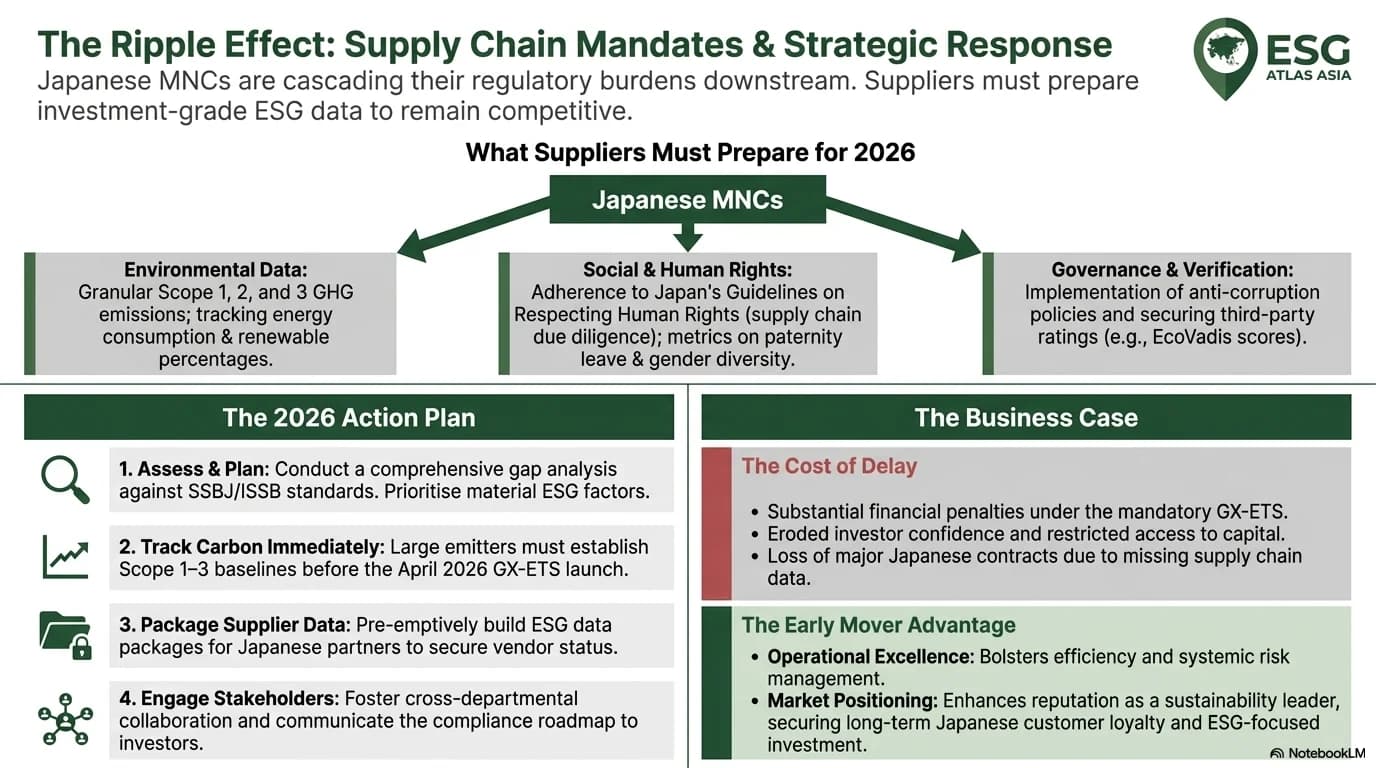
If you supply to Japanese companies, expect requests for:
- Scope 1, 2, and 3 GHG emissions data
- Energy consumption and renewable energy percentage
- Labor practices, working hours, and health/safety data
- Anti-corruption and governance policies
- EcoVadis score or equivalent third-party rating
Japanese MNCs are increasingly requiring Scope 3 emissions data from suppliers, as supply chain emissions are a key focus of Japan's GX Strategy.
Human Rights Guidelines (Soft Law)
Japan's "Guidelines on Respecting Human Rights in Responsible Supply Chains" (issued 2022) provides a soft law framework based on UN Guiding Principles. While not legally binding, the government calls on all companies conducting business in Japan to carry out human rights due diligence for their supply chains.
Action Steps for 2026 Compliance
- Assessment and gap analysis: Conduct a comprehensive review of existing ESG disclosures against SSBJ and ISSB standards
- Strategic planning: Prioritize ESG factors based on materiality; develop an incremental adoption approach
- Stakeholder engagement: Foster cross-departmental collaboration and communicate your compliance roadmap to investors
- Carbon data collection: Begin tracking Scope 1, 2, and 3 emissions immediately if you're a large emitter
- Supplier data requests: If you're a supplier, prepare ESG data packages for Japanese customers
Risks of Noncompliance
Delaying engagement with new standards carries substantial risks:
- Substantial penalties under the mandatory GX-ETS
- Eroded investor confidence and limited access to capital
- Harm to brand reputation and long-term competitiveness
Strategic Advantages Beyond Compliance
Early adoption offers benefits:
- Investor trust: Robust ESG practices attract ESG-focused investment
- Operational excellence: Sustainability standards bolster efficiency and risk management
- Enhanced reputation: Position as a sustainability leader to boost customer loyalty
Bottom Line for 2026
While SSBJ adoption remains voluntary in 2026, the roadmap to mandatory compliance is clear. The mandatory GX-ETS starting April 2026 means large emitters must act immediately. Companies should treat 2026 as a preparation year for mandatory SSBJ reporting beginning in 2027 for the largest firms.
Japan's alignment with global ISSB standards places it firmly in the mainstream of international ESG reporting, making structured, comparable ESG data expectations arrives quickly for companies in Japan's supply chain—domestic or international.
Reference
1. Asia ESG Regulatory Watch – March 2026: ISSB Alignment, Scope 3 Mandates & Assurance Trends
2. Japan’s SSBJ Announces Sustainability Disclosure Standards
3. Regulatory Update: Japan’s GX-ETS to Become Mandatory for Large Emitters in 2026
4. Japan Sustainability Reporting Standards (SSBJ) Readiness Solution
5. Guide to Asia Pacific's ESG Regulations & Sustainability Reporting Landscape
7. ESG compliance in Japan: a guide for SMEs
8. Navigating Japan’s new sustainability disclosure standards