
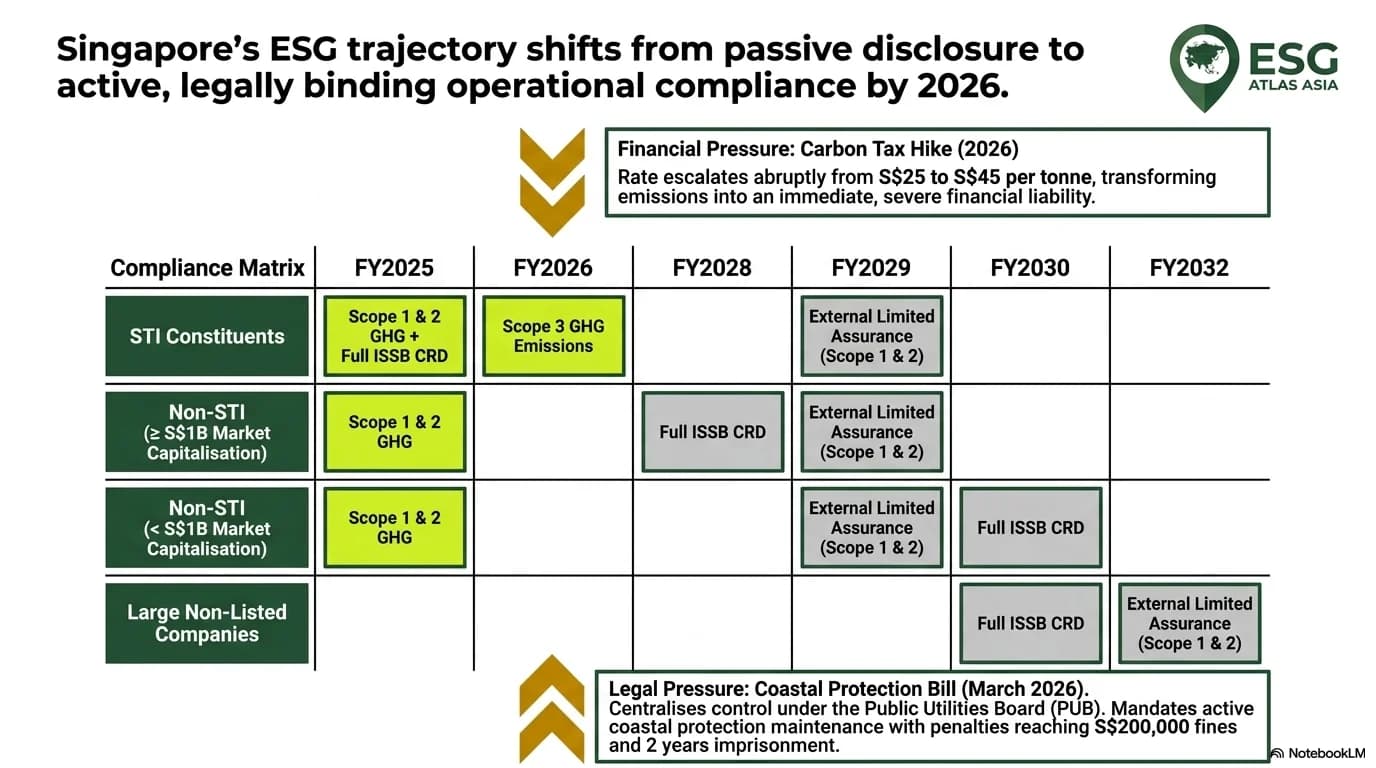
Singapore is accelerating its ESG regulatory framework in 2026, with mandatory climate-related disclosures under ISSB standards now in effect for major listed companies, Scope 3 emissions reporting beginning for large firms, and carbon taxes rising significantly. Companies operating in Singapore must navigate these changes to maintain compliance and investor confidence.
Key Regulatory Changes Taking Effect in 2026
1. Mandatory ISSB-Based Climate-Related Disclosures (CRD)
Singapore has implemented a phased mandatory climate-related disclosures (CRD) regime aligned with IFRS ISSB Standards.
Company Category | Requirement | Timeline |
|---|---|---|
STI constituents | ISSB-based CRD (all requirements) | FY2025 |
STI constituents | Scope 3 GHG emissions | FY2026 |
All listed companies | Scope 1 & 2 GHG emissions | FY2025 |
Non-STI ≥ $1B market cap | Other ISSB-based CRD | FY2028 |
Non-STI < $1B market cap | ISSB-based CRD | FY2030 |
Large non-listed companies | Full ISSB-based CRD | FY2030 |
STI constituents (Straits Times Index) must report on Scope 3 emissions starting FY2026, covering indirect emissions from supply chains.
2. Carbon Tax Increases to S$45 per Tonne (2026)
Singapore's carbon tax will rise from S$25 to S$45 per tonne in 2026, significantly increasing the financial impact of emissions on business operations.
3. SGX Sustainability Reporting Guide Requirements
The Singapore Exchange (SGX) mandates that ESG activities reported in Sustainability Reports must minimally comply with TCFD for entities listed in Singapore.
Key SGX requirements:
- Publish sustainability report within 12 months of financial year end (for 2017, reduced to 5 months in subsequent years)
- Disclose based on material ESG factors identified through stakeholder assessment
- Include Board statement on ESG consideration in strategy formulation
- Select a sustainability reporting framework (or frameworks)
- Disclose policies, practices, and performance in descriptive and quantitative terms
- Set targets for the forthcoming year for each material ESG factor
4. Climate-Related Disclosure Requirements for Listed Companies
Starting FY2025, Singapore Exchange Regulation (SGX RegCo) requires all listed companies to disclose climate-related information based on IFRS ISSB standards.
Three-tier structure based on market capitalization:
- Straits Times Index (STI) constituents - immediate compliance
- Non-STI ≥ $1 billion market cap - phased to FY2028
- Non-STI < $1 billion market cap - phased to FY2030
5. External Assurance Coming (FY2029)
External limited assurance for Scope 1 and 2 emissions becomes mandatory by FY2029 for all listed companies. Large non-listed companies receive this requirement by FY2032.
6. New Coastal Protection Bill (March 2026)
Singapore's Coastal Protection and Other Amendments Bill (passed Parliament March 6, 2026) signals a shift from ESG disclosure to concrete legal obligations.
Requirement | Details |
|---|---|
Obligation | Landowners/long-term lessees must implement coastal protection measures |
Maintenance | Inspect, monitor, maintain, and repair coastal protection measures |
Regulatory control | Centralized under Public Utilities Board (PUB) |
Penalties | Up to S$200,000 fines and 2 years imprisonment |
Notice period | At least 10 years advance notice for implementation |
This bill moves climate obligations beyond disclosure into direct operational compliance.
What Companies Must Disclose
Starting in 2026, Singapore-listed companies must disclose:
Category | Specific Requirements |
|---|---|
Environmental | Scope 1, 2 GHG emissions (mandatory FY2025); Scope 3 for STI/large companies (mandatory FY2026); carbon tax impact; climate risks |
Social | Board diversity; employee health & safety; human rights policies; labor practices |
Governance | Board oversight of ESG; ESG integration in strategy; anti-corruption policies; executive compensation linked to ESG |
Supply Chain Implications for Singapore
If you supply to Singapore companies, expect requests for:
- Scope 1, 2, and 3 GHG emissions data
- Carbon tax impact calculations
- Climate risk assessments
- Sustainability policies and certifications
- Third-party ESG ratings (e.g., EcoVadis)
STI constituents and large companies must report Scope 3 emissions, making supply chain data critical for their compliance.
Action Steps for 2026 Compliance
- Determine your tier: Identify if you're STI constituent, non-STI ≥$1B, or non-STI <$1B
- Collect emissions data: Begin tracking Scope 1 and 2 emissions immediately (mandatory FY2025)
- Prepare Scope 3: If you're STI or large company, start supply chain emissions data collection for FY2026
- Update governance: Ensure Board statement on ESG oversight is included in reports
- Select framework: Choose ISSB-aligned reporting framework for sustainability reports
- Plan for assurance: Prepare for external limited assurance by FY2029
- Carbon tax planning: Assess impact of S$45/tonne tax on operations
Risks of Noncompliance
- Penalties up to S$200,000 and imprisonment for Coastal Protection violations
- SGX listing penalties for failure to disclose required sustainability information
- Eroded investor confidence and limited access to ESG-focused capital
- Increased carbon costs from S$45/tonne tax
Strategic Advantages Beyond Compliance
- Investor trust: Robust ESG practices attract ESG-focused investment in Singapore's mature market
- Operational efficiency: Carbon pricing creates incentives for emissions reduction
- Regional competitiveness: Singapore as ESG hub enhances reputation across Asia
Bottom Line for 2026
All listed companies must report Scope 1 and 2 emissions from FY2025 (non-negotiable, no exceptions). STI constituents must report Scope 3 from FY2026. The carbon tax increase to S$45/tonne in 2026 makes emissions management financially critical.
Singapore's phased approach gives smaller companies until FY2030 for full ISSB compliance, but the regulatory trajectory is clear: mandatory climate disclosures with external assurance by FY2029. The new Coastal Protection Bill marks Singapore's shift from disclosure to operational compliance, signaling more binding ESG obligations ahead.
Reference:
1. SGX guidance
2. Singapore’s Coastal Protection Bill
3. Preparing for SGX’s New Climate Reporting Mandates: What You Need to Know
5. Datatrack
6. Navigating through SGX's ESG Disclosure Requirements
7. ESG Reporting in Singapore: Standards & Regulations