
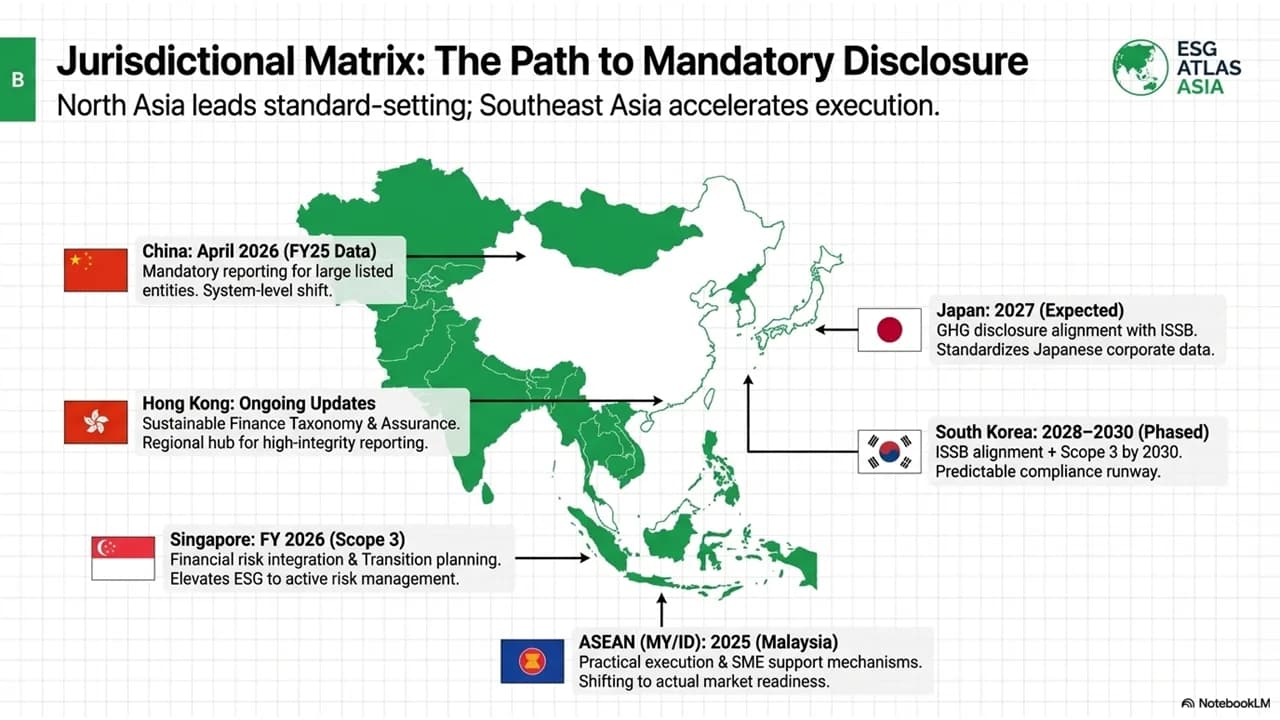
Asia’s ESG regulatory landscape accelerated in March 2026, with ISSB alignment, Scope 3 reporting, and assurance frameworks gaining momentum. South Korea and Singapore led with detailed roadmaps, while China, Hong Kong, and Southeast Asia advanced mandatory disclosures and taxonomies—signaling a region-wide shift toward standardized, decision-useful ESG reporting.
Stay ahead of ESG regulation in Asia. Get monthly insights on policy shifts, enforcement trends, and what they mean for your business—before they hit the headlines.
Asia’s ESG regulatory landscape accelerated significantly in March 2026, with multiple jurisdictions advancing toward mandatory climate disclosures, assurance frameworks, and transition planning requirements.
A clear regional pattern is emerging: alignment with ISSB standards as baseline (IFRS S1 and S2), expansion of Scope 3 emissions reporting, and gradual introduction of third-party assurance.
While North Asia continues to lead on technical standard-setting, Southeast Asia is rapidly closing the gap through implementation-focused policies and taxonomies.

🇰🇷 South Korea: Structured Path to Mandatory ESG Disclosure
Financial Services Commission (FSC) released a draft roadmap for mandatory ESG disclosures, marking one of the most detailed transition plans in the region.
Key highlights:
- Alignment with International Sustainability Standards Board standards (IFRS S1 and S2) via the Korean Sustainability Standards Board (KSSB)
- Consultation period closed on March 31, 2026
- Phased implementation:
- 2028: KOSPI-listed firms with assets > KRW 30 trillion
- Gradual expansion to smaller listed firms thereafter: KRW 10 trillion+ in 2029
- Scope 3 emissions disclosure required from 2030
- Assurance initially voluntary, signaling future mandatory direction
👉 Why it matters: South Korea is setting a predictable compliance runway, giving companies time to build data systems and governance before full enforcement.
🇸🇬 Singapore: From Disclosure to Risk Integration
Monetary Authority of Singapore finalized Guidelines on Environmental Risk Management – Transition Planning, pushing financial institutions beyond disclosure into active risk integration.
Applicable for: banks, asset managers, and insurers
Core requirements:
- Systematic climate data collection
- Risk identification and prioritization high-risk exposures, and avoid hasty divestments, with sector-specific tailoring.
- Integration into strategy, governance, and decision-making
In parallel:
- Listed issuers must report Scope 3 emissions from FY2026
- Continued alignment with ISSB standards
👉 Why it matters: Singapore is shifting the focus from reporting compliance to financial risk management, raising expectations for boards and senior management.
We track ESG regulations across Asia—so you don’t have to.
📥 Get the full picture delivered monthly
🇭🇰 Hong Kong: Moving Toward Mandatory Assurance
Hong Kong Exchanges and Clearing signaled progress toward mandatory sustainability assurance, alongside updates to its Sustainable Finance Taxonomy.
Key direction:
- Strengthening credibility of ESG disclosures
- Enhancing governance requirements for listed companies and financial institutions
👉 Why it matters: Assurance is becoming the next frontier of ESG regulation, and Hong Kong is positioning itself as a regional leader in high-integrity reporting.
🇨🇳 China: Mandatory ESG Reporting Begins
China advanced refinements to its climate disclosure framework, with a major milestone:
- Mandatory ESG reporting for large listed companies starting April 2026
- Covers FY2025 data
- Continued development of localized climate standards
👉 Why it matters: China’s scale makes this a system-level shift, significantly increasing the volume of ESG data across global supply chains.
🇯🇵 Japan
Sustainability Standards Board of Japan closed its Exposure Draft consultation on March 25, 2026.
- Focus: GHG disclosure alignment with ISSB
- Expected implementation: 2027
Southeast Asia
Malaysia:
- Mandated ISSB-aligned disclosures from 2025 listed issuers
- Introduced support mechanisms for SMEs
Indonesia:
- Continued rollout of its Sustainable Finance Roadmap oward ISSB alignment, though not fully mandatory yet.
- Focus on implementation and sector-level guidance
👉 Why it matters: Southeast Asia is transitioning from policy adoption to execution, with increasing emphasis on practical implementation and market readiness.
Key Trend: ISSB Convergence Is Now Regional Reality
Across Asia, March 2026 confirms a decisive shift:
- ISSB (IFRS S1 & S2) is becoming the common baseline
- Scope 3 emissions disclosure is moving from voluntary to expected
- Third-party assurance is the next regulatory wave
- Transition planning is becoming embedded in governance frameworks
What Companies Should Do Now
- Prepare for Scope 3 data challenges: Build supplier engagement and data collection systems early
- Strengthen internal controls and governance: Anticipate assurance requirements
- Align disclosures with ISSB standards even where not yet mandatory
- Integrate climate risk into strategy, especially for financial institutions and listed firms

What to Watch Next
- Timelines for mandatory assurance across major markets
- Expansion of Scope 3 enforcement
- Greater interoperability between regional taxonomies
- Regulatory focus shifting from disclosure → decision-usefulness
Asia’s ESG regulatory shift is just getting started.
The companies that act early will have the advantage. 👇
Subscribe to ESG Atlas Asia for monthly regulatory insights, analysis, and what to do next
Reference