
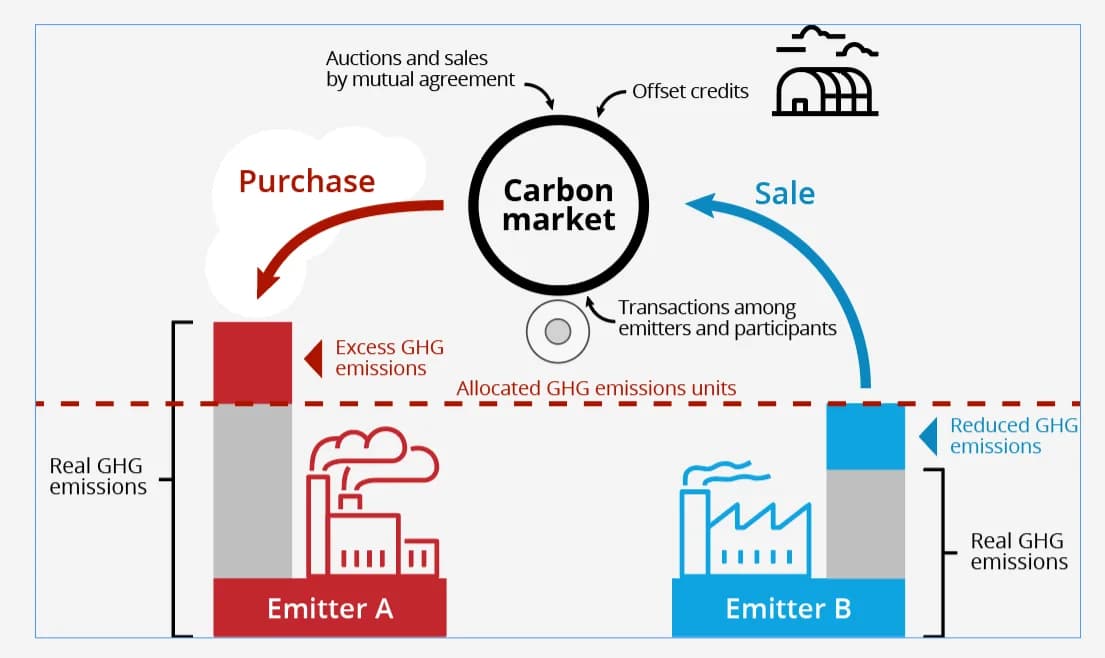
The global architecture of climate action has shifted from a period of testing and policy design into an era of enforcement, integration, and structural scaling. Data from the World Bank’s State and Trends of Carbon Pricing report reveals that direct carbon pricing policies have expanded to 87 implemented instruments worldwide, now covering nearly 30% of global greenhouse gas (GHG) emissions.
This expansion has fundamentally restructured how governments raise revenue, generating over $107 billion for public budgets annually, while accelerating a profound structural shift across international trade and regional markets.
The global carbon landscape is currently being reshaped by three overarching economic forces:
1. The Convergence of Voluntary and Compliance Markets
Historically, compliance markets (like the EU ETS) and the Voluntary Carbon Market (VCM) operated in completely separate universes. That boundary has blurred. Driven by Article 6 of the Paris Agreement, corporate buyers can no longer view voluntary offsets in isolation.Independent registries are aligning with state-backed criteria, and compliance systems are increasingly allowing a limited percentage of high-integrity, externally sourced carbon credits to settle domestic compliance obligations.
2. The "Flight to Quality" and Pricing Premiums
The voluntary market has faced intense scrutiny over environmental integrity.As a result, a strict quality premium has become structurally priced into carbon assets.High-integrity credits vetted through frameworks like the Integrity Council for the Voluntary Carbon Market’s (ICVCM) "Core Carbon Principles" (CCPs) command dramatic price premiums, while low-grade legacy avoidance credits struggle to find buyers at any price.
3. Trade Compliance and "Carbon Border Taxes"
Carbon pricing is no longer just a localized environmental penalty; it has transformed into an international trade compliance requirement. The definitive implementation of the European Union's Carbon Border Adjustment Mechanism (CBAM) has forced global exporters to calculate and verify the embedded emissions of heavy industrial goods (such as steel, aluminum, and cement) entering Europe.To protect their domestic industries from paying these steep tariffs abroad, governments globally are accelerating local carbon pricing to capture that tax revenue within their own borders.
Asia Outlook
The epicenter of this rapid transformation has shifted directly to Asia, where nations are transitioning from policy design to concrete regulatory implementation.
Country / Region | Carbon Pricing Instrument & Newest Developments | Market Scale & Impact |
China | National ETS expanded to include aluminum, cement, and steel. Introduced mandatory allowance banking restrictions to wipe out a 400-million ton pre-2025 surplus. | Covers 8 billion tons of $CO_2$ (~60% of national emissions). Introduced 3% allowance auctioning to transition toward an absolute declining cap by 2031. |
India | Launched a centralized carbon market trading platform under its Carbon Credit Trading Scheme (CCTS). | Targets 490 large industrial units across 7 energy-intensive sectors, starting as a voluntary compliance market. |
Indonesia | Lifted its moratorium on international credit sales; expanded its compliance power-sector ETS to cover 146 coal-fired power plants (CFPPs). | Covers 38% of Indonesia's power generation capacity, with plans to incorporate all fossil fuel and captive power plants. |
South Korea & Japan | Mature systems undergoing Phase 4 allocation adjustments and building formal Market Stability Reserves. | Cover 79% and 60% of their respective national emissions. |
Vietnam's Regulatory Pivot
Positioned as a major manufacturing export hub, Vietnam has rapidly adjusted its domestic legal framework to mirror these shifting global dynamics. Rather than waiting for a prolonged trial period, the country has accelerated its regulatory architecture to establish a fully compliant domestic market.
Vietnam has officially treated carbon as a formalized financial asset class. The government issued Decree No. 29/2026/ND-CP, which legally integrates carbon asset trading into the country’s existing financial market infrastructure.
- The Hanoi Stock Exchange (HNX) runs the centralized trading platform.
- The Vietnam Securities Depository and Clearing Corporation (VSDC) manages the custody and clearing.
- To eliminate speculative risks, the market enforces a strict T+0 (same day) gross settlement mechanism, requiring participants to fully back their trades with either verified quotas or cleared capital upfront.
Under Decision No. 263/QD-TTg, Vietnam finalized its aggregate greenhouse gas allowance caps for the pilot phase of the Vietnam Emissions Trading System (V-ETS), covering roughly 40% of national emissions. The pilot mandates compliance for 110 major entities across the three most carbon-exposed sectors: thermal power, steel, and cement. The system is intentionally designed to run a fee-free adjustment phase through December 2028, giving domestic industries a clear window to optimize their decarbonization technologies before full compliance fees and auctioning kick in on January 1, 2029.
In the modern global economy, a country's or company's carbon footprint is closely linked to its financial health. As global standards tighten and regional hubs like Vietnam and the broader Asian market establish rigid compliance mechanisms, managing carbon emissions has shifted from a corporate social responsibility initiative to a core pillar of macroeconomic survival and international competitiveness.
Reference