
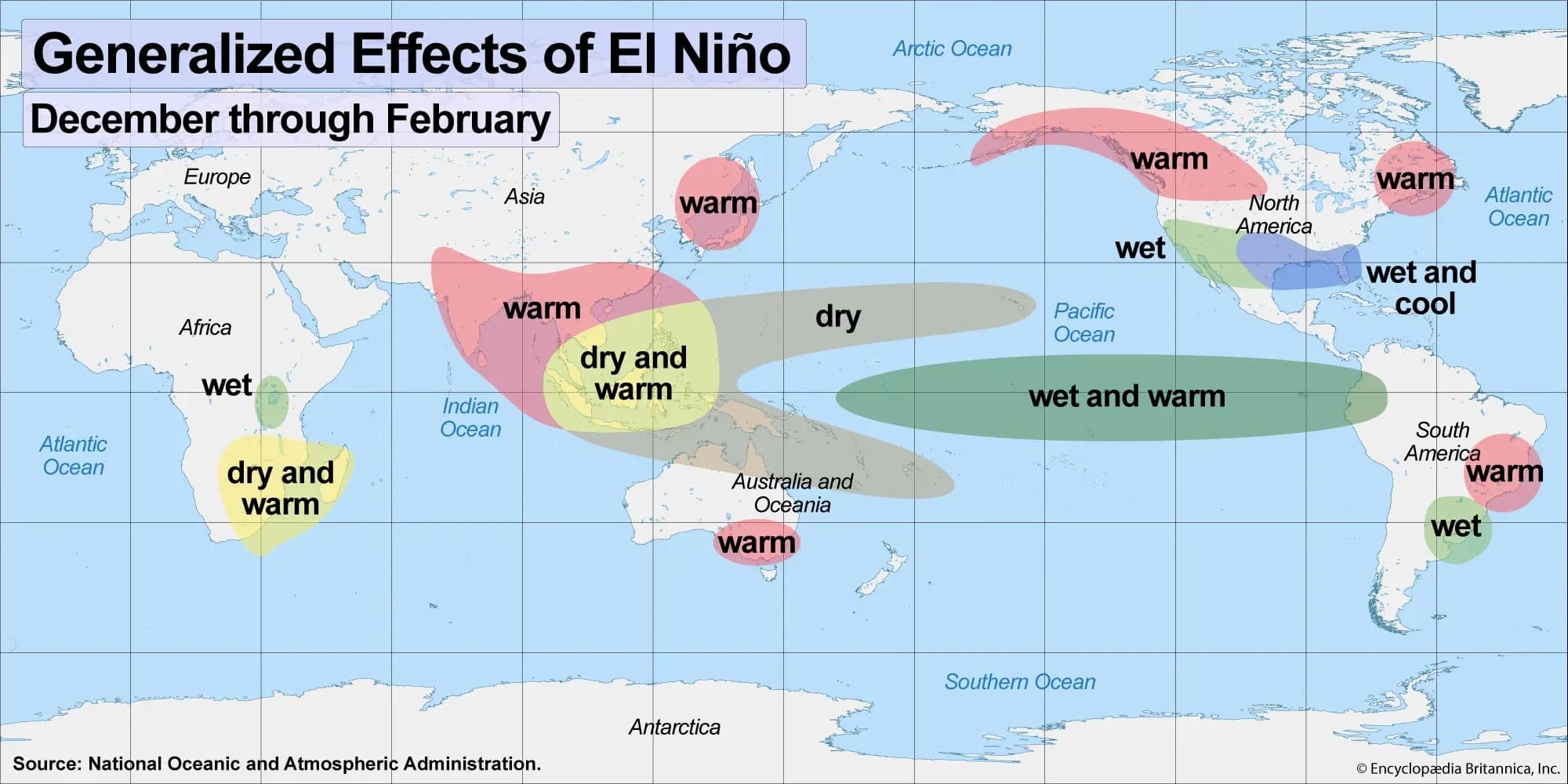
El Niño is intensifying across the Pacific and is expected to peak around December 2026, with impacts likely to persist into early 2027. For businesses operating in—or sourcing from—Asia, this is not a distant climate scenario. It is already affecting rainfall, water availability, agriculture, wildfire risk, air quality, and energy systems across the region.
That is why companies should be discussing it now. The strongest period of El Niño is approaching, but its consequences—drought, crop stress, haze, power constraints, and supply-chain disruption—can continue well beyond the climate event itself. The World Meteorological Organization (WMO) forecasts that tropical Pacific sea-surface temperatures may reach about 3.8°C above average from November 2026 to January 2027, with the warming trend peaking around December 2026.
For companies, the central question is not whether El Niño will affect Asia. It is whether their operations, suppliers, logistics networks, and communities are prepared for the effects.
Why now is the critical window
El Niño is a warming of sea-surface temperatures in the central and eastern tropical Pacific. It changes atmospheric circulation and can disrupt rainfall, temperature, wind, and storm patterns across Asia and beyond.
The WMO expects El Niño to intensify before its forecast peak in December 2026 and has indicated a near-100% likelihood that it will persist through February 2027. The United Nations similarly notes that stronger El Niño conditions are expected during September–November 2026, followed by a peak toward the end of the year.
For businesses, this creates a narrow but important window to prepare. Companies that identify water, supplier, workforce, energy, and logistics exposure now can respond more effectively during the peak period and reduce longer-term disruption.
Southeast Asia faces compounding risks
Southeast Asia is particularly exposed to warmer conditions and rainfall deficits. The WMO warns that these conditions increase heat exposure and place additional pressure on agriculture and water supplies, while also raising wildfire and smoke-haze risks.
The impacts are not evenly distributed. Some areas may experience drought and water stress, while others may still face intense rainfall, flooding, or storm-related disruption. This uneven pattern makes asset-level and supply-chain-level climate-risk assessment essential.
For companies, the key issue is that climate impacts rarely stay within one location. A drought in an agricultural region can affect raw-material supply. Wildfire haze can disrupt operations across borders. Reduced hydropower generation can increase electricity costs and grid stress. Flooding can damage logistics routes and delay shipments.
Indonesia: a live example of El Niño risk
Indonesia illustrates how El Niño can turn a climate pattern into a regional ESG crisis. From August to October 2026, western Indonesia experienced widespread fire activity during an exceptionally hot and dry season that coincided with a strong El Niño event.worldweatherattribution
Research by World Weather Attribution found that El Niño was the dominant driver of the extreme rainfall deficit, reducing seasonal rainfall by roughly half from July to October. Human-induced climate change also contributed about 1.6°C of additional heat during the fire season, making fire conditions more severe.worldweatherattribution
The consequences were severe:
- Fires burned approximately 1.9 million hectares of peatland and rainforest in western Indonesia between August and October 2026.worldweatherattribution
- Almost 2.88 million hectares of Indonesian territory were affected by fire from January to October 2026, with nearly 1 million hectares affected in October alone.thejakartapost
- Toxic haze exposed an estimated 12.5 million people across Indonesia, Malaysia, Singapore, and Timor-Leste.worldweatherattribution
- Indonesian authorities reported more than 400,000 respiratory infections associated with the fires by November.worldweatherattribution
For companies, this is not only an environmental issue. Haze affects employee health, outdoor work, transport, productivity, and community wellbeing. It also creates reputational risk for businesses linked—directly or indirectly—to land clearing, deforestation, or weak fire-prevention practices.

A forest and land fire in Palangka Raya city, Central Kalimantan province, Indonesia. Antara/Auliya Rahman
Water stress and business continuity
Reduced rainfall can affect reservoir levels, river flows, groundwater recharge, and water quality. In parts of Southeast Asia, this creates direct risks for manufacturing, agriculture, food processing, textiles, electronics, and other water-intensive sectors.
The impacts are already visible in regional agricultural systems. FEWS NET reported below-average rainfall and drier-than-normal conditions in Thailand during mid-to-late 2026, while Vietnam faced below-average rainfall, drought, and reduced water for irrigation.fews
Water stress is therefore both an operational and social issue. Companies should understand not only how much water they use, but also where they use it, who else depends on the same water source, and how scarcity could affect production and local communities.
Agriculture and supply-chain exposure
El Niño can disrupt agricultural production through drought, heat stress, irregular rainfall, and pest pressure. In Asia, this can affect commodities such as rice, sugar, palm oil, coffee, and other agricultural inputs that sit deep within regional and global supply chains.
BMI has identified rice, Thai sugar, Indonesian and Malaysian palm oil, and Vietnamese robusta coffee as particularly exposed to drought risk in Southeast Asia. It also notes that the Philippines and Thailand are among the economies most exposed to El Niño-related drought.
For brands, retailers, manufacturers, and food companies, the risk is not limited to commodity availability. Crop losses can reduce farmer incomes, increase food prices, and worsen financial insecurity in producing communities. This makes supplier engagement and responsible sourcing essential parts of climate adaptation.
Energy systems under pressure
El Niño can create a difficult combination for energy systems: lower rainfall may reduce hydropower output, while hotter weather increases electricity demand for cooling.
BMI has warned that reduced rainfall can lower reservoir levels and constrain hydroelectric output, while heat simultaneously increases demand. It identified Malaysia, Thailand, the Philippines, and Indonesia among Southeast Asian economies where the proportion of hydropower capacity exposed to drought could increase.
For businesses, this can mean higher energy costs, grid stress, production interruptions, and greater reliance on backup generation. Energy resilience is no longer only an infrastructure issue; it is a core part of climate adaptation and decarbonisation planning.
Flooding remains a risk
It is important not to assume that El Niño means drought everywhere. Climate variability can still produce intense rainfall, typhoons, flooding, and landslides in parts of Asia.
For companies with factories, warehouses, data centres, retail networks, or logistics infrastructure, physical climate risk should be assessed at site level. A company may have strong emissions-reduction targets but still face disruption if it has not assessed the resilience of its physical assets and critical dependencies.
What this means for ESG
El Niño intersects with all three ESG pillars.
ESG pillar | Why it matters during El Niño |
|---|---|
Environmental | Drought, heat, wildfire, water stress, biodiversity pressure, and hydropower variability can disrupt ecosystems and resource availability. |
Social | Heat exposure, air pollution, food-price pressure, water access, and livelihood disruption can affect workers, suppliers, and communities. |
Governance | Boards and management need oversight of climate risks, resilience planning, disclosure, and stakeholder engagement. |
This is why El Niño should be treated as a material climate and operational risk, rather than a sustainability communications topic.
Practical actions for Asia businesses
Companies do not need to solve every climate risk at once. The priority is to build a clear understanding of exposure and take practical, prioritised action.
- Map exposure. Identify key sites, suppliers, commodities, logistics routes, and markets in areas exposed to drought, heat, fire, flood, or water stress.
- Assess water dependency. Understand water use, local water stress, community needs, and operational thresholds for production disruption.
- Engage suppliers. Move beyond questionnaires and understand how suppliers are affected by climate conditions, what adaptation measures they need, and where support is most useful.
- Protect people. Establish heat-safety protocols, air-quality guidance, emergency communication, and support for workers and surrounding communities.
- Strengthen resilience. Review business-continuity plans, backup energy, transport alternatives, inventory strategies, and site-level adaptation measures.
- Align disclosure with action. Ensure climate-related disclosures reflect real governance, risk assessment, targets, and progress—not only high-level commitments.
From response to resilience
El Niño is a reminder that climate risk is not a future problem. It is already shaping water availability, agricultural output, energy systems, working conditions, and supply-chain stability across Asia.
The Indonesian wildfire and haze crisis shows how quickly a climate event can become a public-health, social, environmental, and business issue. Companies that understand their dependencies, invest in adaptation, and engage meaningfully with suppliers and communities will be better positioned to protect operations, maintain trust, and contribute to a more sustainable Asia-Pacific economy.
Stay ahead of Asia’s ESG agenda
Climate resilience requires more than awareness. It requires practical risk assessment, supplier engagement, governance, and credible disclosure.
Join the ESG Asia Brief to receive practical insights on ESG reporting, climate strategy, and sustainability developments across the Asia-Pacific region.
Reference link
1. World Meteorological Organization
3. Sea-surface temperatures reflect strengthening El Niño
4. El Niño and humanitarian action
6. El Nino mostly to blame for Indonesian wildfires: research
7. Reuters - Climate change made Indonesian fires more severe, scientists say
8. El Niño forecast, risks, and projected impacts in East Asia and the Pacific
9. El Niño influences South Asia winter climate outlook
10. The Conversation
11. Britannica