
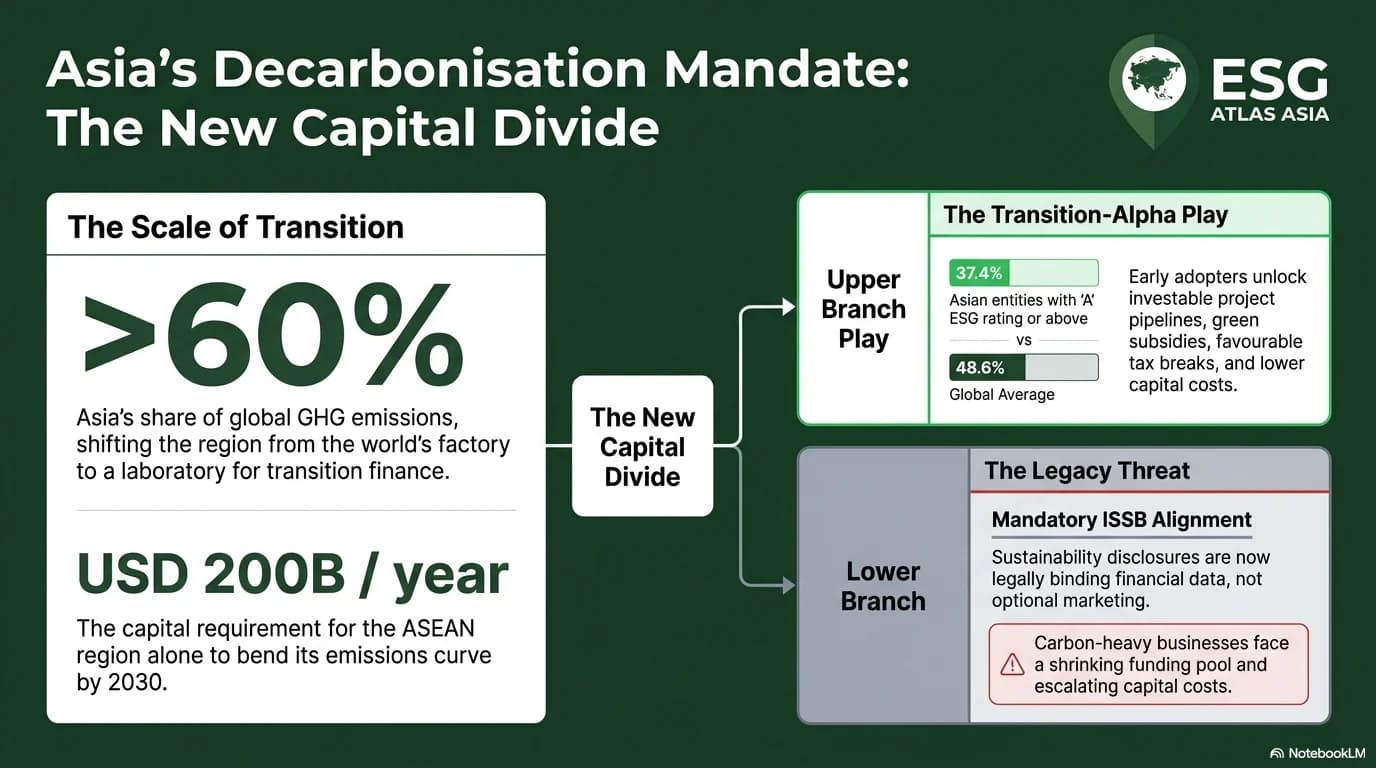
Asia drives over 60% of global greenhouse gas emissions. Discover how tightening Scope 3 mandates, evolving compliance carbon markets, and the urgent demand for transition finance are rapidly shifting the cost of capital and supply chain competitiveness across the region.
For decades, Asia has worn its title as the "world's factory" with pride, driving global economic expansion. However, that industrial dominance comes with a sobering climate reality: the region now accounts for over 60% of global greenhouse gas (GHG) emissions. As global supply chains face scrutiny and climate risks intensify, Asia is undergoing a structural pivot.
Faced with stricter international trade penalties, tightening domestic regulations, and a dramatic expansion of regional carbon pricing, the continent is transforming from a carbon hotspot into a massive laboratory for transition finance and decarbonization technology.
1. The Multi-Trillion Dollar Decarbonization Mandate
The scale of capital required to bend Asia’s emissions curve is staggering. For the ASEAN region alone, securing a sustainable path requires roughly USD 200 billion annually in green investments between now and 2030. When factoring in the massive industrial footprints of China, India, and Japan, the financing needs enter the multi-trillion-dollar territory.
This reality is creating a massive divide in Asian capital markets. Companies that aggressively transition toward low-carbon operations are unlocking a continuous pipeline of investable projects, backed by government subsidies and favorable tax breaks. On the flip side, carbon-heavy legacy businesses face a dual threat: escalating capital costs and a rapidly shrinking pool of traditional financing.
The Alpha Opportunity: While approximately 48.6% of companies globally hold high ESG ratings ("A" or above), only 37.4% of Asian listed entities hit that mark. For institutional investors, this gap represents the ultimate transition-alpha play: backing fundamentally solid companies positioned to capture major valuation uplifts as they modernize their operations and clean up their carbon footprints.
2. The Multi-Speed Regulatory Landscape
Asia does not move as a single entity; it operates at a multi-speed pace. Large middle-income and advanced economies across the continent are rapidly formalizing mandatory ESG reporting frameworks, closely mirroring international baselines like the International Sustainability Standards Board (ISSB) standards.
The incorporation of sustainability disclosures into core financial filings marks a fundamental shift. Sustainability data is no longer an optional marketing exercise; it is treated with the same legal and financial accountability as a standard balance sheet.
3. The Weaponization of Carbon: Compliance Markets Take Center Stage
The defining development for Asian markets is the rapid mainstreaming of direct carbon pricing. Driven in part by defensive economic positioning against the European Union’s Carbon Border Adjustment Mechanism (CBAM), Asian governments are leveraging carbon markets as core industrial and trade strategies.
The numbers tell a compelling story of regional acceleration:
- The Global Benchmark: According to the World Bank, carbon pricing now covers nearly 30% of global emissions, with average prices doubling over the last decade to roughly USD 21 per tonne.
- The Launching Pad: Major frameworks are launching across Japan, India, and Vietnam, anchoring emissions trading systems (ETS) directly into national legal architectures.
- The Frontrunners: Indonesia has established itself as Southeast Asia's leader with a fully operational power-sector ETS, while China is moving aggressively to transition its national ETS into an absolute cap system by 2027, expanding into hard-to-abate industrial sectors.
- The Financial Squeeze: Singapore sent a clear signal to regional markets by increasing its carbon tax by 80% to SGD 45 (approx. USD 33) per tonne.
For major exporters in Vietnam (iron and steel) or Indonesia (aluminum), domestic carbon pricing is no longer just about compliance—it is a vital shield to protect export revenues from being heavily taxed at foreign borders.
4. The Critical Bottlenecks: Supply Chains, Tech, and Grids
Despite clear policy momentum, executing a deep decarbonization strategy across Asia reveals three distinct operational pain points:

The Scope 3 Blind Spot
While large multinational enterprises can calculate their immediate emissions, the vast network of small and medium-sized suppliers making up Asia's secondary and tertiary supply chains lacks the tools to accurately track data. With Scope 3 disclosures becoming mandatory, businesses are turning to automated platforms and AI infrastructure to aggregate verifiable data without overwhelming their supply base.
The Storage Bottleneck
The region is experiencing a massive renewable energy boom, heavily anchored by India’s solar rollout and offshore wind initiatives in the Philippines. However, Southeast Asia still relies on fossil fuels for roughly 80% of its primary energy mix. Intermittent solar and wind cannot reliably power an interconnected regional network—like the long-discussed ASEAN Power Grid—without massive deployment of Battery Energy Storage Systems (BESS). De-risking these high-cost storage infrastructure assets remains a critical priority for development finance.
The Carbon Credit Quality Crunch
While compliance ETS frameworks expand, voluntary carbon markets are adjusting to a distinct "flight to quality." Buyers are willing to pay significant premiums—often USD 15 to USD 22 per tonne for CORSIA-eligible aviation offset credits—while poorly rated or unverified projects languish at nominal values. This dynamic has turned Southeast Asia's rich nature-based forestry and blue carbon assets into highly competitive, supply-constrained real estate, attracting buyers willing to pay for top-tier, third-party verified removals.
Strategic Takeaways for the C-Suite

Asia's greenhouse gas narrative has permanently shifted. The era of treating decarbonization as a secondary corporate social responsibility initiative is over. In today's market, managing emissions profile is directly tied to managing fundamental cost of capital, regulatory compliance, and cross-border competitiveness.
Reference
- Policy Center for the New South Policy Brief
- RFF Global Energy Outlook Report
- Griffith Research Online Repository
- Climate Analytics Briefing Paper
- EconStor Open Access Publication
- Climate Change Report
- UI ScholarHub Journal System