
For many service-oriented, commercial, and tech-driven organizations, Scope 2 emissions: emissions stemming from purchased electricity, steam, heating, or cooling, which represent the single largest chunk of their operational carbon footprint.
On the surface, Scope 2 looks simple: you look at your utility meters, see how many megawatt-hours (MWh) you consumed, and run the calculation.
The complexity arrives the moment you have to report those numbers. The GHG Protocol, GRI, and emerging market regulations require dual reporting. This means you cannot just publish one Scope 2 number; you must calculate and disclose your emissions using two completely different methodologies: the Location-Based Method and the Market-Based Method.
Failing to understand how these two numbers interact is one of the most common reasons companies face greenwashing pushback from sharp ESG auditors.
1. One Energy Bill, Two Entirely Different Stories
To understand your indirect energy impact, you have to look at your consumption through two distinct lenses simultaneously.
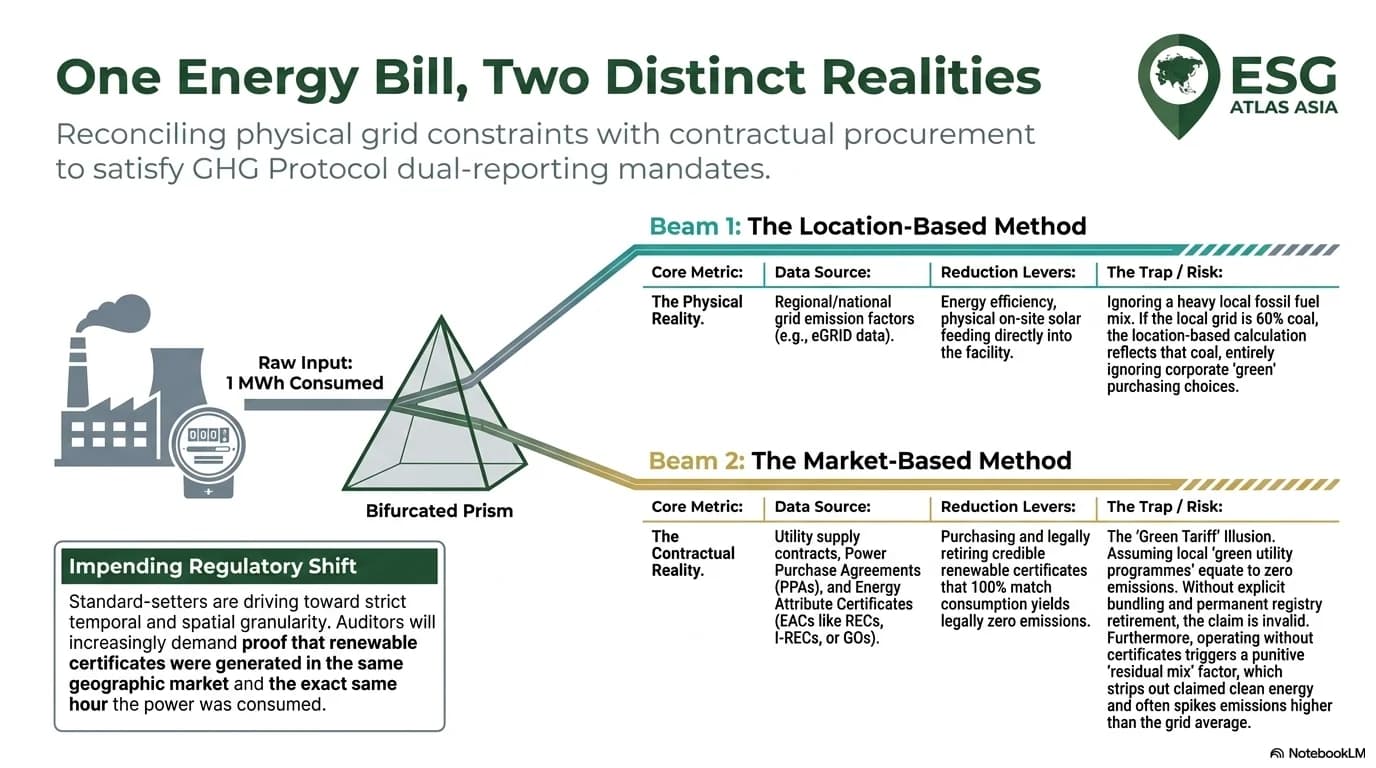
The Location-Based Method: The Physical Reality
The location-based method calculates your emissions based on the average carbon intensity of the local physical grid where your facility operates. It uses regional or national grid emission factors (such as eGRID data or national grid averages).
- The Rule: It ignores your corporate purchasing choices. Even if you signed a contract with a solar provider, if the local physical grid is 60% powered by coal, your location-based calculation will reflect that heavy coal mix.
- How to lower it: The only ways to reduce your location-based number are to reduce your total electricity consumption through energy efficiency or install physical, on-site solar panels that feed directly into your facility.
The Market-Based Method: The Contractual Reality
The market-based method reflects the specific emissions associated with the electricity you have chosen to buy contractually. It looks at your utility supply contracts, Power Purchase Agreements (PPAs), and Energy Attribute Certificates (EACs) like RECs, I-RECs, or Guarantees of Origin (GOs).
- The Rule: If you purchase and legally retire credible renewable energy certificates that match 100% of your power consumption, your market-based Scope 2 emissions can legally be reported as zero.
If you operate in a market with no active renewable procurement options and hold no certificates, you must apply a "residual mix" factor. Because the residual mix strips away all the clean energy claimed by other companies, it is often significantly more carbon-intensive than the simple grid average, meaning your market-based number could actually jump higher than your location-based number.
2. The Danger of the "Green Tariff" Trap
A massive point of friction for sustainability managers is assuming that enrolling in a local utility's "Green Energy Program" automatically equals zero emissions.
Under the GHG Protocol's Scope 2 Quality Criteria, contractual instruments must meet strict standards to be used in a market-based report. If your green utility contract doesn't explicitly bundle and permanently retire the unique environmental attributes (the certificates) in a regional registry on your behalf, your market-based claim is invalid.
Furthermore, global standard-setters are tightening the screws. Recent shifts and public consultations within the standard-setting bodies are driving hard toward temporal and spatial granularity, meaning companies will increasingly need to prove that their renewable certificates were generated in the same geographic market and ideally during the same hour that the power was actually consumed.
3. Setting Up an Auditable Scope 2 Data Flow
To ensure your indirect energy reporting passes investor scrutiny under frameworks like IFRS S2, structure your pipeline around these three pillars:
- Centralize MWh Data, Not Spend: Never calculate carbon footprints based on dollar spend on utility bills. Fluctuating energy prices will corrupt your historical trend lines. Your data inputs must be in raw physical units: Kilowatt-hours (kWh), Megawatt-hours (MWh), or Gigajoules (GJ) for district heating.
- Maintain an Instrument Registry: Keep a dedicated file for every PPA and contractual certificate retired. Ensure each certificate has a unique serial number, details the generation source (wind, hydro, solar), matches the reporting year, and is officially marked as "retired for corporate reporting" to prevent double-counting.
- Apply Regional Grid Hierarchies: For your location-based numbers, don't just grab generic global averages. Use a structured hierarchy: local subnational grid factors first, falling back to national averages only when sub-regional data is completely unavailable.

Summary
Scope 2 accounting is the bridge where corporate procurement strategy directly intersects with climate science. By mastering dual reporting and treating location-based realities and market-based contract tracking with equal technical accuracy, you give your organization a clear, auditable narrative that satisfies both environmental purists and rigorous financial stakeholders.
Reference
1. GRI 300 vs IFRS S2: A Practical Guide to Environmental Metrics
2. Navigating dual reporting for Scope 2 emissions: Location vs market
3. Scope 2 Emissions Explained
4. Scope 2 Emissions: What They Are, How to Measure Them, and Why They Matter