
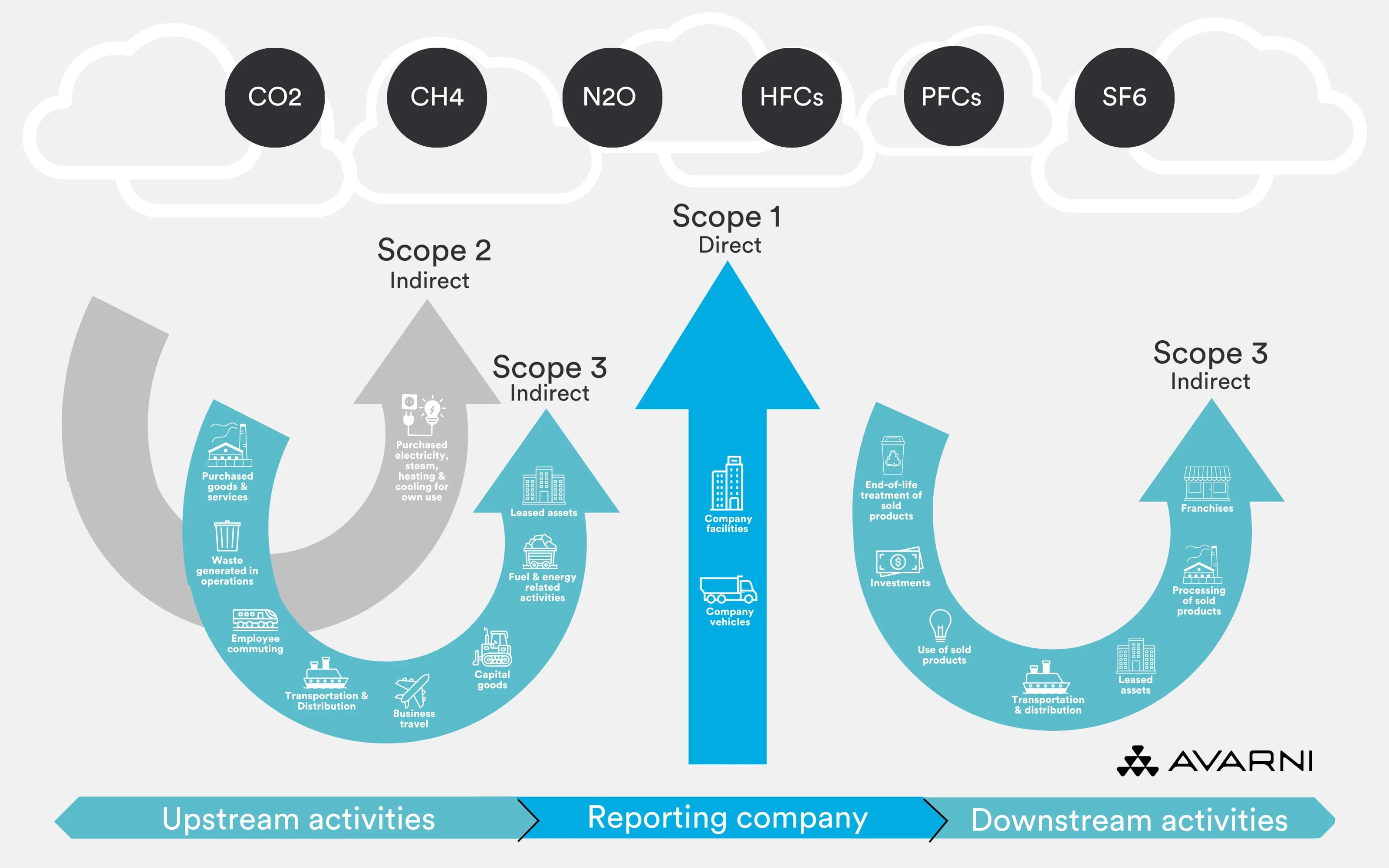
When corporate leadership decides to tackle carbon accounting, they usually start with Scope 1 because it seems the most straightforward. The logic goes: "It’s our facilities, our vehicles, and our fuel, just pull the invoices and multiply."
But any sustainability practitioner who has had to defend an inventory to an independent financial auditor knows that Scope 1 is deceptively complex. As global reporting mandates shift toward the mandatory rigor of IFRS S2, treating Scope 1 as a basic data-entry task is a compliance risk.
To build a high-integrity inventory, you have to look past the obvious stationary assets and tackle the structural realities of direct emissions.
1. The Boundary Dilemma: Who Actually "Owns" the Emissions?
The very first bottleneck in Scope 1 accounting isn't data collection, it's legal structuring. Under the Greenhouse Gas (GHG) Protocol, an organization must choose between two consolidation boundaries: Operational Control or Financial Control.
This choice radically alters your reported footprint, especially in industries that rely heavily on leased assets, joint ventures, or fractional ownership:
- Operational Control: You report 100% of the emissions from any asset where your company has the authority to introduce and implement operating policies. This is the preferred method for operational engineering teams.
- Financial Control: You report emissions based on your financial exposure and equity share in the assets. This aligns directly with your corporate financial statements and is heavily favored by institutional investors looking at climate risk through an IFRS lens.
The Practitioner’s Insight: If your company operates from a leased corporate office or uses a third-party logistics fleet, the data doesn't move automatically. Under operational control, a leased vehicle where you pay for the fuel is Scope 1; under financial control, it might shift to Scope 3. Defining this boundary on day one is critical to avoiding a complete recalculation right before audit season.
2. The Four Pillars of Direct Emissions
To ensure nothing is left out of your database, break your Scope 1 audit into its four distinct operational streams:
A. Stationary Combustion
This is the consumption of fuels in fixed, non-transport equipment. Think of the natural gas powering your industrial boilers, the diesel in your emergency backup generators, or the furnace oil used in manufacturing processes.
- The Data Trap: Relying solely on dollar amounts from accounting. You need the physical volume (liters, gallons, or cubic meters) to apply accurate, fuel-specific emission factors.
B. Mobile Combustion
Emissions resulting from the transportation of materials, products, and employees by assets owned or leased by your company (e.g., corporate cars, delivery vans, internal forklifts).
- The Data Trap: Forgetting to account for localized fuel cards versus centralized bulk fuel tanks stored on-site.
C. Process Emissions
These are emissions released during physical or chemical transformations in industrial processes. For example, CO_2 released during cement manufacturing or calcination in metallurgy. If you operate in heavy industry, process emissions are often your largest and hardest-to-abate carbon liability.
D. Fugitive Emissions
Fugitive emissions are intentional or unintentional releases of greenhouse gases, most commonly hydrofluorocarbons (HFCs) leaking from HVAC systems, industrial refrigeration, or commercial chillers.
- The Data Trap: Most companies skip this entirely. However, common refrigerants (like R-414a or R-404A) have a Global Warming Potential (GWP) thousands of times higher than CO_2. A small leak in a corporate data center’s cooling system can drastically spike your Scope 1 footprint.
3. Transitioning from "Estimated" to "Auditable" Data
If you want your Scope 1 inventory to hold up under third-party assurance, you must graduate from manual estimations to verified source links.
- Audit Trailing: Never let an emission figure sit in a spreadsheet without a primary document link. Every line item must point back to a utility bill, a bulk fuel delivery invoice, or a certified maintenance log showing the exact kilograms of refrigerant top-ups.
- Granular Calculation: Ensure your calculation engine separates different greenhouse gases (CO_2, CH_4, N_2O) before rolling them up into a single $tCO_2e$ figure. This granularity is a core requirement of both GRI 305-1 and IFRS S2.
The Bottom Line
Scope 1 emissions represent your company's direct operational liabilities. By moving away from rough annual estimates and building a structured, boundary-aligned data pipeline, you don't just protect your company against greenwashing audits, you uncover the exact operational inefficiencies hurting your financial bottom line.
Reference
1. GRI 300 vs IFRS S2: A Practical Guide to Environmental Metrics
3. Tango
4. Avarni