
Is your organization truly sustainable, or just paper-mature? Discover why companies fall into the ESG capability trap and how to build internal muscle.
For many corporate leaders, the sustainability dashboard has never looked better. The annual report is packed with glossy metrics, the newly minted disclosure, and an impressive ESG rating sits proudly on the corporate website.
On paper, the organization looks completely mature.
Yet, beneath this immaculate surface lies a fragile reality: if the external management consultants, specialized data contractors, and boutique ESG advisors walked out the door tomorrow, the company’s sustainability machinery would grind to a halt.
This is the ESG Capability Trap. It occurs when a business achieves high outward-facing compliance while remaining utterly dependent on external advisory firms for core sustainability operations. Instead of building internal muscle, companies have built a perpetual-motion machine of outsourced knowledge, creating an institutional addiction that threatens long-term resilience.
The Root of the Addiction
In management theory, a capability trap occurs when an organization invests heavily in short-term fixes—"working harder" or patching symptoms—at the expense of building long-term skills. When a system relies entirely on external intervention to perform, internal capabilities naturally decay, locking the business into a state of structural dependency.
In the ESG space, this trap has manifested with alarming speed due to three main drivers:
- The Reporting vs. Strategy Confusion: Many organizations treat ESG as a disclosure exercise rather than an operational transformation. When sustainability is isolated within corporate communications or legal compliance, the objective becomes producing the report, not changing the business model. Because reporting requires highly specific technical expertise, executives treat it as a specialized task best outsourced to data technicians. The company gets the "paper maturity," but the core business practices remain completely unchanged.
- The Illusion of Outsourced Risk: ESG issues, particularly around supply chain labor rights or environmental footprinting, carry immense reputational and legal risks. Hiring a reputable advisory firm provides a psychological safety net. However, while you can outsource the labor of data aggregation, you cannot outsource structural corporate risk. If a supply chain breaks due to climate volatility, a consultant’s slide deck cannot replace resilient internal operations.
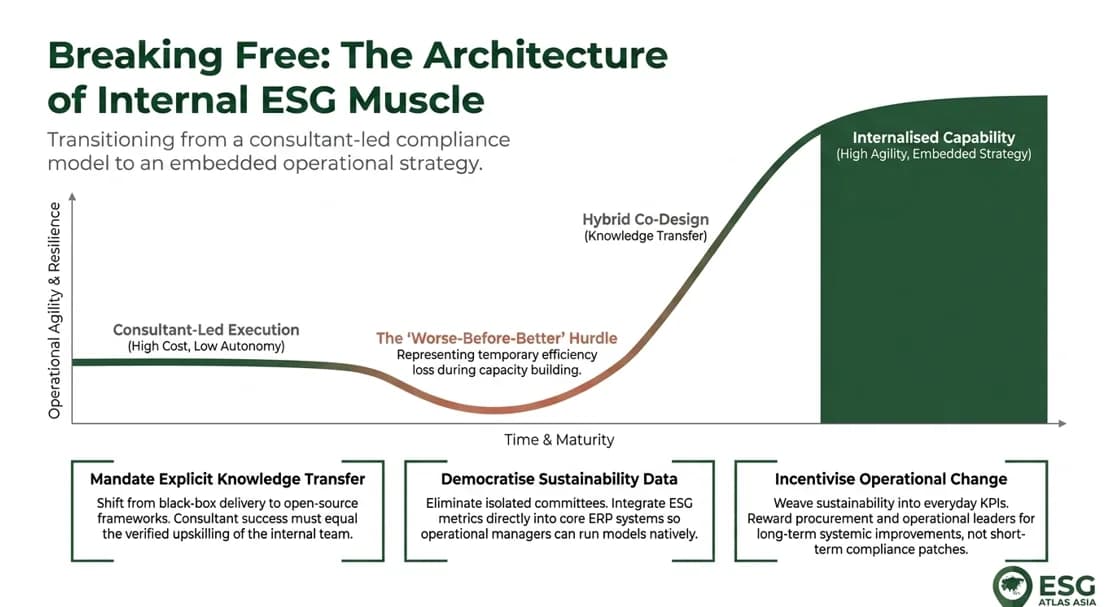
- The "Worse-Before-Better" Hurdle: Escaping a capability trap requires shifting resources away from immediate, short-term performance toward long-term internal capacity building. In sustainability, this means halting the endless cycle of hiring external advisors and instead spending time training procurement officers, upskilling engineers, and building native data infrastructure. Crucially, this transition creates a temporary dip in efficiency—a dynamic few executives have the stomach to accept when chasing immediate rating upgrades.
The Hidden Costs of Dependency
Remaining trapped in this cycle carries steep organizational costs that go far beyond consulting fees:

Institutional Amnesia
When a consultant leaves an organization, they take the "how" with them. Internal teams are left with an elegant spreadsheet or a complex carbon model, but they lack the foundational understanding of the assumptions and data proxies baked into those models. When a variable changes, the company is unable to adjust the model themselves.
Disconnected Data Silos
External advisors are often brought in for fragmented projects: one firm handles the EcoVadis compliance written for procurement, another evaluates real estate climate risks via TCFD, and a third audits labor practices. Because these projects are executed by separate external entities, the data rarely integrates. The company is left with disjointed compliance documents that fail to talk to one another or inform actual business decisions.
The Innovation Deficit
True corporate sustainability requires eco-innovation—redesigning products for a circular economy, swapping out carbon-intensive materials, and altering business models. While consulting firms are highly effective at providing market benchmarks and historical data analysis, they cannot innovate on a company's behalf. True operational innovation requires deep, experiential, internal knowledge of the company’s factory floors, proprietary software, and culture.
Breaking Free: Building Internal ESG Muscle
To break the addiction to external advisors, organizations must transition from a consultant-led model to an internalized, embedded strategy. External expertise should be used to accelerate innovation, not to substitute basic internal operations
  [Consultant-Led Execution]   -->   [Hybrid Co-Design]   -->   [Internalized Capability]
  (High Cost, Low Autonomy)         (Knowledge Transfer)         (High Agility, Embedded Strategy)
- Mandate Explicit Knowledge Transfer: Any contract signed with an ESG advisory firm must move away from a "black-box" delivery model toward an open-source, co-design framework. The primary metric of success should not just be the delivery of a report, but the verified upskilling of the internal team.
- Democratize Sustainability Data: As long as ESG data is confined to a single "Sustainability Committee," the capability trap will persist. Organizations must integrate sustainability metrics directly into core business tools like ERP systems. When financial and sustainability analytics are completely integrated, standard operational managers can run the models themselves, eliminating the need for specialized external data interpreters.
- Incentivize Operational Change: Executives must reward operational leaders who invest in systemic improvements rather than short-term compliance patches. Procurement teams should be measured on the long-term carbon reduction of their suppliers, not just on collecting supplier certificates. When sustainability becomes a KPI woven into the fabric of everyday execution, the need for an external consultant to "translate" ESG requirements evaporates.
From Compliance to Ownership
The ESG Capability Trap is not a failure of intellect; it is a failure of design. Faced with an unprecedented cascade of regulations, corporations did what they have always done: they treated a systemic, adaptive challenge as a temporary technical problem and outsourced it to external specialists.
But sustainability is not a temporary project with a fixed end date. Glossy reports and top-tier ratings may satisfy an investor audit today. But when the landscape shifts, the organizations that survive will not be those with the thickest binders of consultant decks—they will be those that possessed the internal muscle, native data, and operational courage to steer their own course.
References
- Dalmia, N. (n.d.). The emergence of sustainability analytics: Opportunities and challenges
- Jónsdóttir, Á. Þ. (n.d.). Creating a business case for sustainability in Icelandic fishing industry using System dynamic methods
- Lyneis, J. M., & Sterman, J. D. (2016). How to escape the capability trap: Turning working harder into working smarter
- Teece, D. J. (2017). A capability theory of the firm