
As scrutiny over voluntary carbon markets intensifies, companies face a growing challenge:
How do you identify a carbon offset that is actually credible?
For years, many organizations purchased offsets based largely on price, marketing claims, or convenience. But investigations into the voluntary carbon market have revealed widespread concerns around over-crediting, weak methodologies, double-counting, and poor additionality. Today, buying low-cost credits without proper due diligence creates serious ESG, reputational, and regulatory risks.
The reality is simple: Not all carbon offsets are equal.
What Makes a Carbon Offset Credible?
A credible carbon offset should represent a real, measurable, additional, and durable climate benefit. In practice, this means the project must genuinely reduce or remove greenhouse gas emissions beyond what would have happened anyway — and the reduction must not be exaggerated or counted multiple times.
High-integrity offsets increasingly require:
- robust scientific methodologies
- transparent registries
- strong monitoring systems
- conservative accounting
- independent verification
- long-term safeguards
The market is rapidly shifting away from cheap volume credits toward fewer, higher-quality credits.
The 5 Core Integrity Criteria
1. Additionality
The project should only exist because of carbon finance. If the project would have happened anyway without offset funding, the credit does not create real climate impact.
Red flags:
- mature renewable energy projects already economically viable
- existing protected forests later converted into offset projects
- vague financial justification
2. Permanence
The emissions reduction or carbon removal should last for a long time. Nature-based projects face higher reversal risks from:
- wildfire
- illegal logging
- drought
- land-use change
Engineered removals such as DACCS are generally considered more durable but remain expensive.
3. Leakage
A project should not simply move emissions somewhere else. For example, protecting one forest while deforestation shifts to another region does not create meaningful global reductions.
4. No Double Counting
The same emissions reduction should not be claimed multiple times. Double counting can occur between:
- project developers
- buyers
- governments
- national climate targets
5. Accurate Quantification
A project should not overstate climate impact. Weak baselines and inflated assumptions can generate excessive credits.
Which Offset Types Carry Higher Risks?

Some project categories face repeated integrity concerns.
Projects often criticized include:
- avoided-deforestation (REDD+) projects
- low-cost forestry credits
- generic conservation schemes
- large renewable energy projects in mature markets
These projects are not automatically invalid — but they often require much stronger scrutiny.
Higher-integrity categories increasingly include:
- Direct Air Carbon Capture and Storage (DACCS)
- durable geological storage
- certain biochar projects
- high-quality afforestation/reforestation with robust safeguards
- engineered removals with long-term monitoring
These projects are typically:
- more expensive
- lower volume
- harder to scale
- but often viewed as more credible
In carbon markets, low prices frequently correlate with lower integrity.
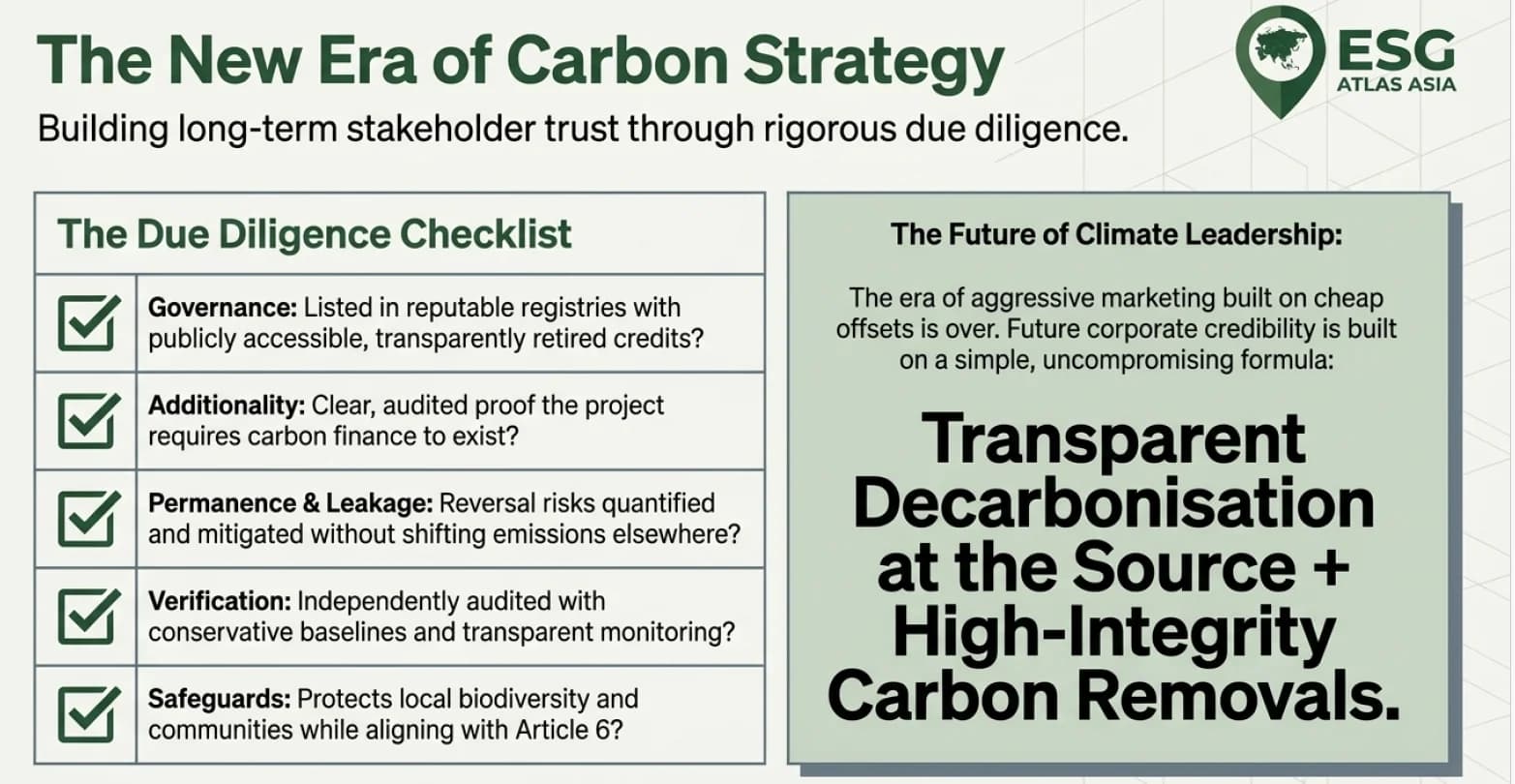
A Practical Carbon Offset Due Diligence Checklist
Before purchasing credits, companies should assess the following:
Governance & Registry
✔ Is the project listed in a reputable registry? ✔ Are credits transparently retired? ✔ Is documentation publicly accessible?
Additionality
✔ Would the project happen without carbon finance? ✔ Is financial additionality clearly demonstrated?
Permanence
✔ How durable is the carbon storage? ✔ Are reversal risks addressed?
Leakage
✔ Has leakage been assessed and quantified?
Quantification & Verification
✔ Is the methodology independently verified? ✔ Are baselines conservative? ✔ Is monitoring ongoing and transparent?
Double Counting
✔ Are there safeguards against double claiming? ✔ Is Article 6 alignment addressed?
Social & Biodiversity Safeguards
✔ Does the project protect local communities? ✔ Are biodiversity impacts considered?
Offsets Should Support — Not Replace — Decarbonization
One of the biggest mistakes companies make is treating offsets as the climate strategy itself. Under evolving guidance from the Science Based Targets initiative (SBTi), offsets should primarily address residual emissions after deep operational decarbonization has already occurred. That means companies should prioritize:
- energy efficiency
- renewable electricity
- electrification
- supply chain decarbonization
- operational redesign
- low-carbon procurement
before relying heavily on offsets.

The Future of High-Integrity Carbon Markets
Voluntary carbon markets are entering a new phase defined by:
- tighter regulation
- stronger integrity standards
- greater transparency
- digital traceability
- Article 6 alignment
- more durable removals
The future market will likely be smaller, more expensive, and more credibility-focused. For companies, this means offset quality matters far more than offset quantity.
Final Thoughts
Carbon offsets can still play a role in climate strategies. But credibility now matters more than ever.
Organizations that purchase low-quality credits without due diligence face growing risks of greenwashing accusations, reputational damage, and regulatory scrutiny. The future of corporate climate leadership will not be built on the cheapest offsets available. It will be built on transparent decarbonization — supported carefully by high-integrity carbon credits where appropriate.
Reference
- SBTi
- SBTi Carbon Offsets
- Low-quality offsets: Scrutiny on voluntary carbon markets
- The EU’s double counting problem
- Study Finds Carbon Offsets Failing to Deliver Real Climate Impact
- Nature Communications
- What is double counting in carbon offsetting
- What are Permanence, Leakage, and Additionality in Carbon Offsets?
- SBTi Corporate Net-Zero Standard 2.0
- Using Carbon Credits: Issues and Considerations