
For project developers and industrial operators in Vietnam, carbon assets now represent a tangible revenue channel. However, navigating project registration and choosing between the domestic exchange and international markets requires careful strategic analysis.
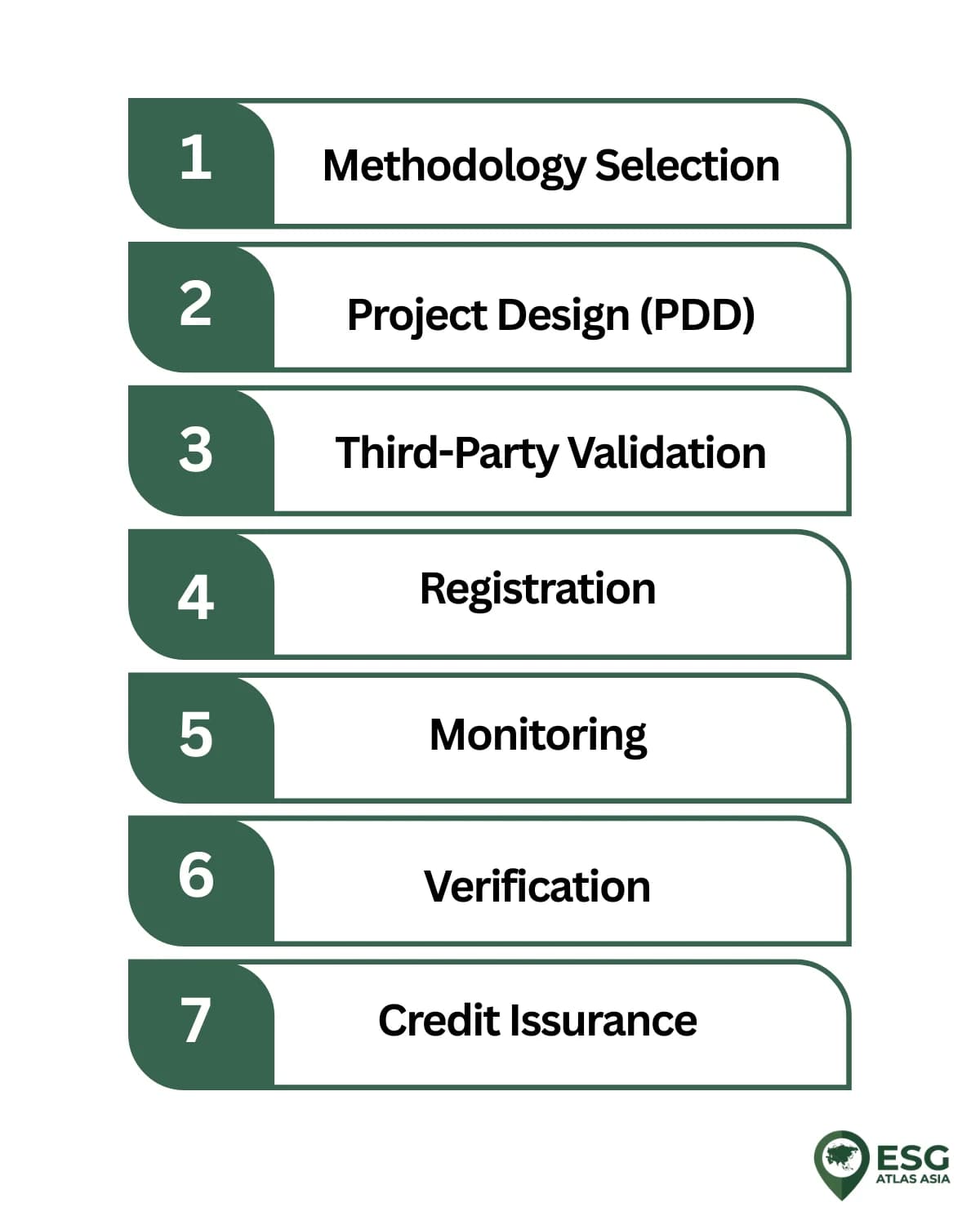
The 7-Step Lifecycle of a Carbon Credit Project
Transforming an emission reduction initiative (such as solar/wind power, alternate wetting and drying rice farming, or industrial energy efficiency) into a bankable carbon asset requires a rigorous 7-step process:

- Step 1: Methodology Selection: Select an approved crediting methodology recognized by MAE or international crediting bodies.
- Step 2: Project Design Document (PDD): Formulate the detailed PDD defining project baselines, additionality, and projected emission reductions.
- Step 3: Validation: Contract an independent validation body to audit the project design.
- Step 4: Registration: Register the validated project with the central mechanism registry (and submit concept approval to MAE if targeting Article 6).
- Step 5: Monitoring: Collect operational performance data in accordance with statutory MRV protocols.
- Step 6: Verification: A designated operational entity audits actual reduction figures.
- Step 7: Credit Issuance: Verified credits are officially issued and registered in the National Registry (V-ETS) or the relevant international crediting registry.
What Motivates Sellers to Target International Markets?
Despite administrative hurdles, developers often prioritize international channels (Article 6.2, Article 6.4, or cross-border voluntary buyers) over domestic sales:
- Significant Price Premium: International compliance buyers (e.g., in Singapore, South Korea, Japan) and international airlines under CORSIA often pay higher prices for high-integrity credits than local spot buyers.
- Upfront Green Capital & Project Bankability: Long-term international off-take contracts or bilateral agreements (such as the JCM) provide foreign currency revenue that helps secure commercial debt and equity financing.
- Demand Depth: While the domestic market's compliance demand remains capped during the pilot phase (given free quota allocations and the 30% offset limit), global demand for high-integrity credits remains broad.
The Export Paradox: The Article 6 & Methodology Filter
While international markets offer premium pricing, selling credits overseas is no longer a simple bilateral transaction. Developers must evaluate key regulatory restrictions:

- No Blank-Check Voluntary Standards: International standard credits (such as Verra or Gold Standard) cannot be recognized or transferred abroad under Article 6 (or with a Corresponding Adjustment) unless their specific methodologies are officially recognized and published by MAE under international agreements.
- Corresponding Adjustments (CAs): Exporting credits with a CA reduces the balance of emissions reductions that can count toward Vietnam’s own NDC. Consequently, Decree 112 enforces a strict 90% cap for priority sectors and 50% cap for encouraged sectors.
- Mandatory National Registry Recording: Every credit transferred internationally must receive host-country authorization and be logged centrally on the National Registry.

Strategic Takeaways for Developers
- Review Decree 112 Sector Alignment: Verify whether your project falls under Category 1 priority sectors (such as CCUS, direct air capture, green hydrogen, offshore wind, and advanced agriculture) to qualify for maximum export quotas or Category 2.
- Dual-Market Structuring: Structure project feasibility models around selling up to the permitted export limit abroad while reserving the remaining balance for domestic ETS compliance buyers.
Reference
1. Vietnam’s Carbon Market: Moving from Policy Architecture to Operational Reality
2. Decoding Vietnam’s Carbon Market Architecture: From Decree 06 to Decrees 29 & 112
3. Vietnam’s Carbon Market Roadmap: Timeline, Scope, Mechanisms, and Pricing Realities
4. Defining Carbon Value: Vietnam Introduces Rules for International Transfers Under Decree 112