
Building an ESG data collection system is often the first step in an SME's sustainability journey. Yet the biggest challenge is rarely the data itself—it is creating ownership, accountability, and governance across the organization.
As sustainability requirements continue to move deeper into global supply chains, an increasing number of small and medium-sized enterprises are finding themselves under pressure to provide ESG-related information. Requests that once came exclusively from investors are now arriving from customers, procurement teams, lenders, and business partners. Carbon emissions, employee turnover, training hours, supplier management, and diversity metrics have become common components of supplier questionnaires and sustainability assessments. For many SMEs, these requests represent their first encounter with structured ESG reporting.

The initial assumption is often that the challenge lies in collecting the necessary data. Sustainability reporting appears to be primarily a technical exercise: identify the required metrics, gather the information, and compile the results into a report or questionnaire. Yet the experience of many organizations suggests that this assumption is fundamentally flawed. The most difficult aspect of ESG reporting is rarely the data itself. More often, the real challenge is the absence of systems, ownership, and governance structures capable of managing information that already exists across the organization.
This became evident during the implementation of a first ESG data collection system at a mid-sized company supplying international customers. The company had operated successfully for years and maintained extensive operational records. Energy consumption was tracked through utility invoices, employee information was managed by the human resources department, supplier records were maintained by procurement, and waste disposal data was available through service providers. On paper, much of the information required for ESG reporting already existed.
However, once stakeholders began requesting ESG disclosures, a different reality emerged. While the data was available, it was dispersed across multiple departments, stored in different formats, collected according to different timelines, and managed for entirely different purposes. No mechanism existed to consolidate this information into a coherent picture of organizational performance. More importantly, no one within the business had responsibility for overseeing the process.
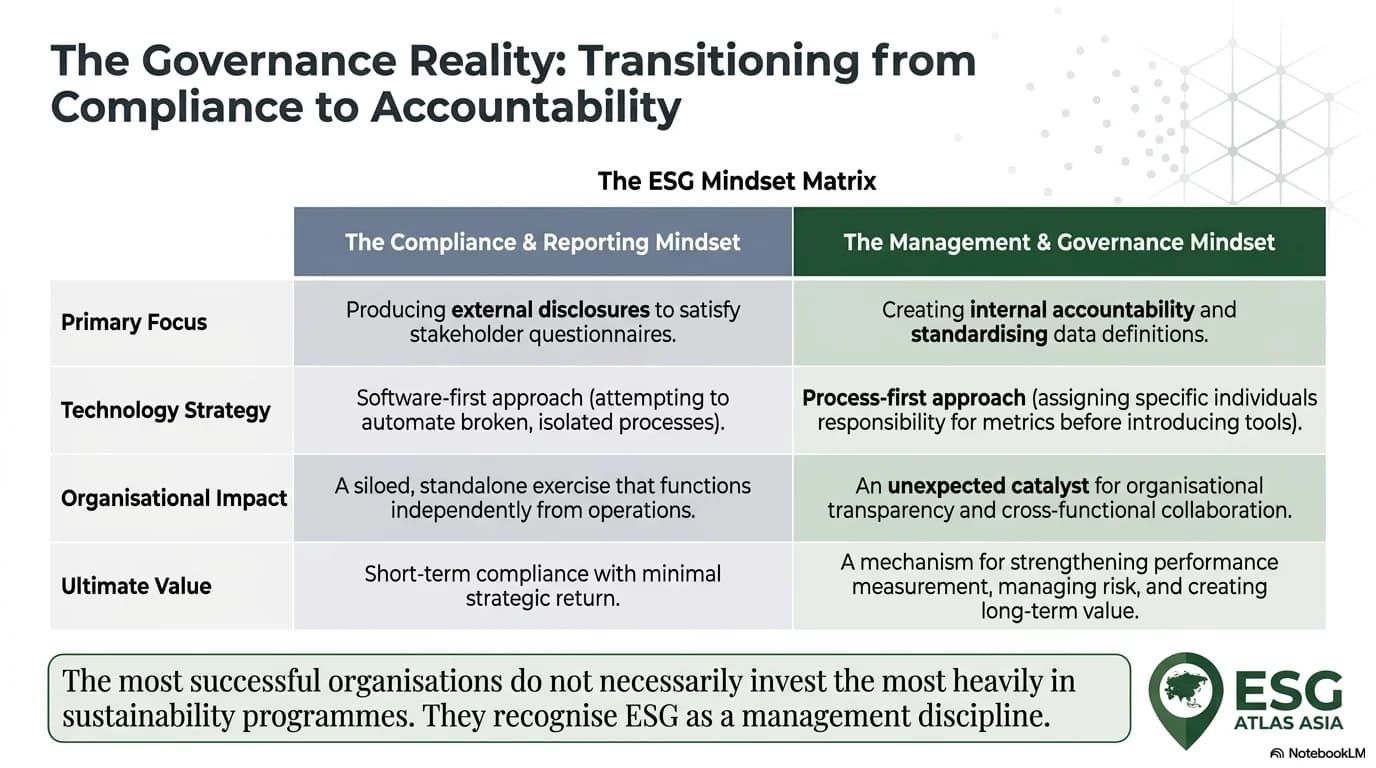
This distinction is significant because it highlights a misunderstanding that continues to shape many ESG initiatives. Organizations often view ESG as a reporting challenge when it is, in fact, a governance challenge. Reporting is simply the final output. The more difficult work involves determining who owns the data, how information is verified, how performance is monitored, and how accountability is distributed across the business. Without these foundations, even the most sophisticated reporting software will struggle to produce reliable results.
The company's first instinct was to explore technology solutions. This response is understandable and increasingly common. The ESG software market has expanded rapidly, promising automated data collection, streamlined reporting, and simplified compliance. Yet technology can only organize processes that already exist. It cannot resolve ambiguity around responsibilities, nor can it create alignment between departments that have historically operated independently. Before any discussion about software could be productive, the company needed to answer a far more basic question: who was responsible for each ESG metric?
Once this question was addressed, the nature of the project changed considerably. Rather than focusing exclusively on data collection, attention shifted toward creating accountability. Specific individuals were assigned responsibility for workforce indicators, environmental metrics, supplier information, and governance-related disclosures. Data definitions were standardized, reporting schedules were established, and review procedures were introduced. What initially appeared to be a sustainability initiative gradually evolved into an exercise in organizational management.
This transition revealed another important insight. Contrary to popular belief, most companies do not suffer from a lack of ESG data. Instead, they suffer from a lack of visibility into the information they already possess. Years of operational growth often result in fragmented systems, departmental silos, and inconsistent reporting practices. Because these issues rarely affect day-to-day operations, they remain largely unnoticed until an external stakeholder requests consolidated information. ESG reporting has therefore become an unexpected catalyst for organizational transparency, forcing businesses to examine how information flows across functions and where accountability truly resides.
As the system developed, it became increasingly clear that ESG data quality was closely linked to management quality. Inconsistencies in reporting often reflected inconsistencies in business processes. Missing workforce data pointed to weaknesses in record management. Incomplete supplier information revealed gaps in procurement oversight. Difficulties tracking energy consumption exposed limitations in operational monitoring. What initially appeared to be sustainability challenges were, in many cases, broader management challenges that had simply remained hidden from view.
This observation helps explain why some organizations derive considerable value from ESG initiatives while others see them merely as compliance exercises. Businesses that approach ESG solely as a reporting requirement tend to focus on producing disclosures that satisfy external stakeholders. While this may achieve short-term compliance objectives, it often generates little strategic value. By contrast, organizations that use ESG implementation as an opportunity to strengthen governance, improve cross-functional collaboration, and enhance performance monitoring frequently discover benefits that extend well beyond reporting itself.
For SMEs in particular, this distinction is becoming increasingly important. Unlike large corporations, smaller businesses typically operate with limited resources and lean management structures. They cannot afford to create separate systems for sustainability reporting that function independently from the rest of the organization. Any ESG process must be integrated into existing business operations and contribute to broader organizational objectives. The companies that are progressing most effectively are not necessarily those investing the most heavily in sustainability programs. They are often the ones that recognize ESG as a management discipline rather than a standalone reporting exercise.
By the time the company completed its first reporting cycle, the most significant outcome was not the report itself. The greater achievement was the establishment of a structured process for managing information across the organization. Departments that previously worked in isolation now shared common reporting responsibilities. Data owners understood their roles. Leadership gained greater visibility into performance indicators that had previously remained fragmented. The reporting output was important, but the capability that emerged behind it proved far more valuable.

As ESG expectations continue to expand across Asia and global supply chains become increasingly focused on sustainability performance, more SMEs will face similar challenges. Many will begin by searching for reporting templates, disclosure frameworks, or software platforms. These tools undoubtedly have a role to play. However, the experience of early adopters suggests that successful ESG implementation begins elsewhere. It starts with governance, ownership, and accountability. Without these foundations, reporting remains a reactive exercise. With them, ESG becomes a mechanism for strengthening how an organization measures performance, manages risk, and creates long-term value.
The lesson is therefore not that SMEs need more data. Most already possess more information than they realize. The real challenge lies in creating the structures necessary to transform fragmented information into meaningful insight. As ESG reporting continues to mature, the organizations that succeed will not necessarily be those with the most advanced reporting systems. They will be those that have built the governance capabilities required to make sustainability information reliable, actionable, and relevant to business decision-making.
Reference