
Carbon offsets were once marketed as one of the simplest solutions to climate change: emit carbon in one place, compensate for it somewhere else.
Airlines offered “carbon neutral” flights. Corporations purchased forestry credits to support net-zero claims. Voluntary carbon markets rapidly expanded into a multi-billion-dollar ecosystem built around the idea that emissions could be balanced through climate projects elsewhere.
But in 2026, the conversation around carbon offsets has fundamentally changed. Today, investors, regulators, sustainability professionals, and even climate scientists are asking a far more difficult question:
Do carbon offsets genuinely reduce emissions — or are they enabling companies to delay real decarbonization?
The answer is increasingly complex.
What Are Carbon Offsets?
Carbon offsets — represent quantified greenhouse gas emission reductions or removals generated outside a company’s own operations or value chain.
A company purchases these offsets to compensate for emissions it still produces. Typical offset projects include:
- Reforestation and afforestation
- Avoided deforestation (REDD+)
- Renewable energy projects
- Methane capture initiatives
- Clean cookstove programs
- Soil carbon projects
- Biochar
- Direct Air Carbon Capture and Storage (DACCS)
The concept is straightforward: if an organization cannot fully eliminate emissions today, it can finance climate-positive projects elsewhere to “offset” its remaining footprint.
For years, this became central to many corporate climate strategies, particularly in sectors where emissions are difficult to eliminate, such as aviation, logistics, manufacturing, energy, and technology. However, the credibility of many offsets is now under intense scrutiny.
The Real Role of Offsets in a Credible Net-Zero Strategy

One of the biggest misconceptions about carbon offsets is that they can replace operational decarbonization.
Leading frameworks increasingly reject this idea.
Under the Science Based Targets initiative (SBTi) Corporate Net-Zero Standard, companies are expected to deeply reduce their own emissions first — typically by around 90% — before relying on carbon credits for residual emissions that are genuinely difficult to eliminate.
This reflects an “abatement-first” hierarchy:
- Avoid emissions
- Reduce emissions
- Replace fossil-intensive systems
- Offset only unavoidable residual emissions
In other words, offsets are increasingly treated as supplementary tools — not substitutes for real emissions reductions.
SBTi discussion papers and evolving market guidance also suggest that after 2035, companies may face growing expectations to prioritize long-lived carbon removal solutions rather than short-term avoidance credits. The market is moving away from “buy cheap offsets and claim carbon neutrality” toward demonstrating measurable operational transition pathways.
Why Carbon Offsets Are Facing a Credibility Crisis
Over the past several years, voluntary carbon markets have faced mounting criticism from researchers, NGOs, regulators, journalists, and investors.
Large empirical studies have found that a significant share of offsets may fail to deliver real climate impact. Some analyses suggest that many widely used voluntary market credits — particularly avoided-deforestation projects and large renewable energy projects — carry substantial integrity risks related to additionality, baseline inflation, or over-crediting. This has triggered growing concern over whether some offset claims represent actual emissions reductions or merely accounting exercises.
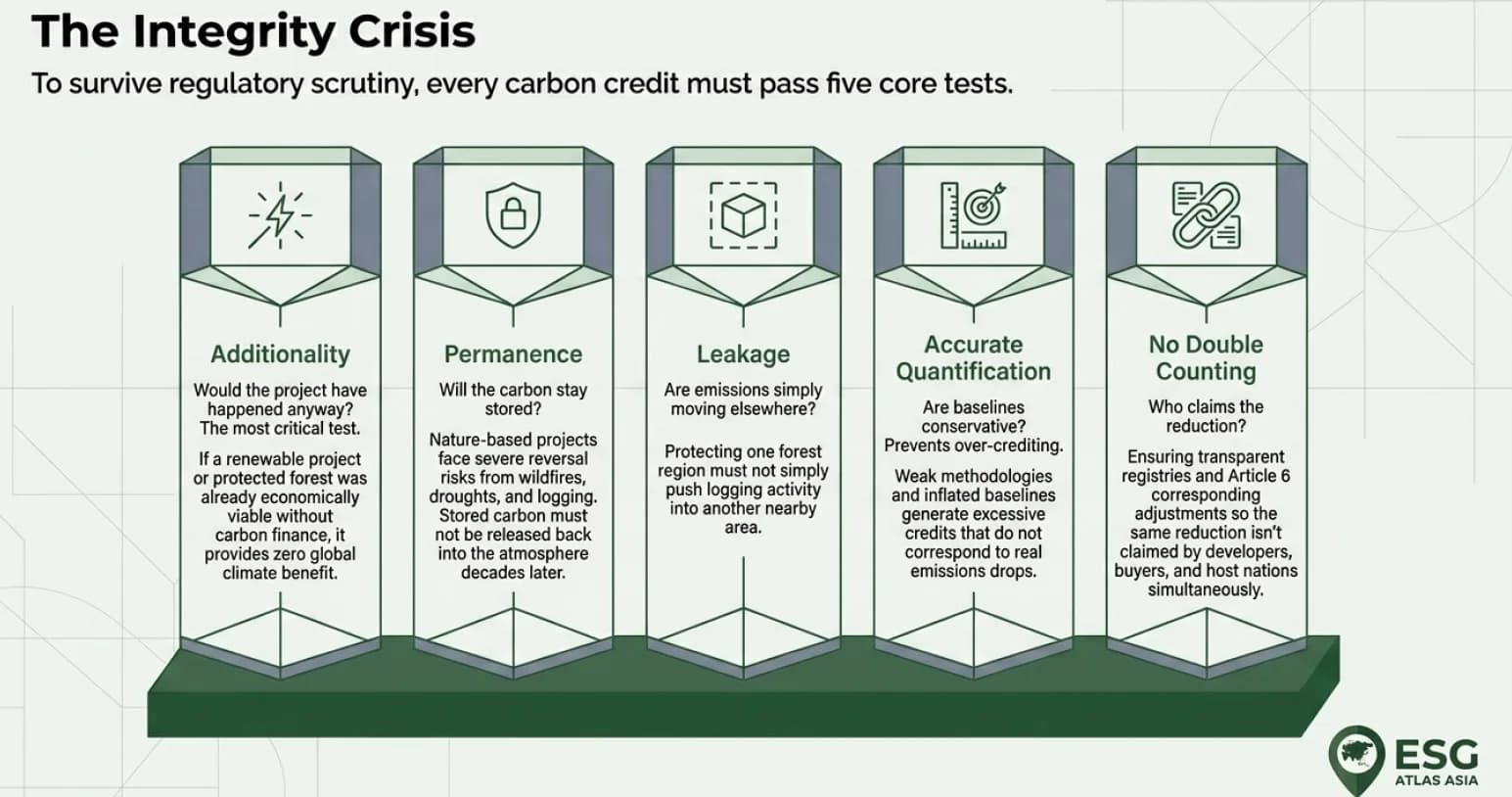
Several integrity issues repeatedly emerge.
1. Additionality: Would the Project Have Happened Anyway?
Additionality is one of the most important principles in carbon markets. A carbon project should only generate credits if the emissions reduction would not have happened without carbon finance.
If a renewable energy project was already economically viable without offsets, or if a forest area was already protected before carbon credit financing arrived, the project may not create additional climate benefit.
Without additionality, the offset does not actually lower global emissions. This remains one of the most common criticisms of voluntary carbon markets.
2. Permanence: Will the Carbon Stay Stored?
Not all carbon storage is permanent.
Nature-based projects — particularly forestry offsets — face significant reversal risks from:
- Wildfires
- Drought
- Illegal logging
- Land-use change
- Climate-related ecosystem degradation
A forest that burns down decades later can release previously stored carbon back into the atmosphere, undermining the original offset claim. This creates major concerns for long-term climate integrity.
By contrast, engineered removals such as DACCS or durable geological storage are generally considered more permanent, though they remain expensive and relatively limited in scale today.
3. Leakage: Are Emissions Simply Moving Elsewhere?
Some offset projects reduce emissions in one area while unintentionally shifting emissions somewhere else.
For example, protecting one forest region may simply push logging activity into another nearby area.
This phenomenon — known as leakage — means global emissions may not actually decline despite the offset project appearing successful locally. Leakage risks are especially important in land-use and forestry projects.
4. Over-Crediting and Weak Baselines
Another major integrity concern is over-crediting. This occurs when projects issue more carbon credits than the actual emissions reductions achieved.
Weak methodologies, inflated baselines, and unrealistic assumptions can all lead to exaggerated climate benefits.
Investigations into voluntary carbon markets have repeatedly highlighted concerns that some projects may systematically overstate their impact.
The result is a market flooded with low-cost credits that may not correspond to real emissions reductions. In many cases, lower prices reflect lower integrity.
5. Double Counting: Who Is Claiming the Reduction?
Double-counting is becoming one of the most critical issues in international carbon accounting. The same emissions reduction can sometimes be claimed multiple times:
- by the project developer
- by the buyer company
- by the host country toward its climate targets
- or even by multiple buyers
When this occurs, global emissions are not actually reduced as claimed. To address this, credible carbon markets increasingly emphasize:
- transparent registries
- unique retirement of credits
- Article 6 corresponding adjustments under the Paris Agreement
- stronger accounting standards
This issue is particularly important as governments integrate carbon markets into national climate commitments.

The ESG Risk: From Climate Strategy to Greenwashing Allegations
The biggest ESG concern surrounding carbon offsets is no longer whether offsets are technically possible. It is whether companies are using them to avoid real decarbonization.
Many organizations continue purchasing inexpensive offsets while maintaining high operational emissions. This creates growing reputational risk, especially as stakeholders become more sophisticated in evaluating climate claims. Increasingly, investors and regulators are asking:
- Are emissions actually declining?
- Is the company relying excessively on offsets?
- Are the credits high integrity?
- Are claims transparent and evidence-based?
As a result, regulators globally are tightening anti-greenwashing rules around environmental claims, including “carbon neutral” marketing statements. For ESG leaders, offsets are no longer a reputational shortcut. In some cases, they may become a reputational liability.
The Future of Voluntary Carbon Markets
Carbon markets are unlikely to disappear. But the market is entering a new era defined by:
- stricter integrity standards
- stronger verification frameworks
- improved digital traceability
- Article 6 alignment
- greater regulatory scrutiny
- increased demand for durable removals
The era of cheap, low-quality offsets supporting aggressive sustainability marketing claims is rapidly fading. Future carbon markets will likely be smaller, more expensive, and more integrity-focused. And that may ultimately strengthen their climate value.
Reference:
- SBTi
- SBTi Carbon Offsets
- Low-quality offsets: Scrutiny on voluntary carbon markets
- The EU’s double counting problem
- Study Finds Carbon Offsets Failing to Deliver Real Climate Impact
- Nature Communications
- What is double counting in carbon offsetting
- What are Permanence, Leakage, and Additionality in Carbon Offsets?
- SBTi Corporate Net-Zero Standard 2.0
- Using Carbon Credits: Issues and Considerations