
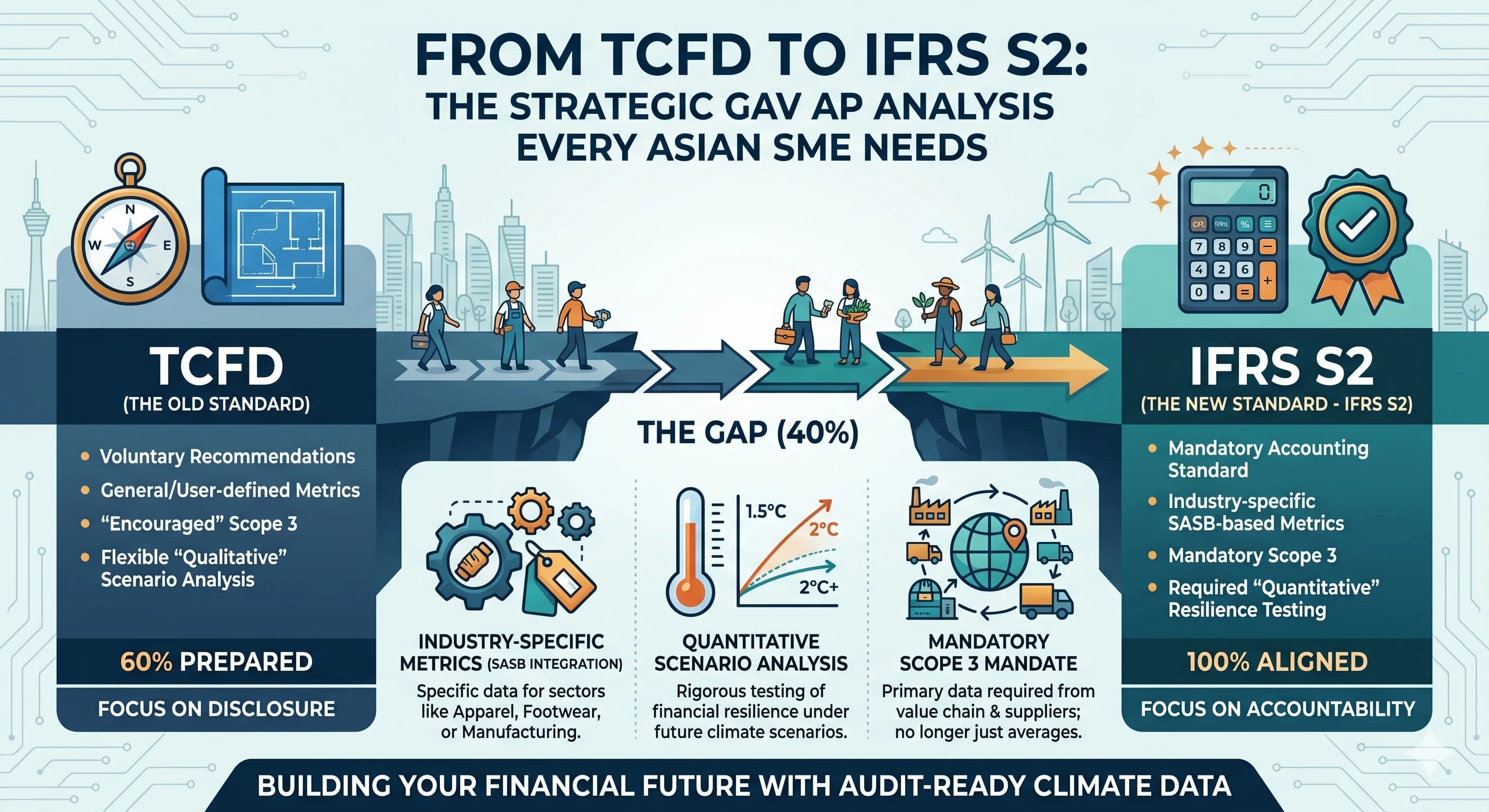
For years, the Task Force on Climate-related Financial Disclosures (TCFD) was the "gold standard" for climate reporting. However, with the International Sustainability Standards Board (ISSB) officially taking over TCFD’s monitoring responsibilities, we have entered the era of IFRS S2.
For Small and Medium Enterprises (SMEs) in Asia, this isn't just a change in acronyms. It is a fundamental shift in how climate data must be structured, verified, and linked to financial performance. If your business has already aligned with TCFD, you are 60% of the way there—but the remaining 40% contains the most rigorous technical requirements.
The Core Shift: From "Disclosure" to "Accounting"
The primary difference lies in the level of precision. While TCFD was designed as a set of recommendations to encourage transparency, IFRS S2 is an accounting standard designed for capital markets.
Here is the deep-dive analysis of the three critical gaps Asian SMEs must close.
1. Industry-Specific Metrics (The SASB Integration)
TCFD allowed companies to choose which metrics they deemed relevant. In contrast, IFRS S2 mandates industry-specific disclosures by incorporating the SASB (Sustainability Accounting Standards Board) standards.
- The Gap: Under TCFD, a textile manufacturer in Vietnam might have reported general energy use. Under IFRS S2, they must now report against specific metrics for the "Apparel, Accessories & Footwear" industry, such as water scarcity in sourcing and chemical management in the supply chain.
- The Action: SMEs must identify their specific SASB industry classification today to see exactly which quantitative data points they will be forced to disclose.
2. Climate Resilience and Quantitative Scenario Analysis
TCFD "encouraged" scenario analysis; IFRS S2 effectively requires it.
- The Gap: Many SMEs previously used "qualitative" scenarios—descriptive stories about how climate change might affect them. IFRS S2 pushes for "quantitative" resilience testing. You must now explain how your financial position would hold up under a 1.5∘C scenario versus a 2∘C or higher scenario.
- The Challenge in Asia: Data for localized climate physical risks (like flooding in the Mekong Delta or heatwaves in South Asia) can be difficult to find. SMEs will need to leverage tools like the IPCC Interactive Atlas or local meteorological data to provide the "high-probability" data ISSB expects.
3. The Scope 3 Mandate and "Reasonable and Supportable" Data
Perhaps the most daunting change is the treatment of Scope 3 (Value Chain) emissions.
- The Gap: TCFD treated Scope 3 as an "if material" disclosure. IFRS S2 makes Scope 3 reporting mandatory, though it offers a "proportionality" relief. It states that companies must use all "reasonable and supportable information that is available without undue cost or effort."
- The Asian Context: For an SME that is part of a global supply chain (e.g., supplying parts to Apple or Samsung), "reasonable information" increasingly includes primary data from their own suppliers. You can no longer rely solely on industry averages.
Comparison Summary: TCFD vs. IFRS S2
Feature | TCFD (Old Standard) | IFRS S2 (New Standard) |
Status | Voluntary Recommendations | Mandatory Accounting Standard |
Materiality | Focused on the planet and the firm | Strictly Financial Materiality |
Metrics | General/User-defined | Industry-specific (SASB-based) |
Scope 3 | Encouraged if material | Mandatory (with transition relief) |
Assurance | Not explicitly required | Designed to be Audit-ready |
The Business-First Strategy: How to Transition
The next step organizations should do is to perform a "Delta Assessment":
- Inventory Your TCFD Data: Map what you currently disclose against the four pillars (Governance, Strategy, Risk Management, and Metrics).
- Apply the SASB Lens: Download the SASB standards for your specific sector and identify the gaps in your current data collection.
- Bridge the Finance Gap: Since IFRS S2 is designed for investors, your CFO's team must be involved. Sustainability data must now undergo the same internal controls as your quarterly financial statements.
Conclusion
The transition from TCFD to ISSB S2 is the "professionalization" of ESG. For Asian SMEs, this is a competitive opportunity. Those who can provide "audit-ready" climate data under IFRS S2 will find it significantly easier to access international green finance and maintain their positions in global value chains.
The "G" (Governance) in ESG is no longer optional—it is the framework upon which your financial future will be built.
References
- IFRS Foundation. (2023). IFRS S2 Climate-related Disclosures.
- Financial Stability Board (FSB). (2023)
- Intergovernmental Panel on Climate Change. Interactive Atlas
- SASB Standards. (2023)